

Daily Dose Of Jazz…
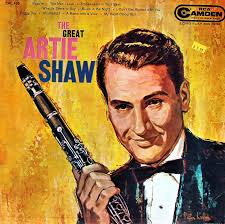
Artie Shaw was born Arthur Jacob Arshawsky on May 23, 1910 in New York City to Austrian and Russian Jewish parents Sarah and Harold Arshawsky, a dressmaker and photographer. He grew up in New Haven, Connecticut, where his natural introversion was deepened by local antisemitism. Buying a saxophone by working in a grocery store and began learning the saxophone at 13. At 16, he switched to the clarinet and left home to tour with a band.
From 1925 to 1936 Shaw performed with many bands and orchestras, working in Cleveland, Ohio and establishing a lasting reputation as music director and arranger for an orchestra led by violinist Austin Wylie. Exposed to symphonic music while playing with Irving Aaronson’s Commanders, which he later incorporated in his arrangements. In 1932 he joined the Roger Wolfe Kahn Orchestra and made several recordings. Three years later he gained attention with his “Interlude in B-flat” at a swing concert at the Imperial Theater in New York. During the swing era, his big bands had numerous popular hits with Begin the Beguine, Stardust and others.
In addition to hiring Buddy Rich, he signed Billie Holiday as his band’s vocalist in 1938, becoming the first white band leader to hire a full-time black female singer to tour the segregated South. However, after recording Any Old Time, Holiday left the band due to hostility from Southern audiences, as well as from music company executives who wanted a more mainstream singer.
He fashioned a smaller band within the orchestra in 1940, naming it Artie Shaw and the Gramercy Five after his home telephone exchange. Over time members of the band were pianist Johnny Guarnieri, electric guitarist Al Hendrickson, trumpeter Roy Eldridge succeeded Billy Butterfield, Oran “Hot Lips” Page, Max Kaminsky, Georgie Auld, Dave Tough, Jack Jenney, and Ray Conniff. In 1940, the original Gramercy Five cut eight sides, then Shaw dissolved the band in early 1941.
The long series of musical groups Shaw subsequently formed included Lena Horne, Helen Forrest, Mel Tormé, Buddy Rich, Dave Tough, Barney Kessel, Jimmy Raney, Tal Farlow, Dodo Marmarosa, and Ray Conniff.
Throughout his career, Shaw formed big bands for his radio broadcasts, made several musical shorts for Vitaphone and Paramount Pictures, and played with Navy personnel during World War II. Active until 1954, his music was used in several films, he had numerous talk show appearances, came out of retirement in 1983 and put together one last band.
Clarinetist Artie Shaw, who received a Lifetime Grammy Award in 2004, died on December 30, 2004, aged 94.

More Posts: bandleader,clarinet,history,instrumental,jazz,music
Daily Dose Of Jazz…
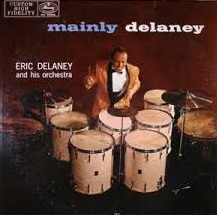
Eric Delaney was born on May 22, 1924 in Acton, London, England. Learning to play early in life by age sixteen, he won the Best Swing Drummer award and later joined the Bert Ambrose Octet which featured George Shearing on piano.
Between 1947 to 1954 he appeared with the Geraldo Orchestra and filled his time with regular session work in recording studios and on film, TV and radio. In 1954 he formed his own band and later signed with the new Pye Records label. Two years later he made three appearances on the Royal Variety Show, the first in 1956.
Specializing in up-tempo dance hall music, often carrying a rock and roll label due to the rise of The Beatles. However, Delaney was able to remain active touring in the UK in holiday resorts. He was held in high regard by his musical peers, drummer Louie Bellson with whom he recorded on the 1967 album Repercussion. Originally released in high quality stereo on the Studio2Stereo label, it was re-released on the Vocalion label in 2011.
Although best known as a swing drummer, Eric was a multi-percussionist. Classically trained as a timpanist, his unique approach turned the ‘timps’ into a lead & solo instrument. He also played xylophone, glockenspiel, military snare drum, tubular bells, Chinese and orchestral gongs, which is exhibited in his showmanship routines, such as Persian Market.
Apart from his showmanship, Delaney could be occasionally found behind a minimal kit, sitting in with a jazz quartet, and letting others take the spotlight. 1990s onward, he would also make guest appearances with bands across the UK. Another facet of his work was his playing on the soundtrack of The Longest Day, where his snare opens the movie.
Drummer and bandleader Eric Delaney, who was popular in the Fifties and early 1960s, died of a brain haemorrhage on July 14, 2011 at 87.
More Posts: drums,history,instrumental,jazz,music

Daily Dose Of Jazz…
Jan Leder was born May 19, 1958 and raised in New York City and pursued her love for improvisation after twelve years of studying classical music. She studied for three years with pianist Lennie Tristano and then continued her jazz studies with pianist Connie Crothers for over ten years. A self-styled course of study in jazz history at SUNY Purchase led to her compilation of the first comprehensive history of women in jazz titled Women in Jazz: A Discography of Instrumentalists 1913-1968.
In February 1997 Monad Records released her first recording, Passage To Freedom, which was recorded live at the Five Spot in New York City. In 1999 Jan recorded Nonchalant, a collection of mostly original melodies.
Ms. Leder leads her own jazz ensembles in the New York City area, appearing at nightclubs, festivals, cultural functions and other public and private engagements. Her repertoire includes standard bebop, swing, blues and bossa novas as well as her own unique jazz compositions and those of her musical colleagues, including drummer/big band leader Art Lillard, with whom Jan collaborated on numerous compositions, mostly writing lyrics to his catchy songs.
From 1987 to 2012 Jan was a member of the flute section in Art Lillard’s Heavenly Band. Jan was also a member of a group of jazz flutists called the NY Jazz Flutet that included Dotti Anita Taylor, Elise Wood, Michele Smith and Chip Shelton along with drummer Art Lillard.
She entertains at healthcare facilities, teaches workshops and seminars, plays at fundraisers and jazz festivals. She has toured around the world, and composed pop, r&b, theater and film music. Leder has worked with the 9th Street Stompers, a popular local jazz band, playing their unique variety of jazz styles in parades, street fairs and other venues.
Flutist Jan Leder, who is a writer and publisher member of the American Society of Composers, Authors and Publishers and a member of the National Association of Music Publishers, continues to perform, compose and teach jazz improvisation.
More Posts: bandleader,flute,history,instrumental,jazz,music
Daily Dose Of Jazz…
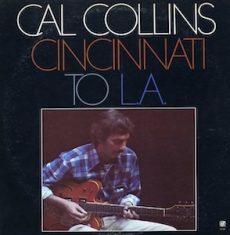
Cal Collins was born on May 5, 1933 in Medora, Indiana and first played the mandolin professionally as a bluegrass musician in the early 1950s. After his Army service he moved to Cincinnati, Ohio he switched to jazz guitar after hearing swing guitarists Charlie Christian, Irving Ashby and Oscar Moore. He played in Cincinnati for twenty years.
In 1976 Benny Goodman hired him at the age of 43 and had a three year stint with the orchestra. Cal then spent three years making albums for Concord Jazz. As a leader and sideman, he worked with Scott Hamilton, Warren Vache, Rosemary Clooney, Ross Tompkins, Woody Herman, John Bunch, and Marshal Royal.
Returning to Cincinnati in the early Eighties, Collins slowed down his career. He joined the Masters of the Steel String Guitar Tour in 1993 with Jerry Douglas and Doc Watson. Over the course of his career he recorded a dozen albums as a leader with his debut recording being Cal Collins In San Francisco in 1978 on the Concord label.
He recorded twenty-eight albums with John Bunch, Rosemary Clooney, Concord Jazz All Stars, Concord Super Band, Benny Goodman, Woody Herman, Eiji Kitamura, Marshal Royal, Warren Vache, Bob Barnard, Michael Moore, Jimmy Madison, Kenny Poole, Scott Hamilton and Buddy Tate, Hank Marr, and Ross Tompkins.
In 2001, guitarist Cal Collins, who recorded his last album in 1998, died of liver failure on August 27th in Dillsboro, Indiana.
More Posts: bandleader,guitar,history,instrumental,jazz,music
Daily Dose Of Jazz…
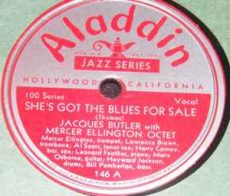
Jacques Butler was born on April 29, 1909 in Washington, D.C. but didn’t pick up the trumpet until his late teens. He began playing professionally with Cliff Jackson and Horace Henderson in New York City, then joined Marion Hardy’s Alabamians in 1931 for a year.
Leading his own ensemble in New York and touring from 1934-1935, Jacques also made recordings with Willie Bryant before relocating to Europe in 1936, where the two performed together until 1939. During that period he played with Frank “Big Boy” Goudie as well as with his own bands. He would tour Scandinavia before WWII and in 1940 he became well known in the Norwegian jazz community, and while visiting Oslo he recorded one 78 rpm. Returning to New York City that same year he played and recorded with Mercer Ellington, Art Hodes, Mezz Mezzrow, and Bingie Madison.
After a brief stay in Toronto he moved back to Europe in 1950, remaining there until 1968 as a regular at the La Cigale club in Paris, France. He appeared in the 1961 Paul Newman/Sidney Poitier film Paris Blues. In the 1970s he came home to the States and was seen working often in New York City, as a sideman with Clyde Bernhardt among others, and in the studio.
Trumpeter and vocalist Jacques Butler, who was sometimes listed as Jack, died in 2003. The date of his death is unknown.
More Posts: bandleader,history,instrumental,jazz,music,trumpet,vocal