

Daily Dose Of Jazz…
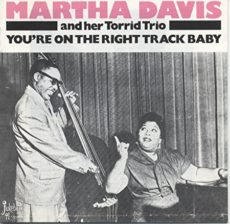
Martha Davis was born on December 14, 1917 in Wichita, Kansas, and was raised in Chicago, Illinois. By the mid-1930s, she had met and been influenced by Fats Waller, and performed regularly as a singer and pianist in Chicago clubs. In 1939, she met, and later married, bassist Calvin Ponder, who went on to play in Earl Hines’ band.
In 1948, Davis moved to California, and developed her recording career on Jewel Records in Hollywood with a trio including Ponder, guitarist Ralph Williams and drummer Lee Young. Their cover of Dick Haymes’ pop hit Little White Lies followed by a duet with Louis Jordan, Daddy-O in 1948, reached # 11 and #7, respectively, on the Billboard charts.
Davis and Ponder also began performing together on stage, developing a musical and comedy routine as “Martha Davis & Spouse” which played on their physical characteristics, she was large, he was smaller. The act became hugely popular, touring and having a residency at the Blue Angel in New York City. They appeared together in movies including Smart Politics with Gene Krupa, and in the mid-Fifties, variety films Rhythm & Blues Revue, Rock ‘n’ Roll Revue and Basin Street Revue. Several of their performances were filmed by Snader Telescriptions for video jukeboxes, and they also broadcast on network TV, particularly Garry Moore’s CBS show.
In 1957, after a break of several years, they resumed recording for the ABC Paramount label, with whom they cut two LPs. Singer and pianist Martha Davis passed away from cancer in New York on April 6, 1960 at age 42.
Daily Dose Of Jazz…
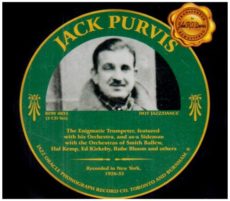
Jack Purvis was born John Purvis on December 11, 1906 in Kokomo, Indiana to Sanford B. Purvis, a real estate agent and Nettie Purvis. His behavior became uncontrollable after his mother’s death in 1912 and as a result of many acts of petty larceny, he was sent to a reform school. While there, he discovered that he had an uncanny musical ability, and soon became proficient enough to play both the trombone and trumpet professionally. This also enabled him to leave the reformatory and continue his high school education, while he was playing paying gigs on the side.
After high school he worked in his home state for a time then went to Lexington, Kentucky where he played with the Original Kentucky Night Hawks. In 1926 he was with Bud Rice touring New England, then with Whitey Kaufman’s Original Pennsylvanians. For a short time he played trumpet with Arnold Johnson’s orchestra, and by July 1928 he traveled to France with George Carhart’s band. In 1929 he joined Hal Kemp’s band and recorded with Kemp, Smith Ballew, Ted Wallace, Rube Bloom, the California Ramblers, and Roy Wilson’s Georgia Crackers. In 1929 Purvis led his own recording groups using Hal Kemp’s rhythm section to produce Copyin’ Louis, and Mental Strain at Dawn.
By 1930, Purvis leading a couple of racially mixed recording sessions including the likes of J.C. Higginbotham, and Adrian Rollini. One of these sessions was organized by Adrian Rollini and OKeh A & R man, Bob Stephens. He went on to work with the Dorsey Brothers and played fourth trumpet with Fletcher Henderson in a rehearsal capacity.
The early Thirties saw him played with a few radio orchestras and worked with Fred Waring, toured the South with Charlie Barnet, worked with the New Orleans Symphony Orchestra, moved to Los Angeles, California and was successful with radio broadcasting work. He worked for the George Stoll Orchestra, Warner Bros. Studios arranging, and composed Legends of Haiti for a one hundred and ten piece orchestra.
Living a checkered life he was in and out of jail, worked outside the musical environment working as a chef, a busker, an aviator in Florida, a carpenter, a radio repairman, a smuggler and a mercenary in South America. Trumpeter and trombonist Jack Purvis gassed himself to death in San Francisco, California on March 30, 1962.
Daily Dose Of Jazz…
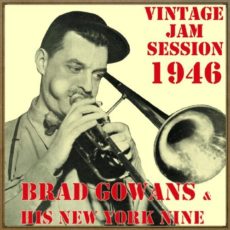
Brad Gowans was born Arthur Bradford Gowans on December 3, 1903 in Billerica, Massachusetts. His earliest work was on the Dixieland jazz scene, playing with the Rhapsody Makers Band, Tommy DeRosa’s New Orleans Jazz Band, and Perley Breed. In 1926 he played cornet with Joe Venuti, and worked later in the decade with Red Nichols, Jimmy Durante, Mal Hallett and Bert Lown. Leaving music for several years during the Great Depression, he returned to play with Bobby Hackett in 1936, then Frank Ward, Wingy Manone, Joe Marsala, and Bud Freeman’s Summa Cum Laude Band by 1940.
Moving to New York City early in the 1940s, Brad played regularly at Nick’s in Greenwich Village and worked with Ray McKinley and Art Hodes. As a clarinetist, he played in the reconstituted Original Dixieland Jazz Band’s 1940s recordings. He stopped playing again briefly in the mid-1940s, then returned to play with Max Kaminsky, Jimmy Dorsey, and Nappy Lamare.
Aside from his playing, Gowans also arranged pieces for Bud Freeman and Lee Wiley, and invented the valide trombone, a hybrid slide-valve trombone which never caught on. He recorded a few times as a leader in 1926, 1927, and 1934, and recorded Brad Gowans and His New York Nine for Victor Records in 1946.
He went on to freelance on the West Coast and collapsed on stage in 1954 while playing with Eddie Skrivanek. Trombonist and reedist Brad Gowans passed eight months later on September 8, 1954 in Los Angeles, California.

Daily Dose Of Jazz…
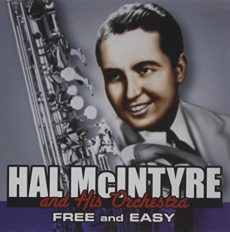
Hal McIntyre was born Harold William McIntyre on November 29, 1914 in Cromwell, Connecticut. McIntyre played extensively as a teenager and led his own octet in 1935. Shortly thereafter, he was offered a temporary slot as an alto saxophonist behind Benny Goodman, but this lasted only ten days. However, Glenn Miller heard of his ability and drafted him as a founding member of the Glenn Miller Orchestra, where he played from 1937 to 1941.
Miller encouraged him to start his own group again, and the McIntyre Orchestra first hit the stage in New Rochelle, New York in 1941. The group included vocalists Gloria Van, Ruth Gaylor, and Al Nobel, bassist Eddie Safranski, and saxophonist Allen Eager. Playing the major ballrooms throughout the United States, they also performed overseas for the troops during World War II.
At the beginning of 1945, Hal and his orchestra had a weekly broadcast on the Blue Network. One feature of the program was that on each program the orchestra would play the theme song of one of America’s college fraternities, saluting some member who had distinguished himself in the war.
Touring extensively with songstress Sunny Gale until the summer of ’51, he maintained the orchestra well into the decade, backing The Mills Brothers for their 1952 smash hit Glow Worm. Hal co-wrote the song Daisy Mae with Billy May which was recorded by Glenn Miller and His Orchestra.
Critically injured in an apartment fire in 1959, saxophonist, clarinetist, and bandleader Hal McIntyre passed away at a hospital a few days later on May 5, 1959 in Los Angeles, California.

Daily Dose Of Jazz…
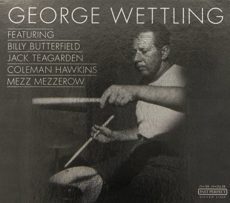
George Godfrey Wettling was born on November 28, 1907 in Topeka, Kansas. He was one of the young Chicagoans who fell in love with jazz after hearing King Oliver’s band with Louis Armstrong on second cornet at Lincoln Gardens in the early 1920s. Oliver’s drummer, Baby Dodds, made a particular and lasting impression on him.
Wettling went on to work with the big bands of Artie Shaw, Bunny Berigan, Red Norvo, Paul Whiteman, and Harpo Marx, but he was at his best with bands led by Eddie Condon, Muggsy Spanier, and himself. In these small settings he demonstrated the arts of dynamics and responding to a particular soloist that he had learned from Dodds.
A member of some of Condon’s bands, George was in the company of Wild Bill Davison, Billy Butterfield, Edmond Hall, Peanuts Hucko, Pee Wee Russell, Cutty Cutshall, Gene Schroeder, Ralph Sutton, and Walter Page. By 1957 he was touring England with a Condon band that included Davison, Cutshall, and Schroeder.
Toward the end of his life, he, like his friend clarinetist Pee Wee Russell, took up painting and was influenced by the American cubist Stuart Davis. Jazz, swing and Dixieland drummer George Wettling, active from the 1920s to the 1950s, passed away on June 6, 1968 in New York City.
More Posts: drums