

Daily Dose Of Jazz…
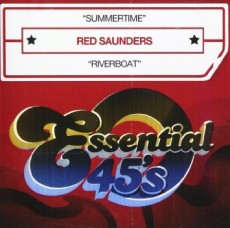
Red Saunders was born Theodore Dudley Saunders on March 2, 1912 in Memphis, Tennessee. Early in his career he played in Milwaukee, Wisconsin and Chicago, Illinois playing with Stomp King. For a time, he worked with Tiny Parham at the Savoy Ballroom in Chicago.
In 1937, the Club DeLisa gave Saunders control of the house band, where he remained almost uninterrupted until the club’s closure in 1958. Among his sidemen were Leon Washington, Porter Kilbert, Earl Washington, Sonny Cohn, Ike Perkins, Riley Hampton, singer Joe Williams and Mac Easton.
Among the arrangers he employed were Johnny Pate and Sun Ra. Despite his regular gig and disinclination to go on the road, Red played with Duke Ellington, Louis Armstrong and Woody Herman, and recorded with Big Joe Turner.
He continued to lead a band at Chicago’s Regal Theater into the Sixties, and played with Little Brother Montgomery and Art Hodes at the New Orleans Jazz Festival in the 1970s. Drummer and bandleader Red Saunders, who also played vibraphone and timpani, passed away on March 5, 1981 in Chicago.

Inspire A Young Mind
More Posts: drums
Daily Dose Of Jazz…
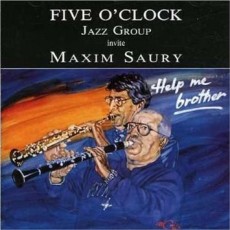
Maxim Saury was born in Enghien-les-Bains, in the Val-d’Oise, France on February 28, 1928. The son of a professional violinist, Andrew “Kiki” Saury, he first took violin lessons between 1940 and 1942, but not suiting him, he turned to the clarinet.
In 1946, he joined the orchestra of Christian Azzi and the following year joined Claude Bolling before leaving in 1949 to mount a trio in 1951. Between 1955 and 1968, Saury played almost exclusively at Caveau de la Huchette in Paris, performed at all the major French jazz festivals including Cannes, Antibes, Nice and Juan-les-Pins.
Maxim represented the middle of French traditional jazz and was invited to perform on television shows and also appear in several films made in the late 1950s and early 1960s, particularly Otto Preminger’s Bonjour Tristesse, The Cheaters by Marcel Carne, My Uncle by Jacque Tati and Jacques Rozier’s Adieu Philippine.
Since the late 1960s, Maxim Saury performed regularly in concert in France and worldwide. In 2007, he was one of few performers selected for the four volume compilation The 100 Greatest Success of Saint-Germain-des-Prés , alongside Yves Montand, Boris Vian, Juliette Greco, Les Freres Jacques, Catherine Sauvage, Sidney Bechet, Marcel Mouloudji and Stephane Grappelli.
Clarinetist, conductor and arranger Maxim Suary, one of the symbols of revival of New Orleans jazz in Saint Germain-des-Pres during the Fifties and Sixties, passed away at the age of eighty-four, on November 15, 2012 at the Ambroise Pare Hospital in Boulogne-Billancourt, following heart problems.
Put A Dose In Your Pocket
More Posts: clarinet
Daily Dose Of Jazz…
William Russell was born Russell William Wagner on February 26, 1905 in Canton, Missouri. He learned to play the violin and throughout his career contributed to many a performance. When he decided to become a classical music composer he changed his name, transposing first and second and dropping his last.
He was a leading figure in percussion music composition, influenced by his acquaintances John Cage and Henry Cowell. In turn, he also influenced Cage, in his emphasis of percussion. During the 1930s, predating Cage’s main work, Russell’s percussion works called for vernacular textures such as Jack Daniels bottles, suitcases, and Haitian drums, and pianos.
One notable performance of his Fugue For Eight Percussion Instruments took place in 1933 at Carnegie Hall, with the ubiquitous and influential critic-writer-performer Nicholas Slonimsky conducting. These performances took place under the auspices of the Pan-American Association of Composers, an organization that was composed of Cowell, Slonimsky Ruth Crawford Seeger, Edgard Varese and other luminaries of American ultra-modernism.
Bill was also one of the leading authorities on early New Orleans jazz, authoring articles and books, including three essays in the milestone book, Jazzmen and the voluminous 720-page Jelly Roll Morton scrapbook, Oh, Mr. Jelly. He made many recordings of historical interest, founded American Music Records, helping bring many forgotten New Orleans performers, including Bunk Johnson back to public attention and became an important force in the New Orleans jazz revival of the early 1940s.
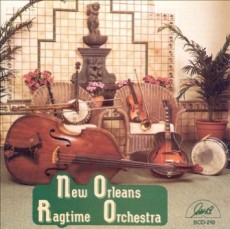
Moving to the French Quarter of New Orleans in 1956, he opened a small record shop from which he also repaired violins. Russell played violin with the New Orleans Ragtime Orchestra, co-founded and became the first curator of The Hogan Jazz Archive at Tulane University in 1958,
Russell collected a large quantity of material related to the history of New Orleans, early jazz, ragtime, blues, and gospel music, all of which he kept in his French Quarter apartment. During his lifetime he always was willing to share access to the material with serious researchers.
At his death on August 9, 1992, Bill Russell, the single most influential figure in the revival of New Orleans jazz that began in the 1940s, bequeathed his collection to the Historic New Orleans Collection, where it continues to be a valuable resource for researchers in the city that became his last home.
Jazz Is Global – Share
Daily Dose Of Jazz…
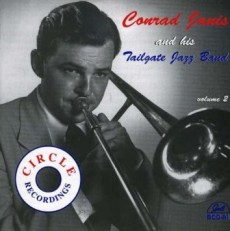
Conrad Janis was born February 11, 1928 in New York City and learned to play trombone as a child. Throughout his life, Janis has striven to keep traditional jazz alive often performing when not in front of a camera. In 1949, Janis put together a band of aging jazz greats comprised of James P. Johnson on piano, trumpeter Henry Goodwin, clarinetist Edmond Hall, Pops Foster on bass and Baby Dodds on the drum, with himself out front on trombone.
He was also a theater, film and television actor who at the age of 19 starred in the film the Brasher Doubloon with George Montgomery and went on to appear in the film Margie with Jeanne Crain.
In 1953, he played eldest son Edward in NBC’s Bonino, guest appeared on Get Smart, The Golden Girls and Quark. He was featured in the movies The Buddy Holly Story, The Duchess and The Dirtwater Fox, and appeared as himself in the bar scene in Tom Hanks/Jackie Gleason film Nothing In Common. Janis is best known for playing Mindy McConnell’s father Frederick on Mork & Mindy.
By the late 1970s, he formed the Beverly Hills Unlisted Jazz Band, which appeared multiple times on the Tonight Show Starring Johnny Carson and made eight sold-out performances at Carnegie hall. Trombonist and bandleader Conrad Janis continues to play and act whenever possible at the age of 87.
Give A Gift Of Jazz – Share
More Posts: trombone
Daily Dose Of Jazz…
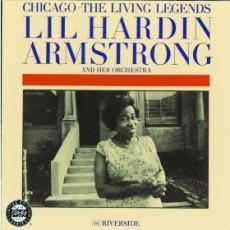
Lil Hardin Armstrong was born Lillian Hardin on February 3, 1898 in Memphis, Tennessee and grew up with her grandmother learning hymns, spirituals and classics on the piano, but she was drawn to pop music and later blues. Her initial piano instruction came from her third grade teacher, Miss Violet White, followed by enrollment in Mrs. Hook’s School of Music, but it was while attending Fisk University that she was taught a more acceptable approach to the instrument.
In 1918, Lil moved to Chicago and landed a job as a sheet music demonstrator at Jones Music Store for $3 a week. Shortly afterward bandleader Lawrence Duhé offered her $22.50 she joined him. From cabaret to the De Luxe Café to Dreamland playing behind Alberta Hunter and Ollie Powers. Replace by King Oliver’s Creole Jazz Band, he asked her to stay, which led to an engagement in San Francisco, back to Chicago playing eventually with Oliver again.
Hardin met Louis Armstrong when Oliver sent for him and subsequently were married in 1924. She took him shopping and taught him how to dress more fashionably, and finally convinced him to strike out on his own. Moving to New York City he joined Fletcher Henderson, while she stayed in Chicago with Oliver and then leading her own band.
Hardin, Armstrong, Kid Ory, Johnny St. Cyr and Johnny Dodds comprised the Hot Five recordings for Okeh Records. She would go on to record sessions with the same group as a leader for Vocalion, Columbia Records and New Orleans Wanderers. In the late 1920s Hardin and Louis parted ways and she formed a band with a cornet player she considered Louis equal, Freddie Keppard. In the 1930s, she sometimes billed herself as Mrs. Louis Armstrong, led an All Girl Orchestra, then a mixed-sex big band, which broadcasted nationally over the NBC radio network.
The same decade she recorded a series of sides for Decca Records as a swing vocalist, recorded with Red Allen, and back in Chicago collaborated with Joe Williams, Oscar Brown Jr., Red Saunders and Little Brother Montgomery. Throughout the rest of her career she continued to perform and record, and began writing an autobiography that she never completed. A month after attending Louis’ funeral in New York City, she was performing at a televised memorial concert for Louis, Lil Hardin Armstrong collapsed at the piano and died on the way to the hospital.
Pianist, composer, arranger, singer and bandleader Lil Hardin Armstrong, second wife and recording collaborator of Louis Armstrong in the 1920s, passed away on August 27, 1971. Her compositions have been sampled and revived by many and was inducted into the Memphis Music Hall of Fame in 2014.
Inspire A Young Mind