

Daily Dose Of Jazz…
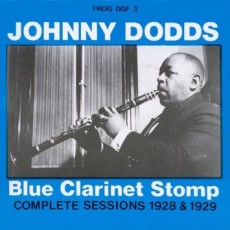
Johnny Dodds (pronounced dots) was born April 12,1892 in Waveland, Mississippi and moved to New Orleans in his youth, and studied clarinet with Loranzo Tio. He played with the bands of Frankie Duson, Kid Ory and Joe “King” Oliver.
Dodds went to Chicago, Illinois to play with Oliver’s Creole Jazz Band, with whom he first recorded in 1923. He also worked frequently with his good friend Natty Dominique during this period, a professional relationship that would last a lifetime.
After the breakup of Oliver’s band in 1924, he replaced Alcide Nunez as the house clarinetist and bandleader of Kelly’s Stable. He recorded with numerous small groups in Chicago, most notably Louis Armstrong’s Hot Five and Fot Seven, Jelly Roll Morton’s Red Hot Peppers and Lovie Austin.
Noted for his professionalism and virtuosity as a musician, and his heartfelt, heavily blues-laden style, Dodds was an important influence on later clarinetists, notably Benny Goodman.
Along with his younger brother drummer Warren “Baby” Dodds, they worked together in the New Orleans Bootblacks in 1926. As a leader he recorded prolifically between 1927 and 1929, recording for Paramount, Brunswick/Vocalion, and Victor. Affected by ill he recorded two more sessions in 1938 and 1940 both for Decca before passing away of a heart attack in Chicgo, Illinois on August 8, 1940. In 1987, clarinetist and alto saxophonist Johnny Dodds was inducted into the Down Beat Jazz Hall of Fame.

Take A Dose On The Road

Daily Dose Of Jazz…
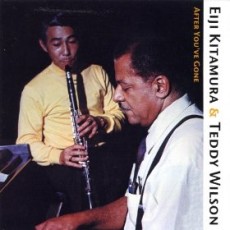
Eiji Kitamura 北村 英治 was born on April 8, 1929 in Tokyo, Japan. Devoting himself to clarinet, he was playing while still an undergrad at Keio University at in Tokyo. He made his debut at the age of 22.
Kitamura built a following in his country performing regularly on his television program. He first came to prominence in the United States at the 20th Anniversary Jam Session of the Monterey Jazz Festival in 1977. His following in Japan was built previous to this on his regular television program.
An interpreter of traditional jazz, the clarinetist prefers this genre over modern jazz. Much of his influence in his playing came from the swing of Benny Goodman and Woody Herman. He has recorded some two-dozen albums or more albums including a series of albums with Teddy Wilson as well as for CBS Sony, Concord and various Japanese labels over the course of his career.
Jazz Is Global – Share
More Posts: clarinet
Daily Dose Of Jazz…
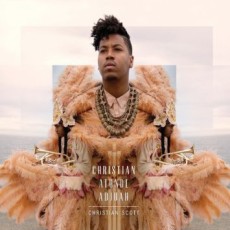
Christian Scott, also known as Christian Scott aTunde Adjuah was born March 31, 1983 in New Orleans, Louisiana. A twin to brother Kiel, at the age of 13 he was given the chance to play with his uncle, jazz alto saxophonist Donald Harrison. A year later he was accepted into the New Orleans Center of Creative Arts where he studied jazz under the guidance of program directors, Clyde Kerr, Jr. and Kent Jordan.
After graduating NOCCA, Christian received a scholarship to Berklee College of Music in Boston, Massachusetts, graduating in 2004. While matriculating his last year he was member of the Berklee Monterey Quartet and recorded as part of the Art:21 student cooperative quintet. He studied under the direction of Charlie Lewis, Dave Santoro, and Gary Burton. He majored in professional music with a concentration in film scoring.
Scott has worked across musical genres with Stefon Harris, David Sanchez, Donald Harrison, Karin Williams, Nnenna Freelon, Grace Kelly, Erin Boheme, X Clan, Prince, Mike Clark, David Benoit, Global Noize, Ledisi, Marcus Miller and Esperanza Spaulding, to name a few.
His debut album Rewind That on the Concord Record label garnered him a Grammy nomination and received the Edison Award in 2010 and 2012. Since 2002, he has released eight studio albums, and two live recordings. Trumpeter, composer and producer Christian Scott continues performing with his eight-piece ensemble his legacy in jazz.
Uplift Someone’s World
More Posts: trumpet
Daily Dose Of Jazz…
Shelton “Scad” Hemphill was born on March 16, 1906 in Birmingham, Alabama. While still in his teens when he played trumpet in the Fred Longshaw band that accompanied Bessie Smith on recordings in 1924–25. In 1924, at age 18, he enrolled at Wilberforce University in Ohio and was a member of Horace Henderson’s student band alongside the likes of Ted and Castor McCord.
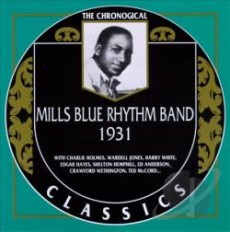
Moving to New York late in the 1920s, he played with Benny Carter and Chick Webb before joining the Mills Blue Rhythm Band. He played with this group from 1931 to 1937, and then joined Louis Armstrong from 1937 to 1944. He followed with a five-year stint with Duke Ellington until 1949.
By the 1950s, he played occasionally in New York City but left music due to mounting health problems later in the decade.
Trumpeter Shelton Hemphill passed away in New York City on January 6, 1960 just two months and ten days before his 54th birthday. His demise was noted in the syndicated column of veteran music critic Ralph J. Gleason.
Put A Dose In Your Pocket
More Posts: trumpet
Daily Dose Of Jazz…
Louis Albert Cottrell, Jr. was born in New Orleans, Louisiana on March 7, 1911. Raised in an upper class Creole musical family, his father Louis Cottrell Sr. was an influential drummer and cornetist Manny Perez was his godfather. Growing up around John Robichaux, A.J. Piron and Barney Bigard, the latter giving him lessons as well as studying under Lorenzo Tio, Jr.
He began his career in the 1920s with the Golden Rule Orchestra and by 1925 was playing with “Polo” Barnes. Louis would go on to work with Chris Kelly, Kid Rena, on the riverboat SS Island Queen with Lawrence Marrero’s young Tuxedo Brass Band and with Sidney Desvigne.
During this period he became a prominent union organizer, joining Don Albert’s orchestra soon after, recording an album with the orchestra in 1935 under the Vocalion label. Trying his hand at composing, with Lloyd Glenn and Albert wrote You Don’t Love Me (True) that became one of the hits of the R&B New Orleans era for bandleader Paul Gayten.
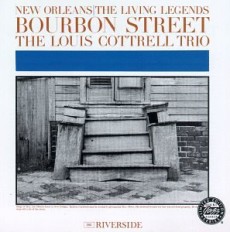
During the 40s he had an enduring collaboration with Paul Barbarin, played with Piron and Desvigne, formed and recorded for the first time as a leader in 1961 with the Louis Cottrell Trio for Riverside Records Living Legends series and with Barbarin revived the Onward Brass Band. His sideman duties led him to perform and record with Peter Bocage, Jim Robinson, Harold Dejan, Thomas Jefferson, Sweet Emma Barrett, Avery Kid Howard, Waldren Joseph, and Polo Barnes.
In 1971 Louis formed the Heritage Hall Jazz Band, leading that ensemble up until his death. Under his leadership the band rivaled Preservation Hall and with Blanche Thomas on vocals played Carnegie Hall in 1974. He went on to make several television appearances on the Perry Como and Mike Douglas shows, had a cameo and recorded Academy Award nominated Big Lip Blues for the soundtrack of 1978 film Pretty Baby.
Clarinetist and saxophonist Louis Cottrell died suddenly at his home after a short illness on March 21, 1978 at the age of 67. Fittingly, he was honored with a jazz funeral, as thousands assembled in a small Gentilly Catholic church to bid him farewell.
Give The Gift Of Knowledge