

Daily Dose Of Jazz…
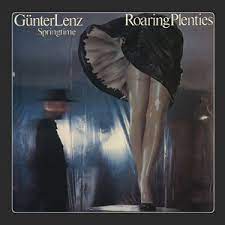
Günter Lenz was born July 25, 1938 in Frankfurt am Main. He first taught himself guitar and studied with Carlo Bohländer, playing jazz in the clubs of the U.S. Army from 1954 onwards. During national service in 1959/1960 he switched to the bass.
In 1961 Albert Mangelsdorff picked him up as a member of the Albert Mangelsdorff Quintet. Since then Lenz has also become a member of the hr-jazz ensemble, for which he arranged and composed. 1965 saw him working in the Krzysztof Komeda Quintet, recording the album Astigmatic. Three years later he was playing with Joachim Kühn and Aldo Romano in a band led by Barney Wilen at the Berlin Jazz Days. With The German All Stars he toured internationally in 1969 and 1971.
He played with the George Russell Sextet, and with a band led by Leon Thomas. This allowed him to collect big band experience. During the 1970s he was a member of the Kurt Edelhagen Big Band and with Peter Herbolzheimer Rhythm Combination & Brass. He would go on to be engaged for their concert tours and record productions by Chet Baker, Coleman Hawkins, Oliver Nelson and Benny Bailey, as well as German musicians such as Eugen Cicero, Horst Jankowski and Volker Kriegel.
Dipping into the blues field in 1972 Günter played with Lightning Hopkins. The mid-1970s saw Lenz joining drummer Peter Giger in Clarinet Contrast, an avant garde band around the clarinetists Perry Robinson, Theo Jörgensmann, Bernd Konrad and Michel Pilz. As a member of the Manfred Schoof Quintet he recorded for ECM/Japo.
In the late 1970s Günter founded his combo, Günter Lenz Springtime, an international jazz-fusion band with members as Bob Degen, Claus Stötter, Frank St. Peter, Johannes Faber, Leszek Zadlo and Joe Nay. He recorded as part of the Berlin Contemporary Jazz Orchestra. In 1991 he recorded “Life at the Montreux Music Festival” in trio-formation with Uli Lenz and Allen Blairman
Lenz created orchestral arrangements for Plácido Domingo, and from 2001 to 2006 as a professor he taught bass at the Musikhochschule Stuttgart. During that period of education he received the Hesse state Jazz prize awarded by the State Minister for Higher Education, Research and the Arts Udo Corts.
Bassist Günter Lenz continues to perform, compose, arrange and educate.

More Posts: arranger,bandleader,bass,composer,history,instrumental,jazz,music
Daily Dose Of Jazz…
Kenneth John Moule was born on June 26, 1925 in Barking, Essex, England and was the only child of Frederick and Ethal Moule. Surviving an early childhood illness, left him with a cadaverous look which went well with his ridiculous sense of humor.
In the Forties Moule played piano with the Johnny Dankworth Quartet before leaving to join Oscar Rabin in 1945. He would go on to perform with Remo Cavalotti for a summer season and Joe Daniels before working on the Queen Mary in Bobby Kevin’s Band, with Ronnie Scott and Johnny Dankworth. He closed out the decade working with several bands including Jiver Hutchinson, Bert Ambrose, Frank Weir and Ken Mackintosh.
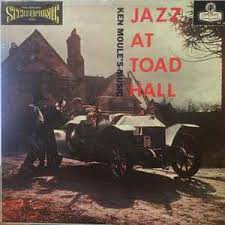
During the early 1950s Ken worked with Raymonde’s Orchestra, again with Ambrose and then with Frank Weir on several occasions. 1954 saw him form under his own name a septet, which was comprised of two-tenor, baritone, trumpet and three rhythm group. He resigned from the septet in 1955 and from 1956–1959 he arranged for Ted Heath’s orchestra. During this time he composed the suite Jazz at Toad Hall, and was released on Decca Records in 1958. He worked in Sweden and toured Europe with Kurt Weill’s Band until 1960.
The 1960s saw his return to England and worked freelance as an arranger, especially with Lionel Bart. He was the musical director for the shows Fings Ain’t Wot They Used T’Be and Twang!!. From 1962 he broadcast regularly with his 15 piece orchestra, and later broadcasted and recorded with a larger band called The Full Score. His Adam’s Rib Suite was recorded by the London Jazz Chamber Group in 1970 with Kenny Wheeler on the recording issued on Ember Records.
He scored Cole Porter songs for the musical Cole! performed at the Mermaid Theatre in 1974, and worked with Dankworth again around that time with his London Symphony Orchestra collaborations. He worked out of Germany for part of the 1970s before ill health caused him to move to the warmer climate of Spain.
Pianist, composer and arranger Ken Moule transitioned in Marbella in January 27, 1986, aged 60.

More Posts: arranger,bandleader,composer,history,instrumental,jazz,music,piano
Daily Dose Of Jazz…
Harry Alexander White was born on June 1, 1898 in Bethlehem, Pennsylvania. As a teenager, he played drums, then switched to trombone after moving to Washington, D.C. around 1919. In the early Twenties he played with Duke Ellington, Elmer Snowden, and Claude Hopkins. Then in 1925 he formed the family band called the White Brothers Orchestra, which played the mid-Atlantic states for several years with regular gigs in New York City and Philadelphia, Pennsylvania.
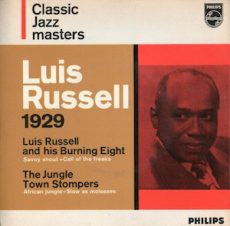
Late in the 1920s, he played with Luis Russell, then joined the Mills Blue Rhythm Band in 1931. The following year he joined Cab Calloway’s orchestra, working as an arranger and composer in addition to his duties on trombone. One of Calloway’s trumpeters, Edwin Swayze, overheard Harry use the term “jitterbug”, and wrote a tune called The Jitterbug. Calloway’s 1934 recording of the song brought the term into widespread currency.
Returning to play with Russell in 1935 when the band was backing Louis Armstrong, he eventually quit playing for part of the Thirties decade. He would later perform with Manzie Johnson, Hot Lips Page, Edgar Hayes, and Bud Freeman.
Trombonist, pianist, saxophonist, arranger and composer Harry White, who was affectionately known as Father White, transitioned on August 14, 1962 in New York City.
More Posts: arranger,bandleader,composer,history,instrumental,jazz,music,piano,saxophone,trombone
Daily Dose Of Jazz…
Russell Morgan was born on April 29, 1904 in Scranton, Pennsylvania into a Welsh family. He was encouraged to express himself musically from the age of seven. His father was a former drummer, his mother a pianist in a vaudeville act. He began studying piano and worked in the mines with his father to earn money to help support the family and pay for his lessons.
By 14, he was earning money as a pianist in a Scranton theater. Purchasing a trombone he learned to play and in 1921 he played trombone with the Scranton Sirens, a popular band in Pennsylvania. Russ moved to New York in 1921 at 18 and three years later he was writing arrangements for John Philip Sousa and Victor Herber. He then joined Paul Specht’s orchestra and toured throughout Europe with the likes of Paul Whiteman, Charlie Spivak, and Artie Shaw. After returning from Europe, Jean Goldkette invited him to Detroit, Michigan to lead his band with former associates Tommy and Jimmy Dorsey, Chauncey Morehouse, Joe Venuti, Eddie Lang, Bix Beiderbecke, and Fuzzy Farrar.
His first records were made for OKeh in mid 1930 and for Parlophone and Odeon, usually under the name Russell Brown and his Orchestra. During the early 1930s, Morgan joined the group of anonymous studio groups recording pop tunes for the dime store labels, which included Banner, Melotone, Oriole, Perfect, Romeo, Conqueror, and Vocalion.
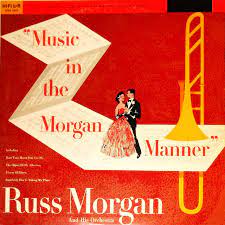
For a short time in the Thirties he arranged for Fletcher Henderson’s Orchestra. In 1935, he played trombone with the Original Dixieland Jazz Band when they recorded four sides for Vocalio and two sides for Brunswick. He was offered the position of musical director for Detroit radio station WXYZ and his show, Music In The Morgan Manner, became one of the most popular radio shows.
An automobile accident in the early 1930s nearly sidelined his career but after several months in the hospital, Russ started again in New York City as an arranger for the George White Scandals, the Cotton Club Revue, and the Capitol Theatre. When not arranging for the Broadway shows, he worked as a pianist or trombonist with orchestras led by Phil Spitalny, Eddie Gilligan, Ted Fio Rito, and Freddy Martin.
He would go on to join the Freddy Martin Orchestra, become music director at Brunswick, hosted The Russ Morgan Show on the Mutual Broadcasting System and formed an orchestra at Rudy Vallee’s insistence. He landed his first engagement at the Biltmore along with Vallee’s band. He was music director for the Rinso-Lifebuoy Show on NBC and the Philip Morris radio series on NBC and CBS for two years.
Through his career he had four songs that charted, was music director for NBC and CBS and hosted television shows, On August 7, 1969 trombonist, arranger, composer, conductor and bandleader Russ Morgan, who has a star on the Hollywood Walk of Fame, transitioned at the age of 65 in Las Vegas, Nevada.
More Posts: arranger,bandleader,composer,conductor,history,instrumental,jazz,music,trombone
Daily Dose Of Jazz…
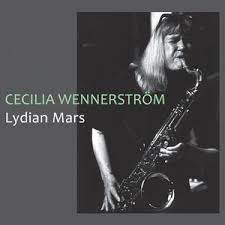
Cecilia Wennerström was born on April 21, 1947 in Stockholm, Sweden. Educated at the music academies in Malmoe and Gothenburg. She was influenced by Archie Shepp, Eric Dolphy, John Coltrane, Elvin Jones, Jack DeJohnette, and Charlie Haden. She took part in a workshop led by David Murray and has allied herself with the music since the Eighties.
From 1979-91 she was the leader of Salamander, a jazz group that toured a lot in Sweden and Europe on festivals and clubs. Salamander made its debut 1981 at the Women’s Jazz Festival in Kansas City, Missouri.
In 1990 she started working with the talented singer and voice art performer Marie Selander in several creative and exciting projects, like for instance Maries composition “Blåst-Tuuli-Wind” that was performed in Kallio-Kuninkala Festival, Finland in 1996. She would go on to tour many times between 1997 to 1999. During the decade she was a member of the all nordic women big band April Light Orchestra
Cecilia is a member of Wennerstrom Larsson Explicity with her husband Sven Larsson. They released their first CD Tussilago in 2011, and she is in the octet LARS 8 which plays compositions by Lars Gullin and other Swedish jazz icons.
Saxophonist, composer and arranger Cecilia Wennerström has won several awards over the three decades and continues to perform, record and compose.
More Posts: arranger,bandleader,composer,history,instrumental,jazz,music,saxophone