

Daily Dose Of Jazz…
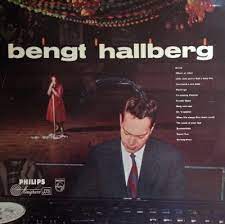
Bengt Hallberg was born on September 13, 1932 in Gothenburg, Sweden and studied classical piano from an early age. He wrote his first jazz arrangement at the age of 13. By 15 he recorded his first record as a member of a group led by bassist Thore Jederby and in 1949 he recorded with the Swedish alto saxophonist Arne Domnérus for the first time. The two musicians continued to play together for several decades.
During the Fifties, Bengt played with leading visiting American musicians tenor saxophonist Stan Getz and altoist Lee Konitz in 1951, and trumpeters Clifford Brown and Quincy Jones in 1953. During the same period he worked with Swedish baritone saxophonist Lars Gullin.
Hallberg had a versatile style and in his later years he wrote music for film and television, as well as choral arrangements. With Domnerus and Georg Riedel among others, he participated in the Jazz at the Pawnshop sessions in 1976.
Pianist, composer and arranger Bengt Hallberg, who also played accordion, transitioned on July 2, 2013 from congestive heart failure at the age of 80 in Uppsala, Sweden.

More Posts: arranger,bandleader,composer,history,instrumental,jazz,music,piano
Daily Dose Of Jazz…
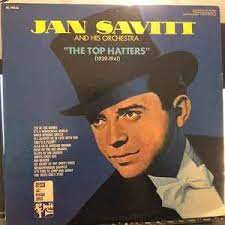
Jan Savitt was born Jacob Savetnick on September 4, 1907 in Shumsk, Russian Empire and reared in Philadelphia, Pennsylvania. He showed musical ability at an early age and began winning conservatory scholarships in the study of the violin. He was offered the position of concertmaster in Leopold Stokowski’s Philadelphia Symphony Orchestra, but turned it down, preferring to continue his studies at Curtis Institute. About a year later, believing himself ready, he joined Stokowski and the association continued for seven years, during which time he gained further laurels as a concert soloist and leader of a string quartet.
By 1938, Jan Savitt & His Top Hatters broadcasted as the KYW staff orchestra at KYW/NBC in Philadelphia coast-to-coast. The group also played at the Earl Theatre and performed with The Andrews Sisters and The Three Stooges.
Getting his start in popular music some time later as music director of KYW, he evolved the unique “shuffle rhythm” which remained his trademark. Numerous sustaining programs created such a demand for the “shuffle rhythm” that Jan left KYW to form his own dance crew.
His band was notable for including George “Bon Bon” Tunnell, one of the first Black singers to perform with a white band. Tunnell’s recording with Savitt included Vol Vistu Gaily Star co-composed by Slim Gaillard and Rose of the Rio Grande. Helen Englert Blaum, known at the time as Helen Warren, also sang with Savitt during the war years. His orchestra had a bit role in the 1946 film High School Hero.
Shortly before arriving in Sacramento, California with his orchestra in 1948 he was stricken with a cerebral hemorrhage and taken to Sacramento County Hospital. Bandleader, arranger, and violinist Jan Savitt, known as The Stokowski of Swing, transitioned on October 4, 1948 with his wife at his bedside.
More Posts: arranger,bandleader,history,instrumental,jazz,music,violin
DEMETRIUS NABORS
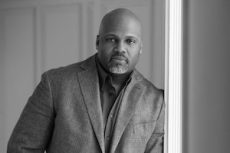
Pianist, composer, producer and arranger Demetrius “Krayon” Nabors is well known and in demand in the Detroit area and on the national contemporary jazz scene. He is a two-time Detroit Music Award Winner in the Outstanding Gospel/Christian Musician category.
His considerable talents caught the attention of numerous high-profile national artists, including R&B singer KEM, flutist Althea Rene, guitarist Tim Bowman and trumpeter Willie Bradley.Demetrius’ productions for these artists have garnered Billboard chart successes: #1 for KEM’s single “Nobody” (2014), #2 for Willie Bradley’s “It’s On Now” (2020) and #5 for Althea Rene’s “Barbara Mae” (2019). In addition, “Nobody” was nominated for the Best Traditional R&B Performance at the 57th Grammy Awards in 2014. Demetrius’ discography includes four critically acclaimed releases, “The Journey Within Part I” (2011), “Christmas with Krayon” (2012), “The Journey Within Part II” (2014) and “Perseverance” (2021). His latest, “Evolution” is set to be released in September of 2022 and was inspired by his graduate studies at the University of Michigan.
More Posts: adventure,arranger,club,composer,festival,genius,jazz,music,piano,preserving,producer,travel
Daily Dose Of Jazz…
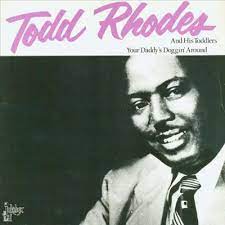
Todd Washington Rhodes was born in Hopkinsville, Kentucky on August 31, 1899 and was raised in Springfield, Ohio. He attended the Springfield School of Music and the Erie Conservatory, studying as pianist and songwriter. After graduating in 1921, he began performing with drummer William McKinney in the jazz band McKinney’s Cotton Pickers, and played with Benny Carter, Coleman Hawkins, Fats Waller, Rex Stewart, Doc Cheatham, and Don Redman.
Leaving McKinney’s Cotton Pickers in 1934, he lived and played in Detroit, Michigan from then on. He formed his own small group in 1943, expanding it into the Todd Rhodes Orchestra by 1946. The orchestra made its first recordings for Sensation Records in 1947.
Turning more towards rhythm and blues music, the band became known as Todd Rhodes & His Toddlers, and their recordings were distributed by the Vitacoustic label. His instrumental Blues for the Red Boy reached number 4 on the R&B chart late in 1948, and the following year Pot Likker, made number 3 on the R&B chart. “Blues for the Red Boy” was later famously used by Alan Freed as the theme song for his Moondog radio show; Freed referring to the song as “Blues for the Moondog” instead of its actual title.
With his Toddlers, Rhodes also recorded Your Daddy’s Doggin’ Around and Your Mouth Got a Hole in It. After signing with King Records in 1951, he also worked with Hank Ballard, Dave Bartholomew, and Wynonie Harris. He featured singers such as Connie Allen, who recorded “Rocket 69” in 1952. After she left the band in early 1952, her position was taken by LaVern Baker. Rhodes made his last recordings in the late 1950s.
Developing diabetes, which was untreated for several years, pianist, arranger and bandleader Todd Rhodes transitioned following the amputation of a leg in Inkster, Michigan on June 4, 1965, at the age of 65.

More Posts: arranger,bandleader,history,instrumental,jazz,music,piano
Daily Dose Of Jazz…
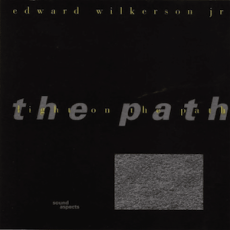
Edward L. Wilkerson Jr. was born in Terre Haute, Indiana on July 27, 1953. Over the course of his career he has associated himself with medium-to large-scale projects and has been a major presence in Chicago, Illinois’s Association for the Advancement of Creative Musicians (AACM), teaching and serving a term as president.
The AACM collective has been a nurturing force for Wilkerson and has informed much of his work. He was an original member of the Ethnic Heritage Ensemble formed by percussionist Kahil El’Zabar and remained with the group from 1976 until 1997. Though he recorded on three albums with the group he was becoming more involved in leading his own projects. His most ambitious project, Shadow Vignettes, was initiated in 1979 with 25 musicians and incorporated dance, poetry, and visual arts. The ensemble’s influences include the big band work of Muhal Richard Abrams, Duke Ellington, Count Basie and Sun Ra.
Wilkerson’s best-documented octet as a leader is 8 Bold Souls, a series of concerts that led Wilkerson to establish the group as a working band. They have released four albums, 8 Bold Souls, Sideshow, Ant Farm, and Last Option. Their music is influenced by the small groups of Duke Ellington and Jimmie Lunceford, but leaves room for adventurous experimentation.
In addition to his work with the preceding groups he has played with the AACM Big Band, Roscoe Mitchell, Douglas Ewart, the Temptations, Chico Freeman, the late Geri Allen, the Lyric Opera of Chicago, Muhal Richard Abrams, Aretha Franklin, and George Lewis.
Wilkerson has received grants from the Illinois Arts Council, the National Endowment for the Arts, Meet the Composer, and the Community Arts Assistance Program, and has been cited in numerous music polls.
Saxophonist, clarinetist, pianist, composer, arranger and educator Ed Wilkerson Jr., who has recorded 14 albums and two soundtracks, continues to teach composition at the AACM School of Music and explore the realms of jazz from his base in Chicago.

More Posts: arranger,bandleader,clarinet,composer,educator,history,instrumental,jazz,music,saxophone