

Daily Dose Of Jazz…
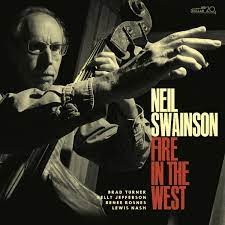
Neil James Sinclair Swainson was born November 15, 1955 in Victoria, British Columbia, Canada. He started his career in his hometown when he supported visiting American musicians Herb Ellis, Barney Kessell, and Sonny Stitt, among others. In 1976 he moved to Vancouver, British Columbia and after playing with the Paul Horn Quintet, he led a band for two years. He moved to Toronto, Quebec in 1977
In the 1980s he played with local and visiting acts including Tommy Flanagan, Rob McConnell, Ed Bickert, Slide Hampton, James Moody, Jay McShann, Moe Koffman, Lee Konitz, Joe Farrell, George Coleman, and Woody Shaw. He went on to collaborate with Woody Shaw appearing on two of his recordings: In My Own Sweet Way and Solid. He toured with Shaw often in New York City and on many European tours.
A collaboration between Swainson and pianist George Shearing would form in 1986, after he replaced Don Thompson in 1988. Their relationship continued until Shearing’s passing in 201 and during their time together they toured across North America, Great Britain, Europe, Australia, Hong Kong, and Japan. They played with musicians including Joe Williams, Nancy Wilson, Diana Krall, Robert Farnon and Mel Tormé.
Together the two recorded eight recordings and he recorded his own album; 49th Parallel on Concord Jazz in 1987. His recordings feature Woody Shaw on trumpet, and Joe Henderson on saxophone along with numerous other musicians such as Jay McShann, Geoff Keezer, Doc Cheatham, Sam Noto, Don Thompson, Peter Leitch, Pat LaBarbera, Joe LaBarbera, Rob McConnell, Ed Bickert, Lorne Lofsky, Kirk MacDonald and JMOG, a cooperative band featuring, Kevin Dean and Pat LaBarbera.
Swainson has also recently toured worldwide with the singer Roberta Gambarini and as well with pianist Gene DiNovi in Japan. As an educator he works at Humber College as a professor in the Bass department after receiving a music degree. Bassist Neil Swainson continues to compose music and freelance in Toronto.

More Posts: bandleader,bass,history,instrumental,jazz,music

Daily Dose Of Jazz…
Janet Lawson was born on November 13, 1940 in Baltimore, Maryland to a Jewish father and Catholic mother from Eastern Europe. Her father was a jazz drummer and her mother was a singer and lyricist who sometimes sang in her father’s band. At home, they worked on songs together at the piano. She performed on the radio and regional television as a child.
Lawson began singing with a local big band in her teens. When she was eighteen, she moved to New York City and got a job as a secretary at Columbia Records. She appeared regularly on Steve Allen’s television show between 1968 and 1969 and worked in theater.
Living across the street from Al Jeter, the head of Riverside Records, gave her access to make contacts when she attended parties at his penthouse apartment. While going to jazz clubs she found inspiration from seeing Thelonious Monk and made her debut at the Village Vanguard with Art Farmer.
In 1976 she formed the Janet Lawson Quintet, which in 1983 included saxophonist and flutist Roger Rosenberg, pianist Bill O’Connell, Ratzo Harris on bass, and drummer Jimmy Madison. She became known as a scat singer and improviser.
Lawson has worked with Art Farmer, Chick Corea, Ron Carter, Bob Dorough, Duke Ellington, Tommy Flanagan, Sheila Jordan, Barry Harris, Milt Hinton, Eddie Jefferson, Barney Kessel, Dave Liebman, Joe Newman, Rufus Reid, Clark Terry, Ed Thigpen, Cedar Walton, Duke Pearson and David Lahm.
She has taught voice at New York University and the New School, given private lessons, taught elementary school children, and has made trips every year to Latvia to attend a youth music camp.
In 1977 she recorded with Eddie Jefferson and by the Eighties she recorded two albums as a leader. In 1982 she was nominated for a Grammy Award in the Best Female Jazz Vocal Performance, and in 2007 received a Hall of Fame nomination from the International Association for Jazz Education.
Vocalist Janet Lawson, who in the early 2000s was diagnosed with Lyme disease, Bell’s palsy, Parkinson’s disease and suffered damage to her vocal cords, transitioned on January 22, 2021 in New Jersey.
Confer a dose of a Baltimore vocalist to those seeking a greater insight about the musicians around the world who are members of the pantheon of jazz…
More Posts: bandleader,history,instrumental,jazz,music,vocal
Daily Dose Of Jazz…
Eddie Benitez was born on November 12, 1956 in San Juan, Puerto Rico and his family moved to Europe soon after his birth for his father’s work. Raised in Italy and Spain, the family returned to the U.S. when he was nine and settled in Brooklyn, New York. He formed his first band at age twelve and began competing and winning local battles of the bands in Brooklyn. It was at one such battle of the bands where he was discovered by an AR person from Fania Records. Soon after the teenage guitarist was signed to the label.
Playing his first concert at Marcala la paz Honduras in front of 20,000 fans soon after joining the label in 1976, his performance with his band Nebula and the Fania All Stars marked the beginning of his early rise to fame as a guitarist. His debut release Nightlife was followed six months later with Essence of Life. He would later perform with such stars as Tito Puente and Mongo Santamaría.
His musical style began with Latin jazz as part of the Fania family, and would later incorporate smooth jazz and world music styles. His performing career came to a sudden halt at the age of 23 when he was diagnosed with Hodgkin’s Lymphoma, changing his life forever. Surviving cancer he took time off to reflect on life and spirituality and throughout his life Benitez has claimed to have had many spiritual visions, including those that occurred while overcoming a heart attack and an unexplained three-day coma.
He returned to performing with a private concert in Phoenix, Arizona in 2003 and it was there that reports that some in attendance saw mysterious beings, some would claim they were angels, on the stage with Benitez when he performed. That event gave rise to the title of his book and his tour.
Guitarist Eddie Benitez transitioned on January 17, 2019 in Scottsdale, Arizona.
More Posts: bandleader,guitar,history,instrumental,jazz,music

Daily Dose Of Jazz…
Hubert Fol was born in Paris, France on November 11, 1925 and learned piano from an early age through lessons from his mother. He also took lessons in violin and clarinet in his teens and early twenties.
As a saxophonist, Hubert worked with Claude Abadie and Boris Vian and co-founded the Be Bop Minstrels with his brother in 1947. In 1949~1950, he toured Europe and recorded with Coleman Hawkins, then worked with Kenny Clarke and Django Reinhardt before embarking on another European tour with Dizzy Gillespie and Rex Stewart.
In the 1960s his health deteriorated, leading to his playing far less frequently.Saxophonist and bandleader Hubert Fol transitioned on January 19, 1995 in Paris.
More Posts: bandleader,history,instrumental,jazz,music,saxophone
Daily Dose Of Jazz…
Gray Hall was born November 10, 1992 in Philadelphia, Pennsylvania. Learning to play the guitar as a youth, by the time he was in high school he was playing lead with Nathaniel’s jazz quartet and with Donnie in their modern blues group called Edens Unknown.
He and his high school classmates Alex Plye and Mike Haldelman while working with Marilisa Cook-Simmons on vocals, creating an electro-future-soul odyssey that blends the art of soul, production, and instrumentation that demonstrates the art of cool.
After graduating from Guilford College in Greensboro, North Carolina he rejoined his fellow musicians Pyle and Haldeman to produce and record tracks for the neo-soul jazz group Space Captain. Splitting his time between performing and recording in New York City and recording at the Great Time Studio in suburban Philadelphia.
Other studio work by Hall features original beats and soundtrack mastering for So Far Productions (NYC). He has studied guitar with Daniel Sheriff, Greg Hyslip, and Rory Stewart; and interned as an studio production assistant with Eddie Motilla of Universal Studios, NYC and The Record Room in Miami, Florida.
Guitarist Gray Hall, who works in genres ranging from modern jazz, jazz fusion, modern blues, and neo-soul, continues to perform, record and produce.
More Posts: bandleader,guitar,history,instrumental,jazz,music,producer