

Daily Dose Of Jazz…
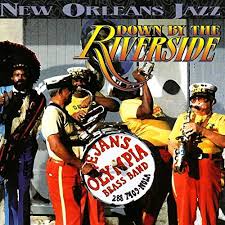
Harold Andrew Dejan was born on February 4, 1909 into a Creole family in New Orleans, Louisiana and took clarinet lessons as a child before switching to the saxophone. He became a professional musician in his teens, joining the Olympia Serenaders and then the Holy Ghost Brass Band.
He played regularly in Storyville, at Mahogany Hall, and on Mississippi riverboats. He also worked in the mail office of the Lykes Brothers Steamship Company for 23 years. In World War II, he played in Navy bands, then returning to his day job and his parallel musical career after the war, he led his own band, Dejan’s Olympia Brass Band, from 1951, was considered one of the top bands in New Orleans.
The band often appeared at Preservation Hall, recorded nine albums, and also toured internationally, making 30 concert tours of Europe and one of Africa. It was featured in the James Bond movie Live and Let Die, and as well as in many TV commercials.
Suffering a stroke in 1991 left him unable to play the saxophone, but he continued as a band leader and singer until shortly before his death. Alto saxophonist and bandleader Harold Dejan, known affectionately as Duke, passed away on July 5, 2002 in New Orleans.

More Posts: bandleader,history,instrumental,jazz,music,saxophone
Daily Dose Of Jazz…
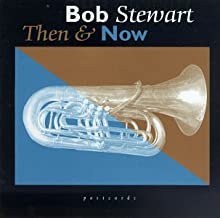
Bob Stewart was born in Sioux Falls, South Dakota on February 3, 1945. He received his Bachelor of Music Education degree from the Philadelphia College of the Performing Arts and his master’s degree in education from Lehman College Graduate School.
Stewart taught music in Pennsylvania public schools and at the Fiorello H. LaGuardia High School of Music & Art and Performing Arts in New York City. He is now a professor at the Juilliard School and is a distinguished lecturer at Lehman College.
Stewart has toured and recorded with such artists as Charles Mingus, Gil Evans, Carla Bley, Muhal Richard Abrams, David Murray, Taj Mahal, Dizzy Gillespie, McCoy Tyner, Freddie Hubbard, Don Cherry, Nicholas Payton, Wynton Marsalis, Charlie Haden, Lester Bowie, Bill Frisell and many others in the United States, Europe, and Eastern Asia.
He was a frequent collaborator with saxophonist Arthur Blythe from the 1970s into the early 2000s, often taking the place of the string bass that traditionally supports a jazz ensemble. In their review of Blythe’s album Lenox Avenue Breakdown, the editors of The Penguin Guide to Jazz called Stewart’s title track solo “one of the few genuinely important tuba statements in jazz. Tubist Bob Stewart continues to be a part of the jazz scene.
More Posts: bandleader,history,instrumental,jazz,music,tuba
Daily Dose Of Jazz…
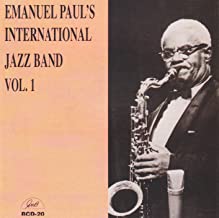
Emanuel Paul was born on February 2, 1904 in New Orleans, Louisiana. He did not begin playing music until late in his youth, picking up the violin at age 18 and then switched to banjo. In the middle of the 1920s he settled on the tenor saxophone, where his instrument often substituted for the baritone horn in a brass band.
Becoming a member of the Eureka Brass Band in 1940 and remained with them into the 1960s; he also played often with Kid Thomas Valentine from 1942 and recorded with Oscar Celestin, Emanuel Sayles, and the Olympia Brass Band. He led three recording sessions for the European Jazz Macon label in 1967. His sidemen on these records include Valentine, George Lewis, and Butch Thompson.
Tenor saxophonist Emanuel Paul, who was one of the first tenor saxophonists to hold regular work in the New Orleans jazz scene, passed away on May 23, 1988 in New Orleans.
More Posts: bandleader,history,instrumental,jazz,music,saxophone
Daily Dose Of Jazz…
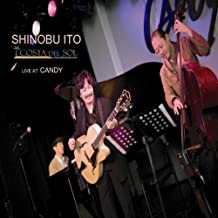
Shinobu Ito was born in Oiso, Kanagawa, Japan on January 28, 1951. While a young boy, his interest was in American pop songs, so his father bought him a guitar and gave him lessons. Devoting great efforts to his study of the guitar, in junior high school he organized his own pop music group and performed at various musical events. He became interested in jazz guitar during his high school days when he listened to Wes Montgomery. While attending Tokai University, he studied guitar with Ikuo Shiosaki, and became a member of the university’s Jazz Workshop.
He began his professional career at this time, performing at clubs and on recordings. In 1975, during a 6-month stay in Los Angeles, California he met Toshiko Akiyoshi, who introduced him to many musicians and strongly suggested to him that he go to New York to learn and play jazz on his next visit to the States.
When he returned to Japan in 1975, Shinobu joined vocalist Yoshiko Kimura’s group, and also resumed activities with top Japanese musicians such as Kohsuke Mine, Seiichi Nakamura, Shigeharu Mukai, Hidefumi Toki and Takao Uematsu. He also performed with Tete Montliu, Bill Reichenbach, Ronnie Foster, Stanley Banks in this era.
Back in New York City again in 1977 he became a member of a 10-piece band directed by Reggie Workman, joined Teruo Nakamura & his Rising Sun Band and Shinobu appeared on pianist Tsuyoshi Yamamoto’s album in 1981. Once settled he performed and recorded with Joe Jones Jr., Sadik Hakim, John Orr, Tommy Turrentine, Bob Mintzer, Rickey Ford and Kenny Kirkland, Valery Ponomarev, Lonnie Plaxico, Eddie Henderson, Lonnie Smith, Jesse Davis, Kenny Davis and Jeff Williams, Mike Formanek, Vincent Herring and Judy Niemack among others.
Shinobu released his first CD in 1991 with Tom Harrell, Danny Gottlieb, Gary King, Mark Soskin and Dick Oates. While Shinobu is known as a jazz guitarist who plays with a pick, he also plays only with his fingers, and his improvisations effectively fuse classical guitar and jazz.
As an educator he has worked as an instructor in the Jazz Division of the Senzoku College of Music in Tokyo, Japan. Returning to New York City in 2009 guitarist Shinobu Ito resumed performing and recording and continues to explore new directions.
More Posts: bandleader,history,instrumental,jazz,music,saxophone

Daily Dose Of Jazz…
Teddy McRae was born in Waycross, Georgia on January 22, 1908 but was raised in Philadelphia, Pennsylvania. Playing with local ensembles, including one composed of family members, when he was young. He played with June Clark in 1926 before his move to New York City to form his own band.
Through the Thirties he played with Charlie Johnson, Elmer Snowden, Stuff Smith, Lil Armstrong, and Chick Webb, the last as both a soloist and arranger. After Webb’s death he was musical director for the orchestra during its tenure under the leadership of Ella Fitzgerald from 1939 to 1941. He recorded in the decade with Benny Morton, Teddy Wilson, and Red Allen.
In the 1940s McRae worked in the orchestras of Cab Calloway, Jimmie Lunceford, Lionel Hampton, and Louis Armstrong; he also served as Armstrong’s musical director during his period with that band. He wrote tunes for Artie Shaw and formed his own band in 1945.
He and Eddie Wilcox formed their own short~lived R&B label, Raecox, in the 1950s. Teddy recorded with Champion Jack Dupree in 1955-56, and recorded a few sides for Groove Records in 1955 and Moonshine Records in 1958.
Tenor saxophonist and arranger Teddy McRae, who was also known as Teddy (Mr. Bear) McRae, or simply as Mr. Bear, passed away on March 4, 1999.
More Posts: arranger,bandleader,history,jazz,music,saxophone