

Daily Dose Of Jazz…
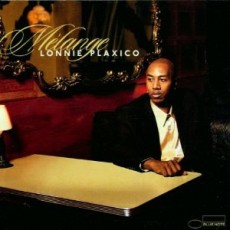
Lonnie Plaxico was born on September 4, 1960 in Chicago, Illinois and started playing the bass at age twelve. He turned professional at 14 playing both double bass and bass guitar. His first recording was with his family’s band, and by the time he was twenty he had moved to New York City, where he had stints playing with Chet Baker, Dexter Gordon, Sonny Stitt, Junior Cook, and Hank Jones..
In 1978 he won the Louis Armstrong Jazz Award but first came to public attention through his work with the Wynton Marsalis group in 1982. Lonnie’s first regular attachment was with Art Blakey‘s Jazz Messengers from 1983–1986, with whom he recorded twelve albums. At the end of his work relationship with Blakey he joined Jack DeJohnette’s Special Edition, and stayed with them until 1993. During his tenure with Blakey, in the mid-1980s he joined the M-Base collective and played on the debut-releases of Steve Coleman, Cassandra Wilson, and Greg Osby
Plaxico held the musical director and featured bassist position for Cassandra Wilson for fifteen years and has performed and recorded with a wide range of artists, including Dizzy Gillespie, David Murray, Alice Coltrane, Stanley Turrentine, Andrew Hill, Joe Sample, Abbey Lincoln, Bill Cosby, Lonnie Liston Smith, Ravi Coltrane, Scott Tixier, Barbara Dennerlein, Helen Sung and Nina Vidal, among others.
Double bassist Lonnie Plaxico has thirteen albums to his credit as a leader and continues to perform and record.
More Posts: bass
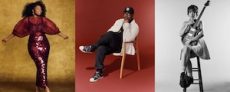
SAMARA JOY, CHRISTIAN MCBRIDE, MEI SEMONES & FRIENDS
Samara Joy and Christian McBride Celebrate Verve’s 70th Anniversary & Mei Semones & Friends play the music of Getz/Gilberto | Sparklmami delivers a DJ set. Presented by the Mayor’s Office of Media & Entertainment.
Performers for this celebration of the label’s 70th anniversary include Samara Joy, a six-time GRAMMY winner and Bronx native, and Christian McBride, a world-class bassist and bandleader, a Juilliard graduate and 11-time GRAMMY winner who has recorded with legends of both the jazz (McCoy Tyner, Herbie Hancock, Chick Corea, Wynton Marsalis, Eddie Palmieri, and more) and pop (Sting, Paul McCartney, Celine Dion) spheres. Also, Mei Semones, an American indie rock musician who writes jazz-influenced songs in both English and Japanese, has invited her own crew of friends including aron!, Liana Flores, and John Roseboro to perform music from Getz/Gilberto, the classic collaborative album by João Gilberto and Stan Getz released on Verve in 1964. Sparklmami will begin the show with a DJ set.
Tickets: Free
More Posts: adventure,bandleader,bass,genius,guitar,instrumental,jazz,music,preserving,travel,vocal
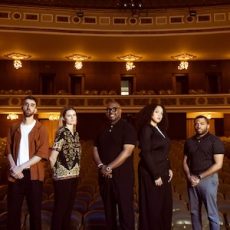
CHRISTIAN MCBRIDE’S URSA MAJOR
Bassist and composer Christian McBride’s most recent project is a quintet showcasing several of the most exciting young players on the scene. Returning to the Miner Auditorium stage for two nights, the cast features tenor saxophonist Nicole Glover, who has toured with Wynton Marsalis and Jazz at Lincoln Center Orchestra, performed with veteran masters such as drummer Al Foster, vocalist Dee Dee Bridgewater, and bassist Reggie Workman, and recorded with pianist Aaron Diehl’s Grammy-nominated 2023 Mary Lou Williams project Zodiac Suite.
Ely Perlman is an exciting young guitarist who has collaborated with Terreon Gully and Braxton Cook, and Chicago pianist Mike King has been touring with Dee Dee Bridgewater, and trumpeters Marquis Hill, Theo Croker, and Marcus Printup. Powering the band is Oakland native Savannah Harris, a remarkably poised young drummer who has made a major impact with the likes of vocalist Cécile McLorin Salvant, Kenny Barron, and Immanuel Wilkins.
Tickets: $40.00 ~ $125.00
More Posts: adventure,bandleader,bass,drums,genius,guitar,jazz,music,piano,preserving,saxophone,travel
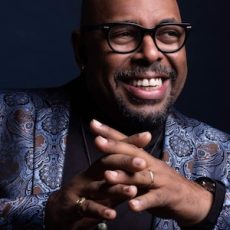
CHRISTIAN MCBRIDE TRIO
Bass genius Christian McBride honors his mentor and greatest inspiration, the legendary Ray Brown, with an all-star trio of Ray Brown Trio alumni — pianist Benny Green and drummer Gregory Hutchinson.
A major figure in the development of bebop and hard bop in the 40s and 50s, Brown was among the most prolific and versatile bassists in jazz history who gained fame through his notable associations with Oscar Peterson, Ella Fitzgerald, and Dizzy Gillespie.
He led a series of remarkable trios in the 1990s and 2000s featuring Green and Hutchinson, whose recordings for the Telarc label stand as benchmarks for the time-honored format.
In addition to his own lengthy histories with both Green and Hutchinson, McBride appeared on Brown’s live 1997 bass summit release SuperBass and 2001 follow-up SuperBass 2 (along with fellow legend John Clayton). He pays tribute to the master with this special performance.
Cover: $45.00 ~ $135.00
More Posts: adventure,bandleader,bass,club,drums,genius,instrumental,jazz,music,piano,preserving,travel
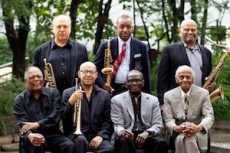
THE COOKERS
The Cookers take their name from Night of the Cookers, the famous 1965 recorded trumpet summit between Lee Morgan and Freddie Hubbard at Brooklyn’s Club La Marchal. Formed by trumpeter and organizer David Weiss, the group brings together some of the most storied musicians in jazz, players who came up in the 1960s and 70s working alongside the very architects of the music.
Drummer Billy Hart and trumpeter Eddie Henderson were both members of Herbie Hancock’s groundbreaking Mwandishi group. Bassist Cecil McBee anchored Charles Lloyd’s celebrated quartet alongside Keith Jarrett and Jack DeJohnette. Pianist George Cables held the piano chair in bands led by Sonny Rollins, Joe Henderson, Freddie Hubbard, Dexter Gordon, and Art Pepper. Saxophonist Donald Harrison, a recently named NEA Jazz Master, came up performing with Art Blakey, Roy Haynes, and Herbie Hancock.
Together these musicians have contributed to well over a thousand recordings across the history of jazz, and the chemistry between them, forged over decades of shared history on bandstands around the world, is unmistakable. Critics have praised The Cookers for embodying the serious commitment it took to thrive on the New York jazz scene of decades past, and audiences consistently describe their live performances as electrifying, a rare opportunity to witness musicians who don’t simply play the music, but live inside of it. This is a true once in a lifetime chance to experience some of the last living architects of modern jazz in an intimate room.
The Side Door Jazz Club is a dedicated jazz listening room located inside the historic Old Lyme Inn, 85 Lyme Street, Old Lyme, CT. Tickets are reserved seating. Guests dining at the Old Lyme Inn prior to the show receive 10% off their dinner bill.
The Band:
Eddie Henderson – Trumpet
David Weiss – Trumpet
Donald Harrison – Alto Saxophone
Azar Lawrence – Tenor Saxophone
George Cables – Piano
Cecil McBee – Bass
Billy Hart – Drums
Cover: $38.57
More Posts: adventure,bandleader,bass,club,drums,genius,instrumental,jazz,music,piano,preserving,saxophone,travel,trumpet