

Requisites
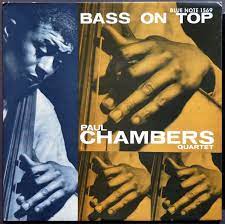
Bass on Top ~ Paul Chambers Quartet | By Eddie Carter
I was in the mood to hear something soothing before going to bed a few nights ago. The record I chose to play inspired my first March discussion by one of the great jazz bassists, Paul Chambers. Bass on Top (Blue Note BLP 1569/BST 81569) by The Paul Chambers Quartet is a 1957 release and his second record for the label. It was one of my mom’s favorite albums to listen to when she was cooking dinner. She always loved his big and warm sound, and his playing always knocked me out whenever I heard him. He is joined on this date by a marvelous rhythm section: Kenny Burrell on guitar, Hank Jones on piano, and Art Taylor on drums. My copy is the 2021 Blue Note Tone Poet Series Stereo Audiophile reissue, sharing the original catalog number.
Side One gets underway with Paul and Kenny’s two-instrument introduction to Yesterdays by Walter Gross and Jack Lawrence. Hank and Art come in to pick up the pace to deliver the alluring melody. The standard’s only solo is a thoughtful, reflective showcase by Paul, complemented by Hank, Kenny, and Art’s delicate accompaniment leading to the gentle ending. You’d Be So Nice To Come Home To by Cole Porter brings the beat up a few notches for the bassist’s introduction, segueing into his stating the melody supported by his colleagues. Chambers starts it off with an easy swinging interpretation, then gives way to Burrell’s unhurried statement. Jones brings on the pleasant finale before the leader’s return for the reprise and conclusion.
Chasin’ The Bird by Charlie Parker affords everyone a solo opportunity and begins with Kenny’s introduction to the group’s medium melody. Paul takes the lead with a lightly swinging solo, then Hank follows with a splendid statement. Kenny comes in next for a thoroughly satisfying reading, and Art cooks comfortably in the closer, preceding the theme’s return. Dear Old Stockholm is a Swedish folk song and jazz standard that receives a medium groove by the quartet. Kenny makes the introduction, and the ensemble joins in for the opening chorus. Chambers is up first and gives a soothing interpretation. Burrell follows with a sensitive and delicate performance; then, Jones wraps up the readings with a delightfully pleasant statement until the quartet regroups for the close.
The Theme ended many of Miles Davis’ live sets. The group opens with Kenny and Paul’s introduction to their lively melody. Paul swings right out of the gate in the opening solo. Kenny follows, maintaining the infectious beat in a vibrant statement. Hank comes in and builds the next reading exquisitely; then, Art shares the finale with Paul ahead of the climax. Confessin’, aka I’m Confessin’ That I Love You by Doc Daugherty, Ellis Reynolds and Al Neiburg begins with Paul’s introduction ahead of the foursome’s lovely opening chorus. Chambers handles the first of two interpretations flawlessly with excellent taste. Jones follows with a short solo as pleasant as a Sunday evening stroll. Chambers returns to give a brief statement that brings the set to a fitting climax.
Alfred Lion produced the original session, and Rudy Van Gelder was the man behind the dials of the recording. Joe Harley supervised this reissue’s release, and Kevin Gray mastered it. The sound quality is superb, with a breathtaking soundstage. A lot of thought and care went into the remastering of this audiophile reissue. The record is pressed on 180 grams of audiophile vinyl and is incredibly quiet until the music starts. The covers could be displayed at home on any wall, and the inside gatefold photos are wonderful. Every once in a while, something magical happens in a recording session where all the musicians come together in such a way that perfection is the result. Bass on Top by Paul Chambers is one of those albums.
Paul Chambers and his bandmates compel you to listen as they’re playing and, as the album unfolds, they provide the perfect backdrop to help you unwind after a long day, night, or week. If you’re new to jazz or only know of his work as a sideman with The Miles Davis Quintet and others. In that case, I happily recommend and invite you to check out Bass on Top by The Paul Chambers Quartet the next time you’re out record shopping. It’s a stellar album of soulful, swinging jazz at its best and a title you won’t have to listen to twice to know you love it!
~ I’m Confessin’ That I Love You, Yesterdays, You’d Be So Nice To Come Home To – Source: JazzStandards.com
~ Chasin’ The Bird, Dear Old Stockholm – Source: Wikipedia.org
© 2024 by Edward Thomas Carter

More Posts: bass,choice,classic,collectible,collector,history,instrumental,jazz,music

Jazz Poems
SNAKE-BLACK SOLO For Louis Armstrong, Steve Cannon, Miles Davis & Eugene Redmond with the music up high boogaloo bass down way way low up & under eye come slidin on in mojoin on in spacin on in on a riff full of rain riffin on in full of rain & pain spacin on in on a sound like coltrane my metaphor is a blues hot pain dealin blues is a blues axin guitar voices whiskey broken niggah deep in the heart is a blues in a glass filled with rain is a blues in the dark slurred voices of straight bourbon is a blues dagger stuck off in the heart of night moanin blike bessie smith is a blues filling up the wings of darkness is a blues & looking through the heart a dream can become a raindrop window to see through can become a window to see through this moment to see yourself hanging around the dark to see through can become a river catching rain feeding time can become a window to see through Quincy Troupefrom Jazz Poems ~ Selected and Edited by Kevin Young

More Posts: book,classic,collectible,history,jazz,library,poet
Requisites
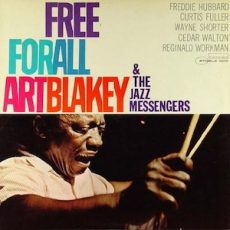
Free For All ~ Art Blakey and The Jazz Messengers | By Eddie Carter
A few years ago, in a discussion of Miles Davis at Carnegie Hall, I stated that every record collector has a few titles in their library that mean the world to them. Free For All (Blue Note BLP 4170/BST 84170) by Art Blakey and The Jazz Messengers is one of those for me. I’ve listened to it countless times over the years whenever I was down or feeling sad, and it always makes me happy. Art Blakey was not only one of the most energetic drummers in jazz but also the leader of one of the best ensembles for over three decades. His group on this date had been together for three years: Freddie Hubbard on trumpet, Curtis Fuller on trombone, Wayne Shorter on tenor sax, Cedar Walton on piano, and Reginald Workman on bass. Free For All initially hit the stores in 1965, and my copy is the 1984 Pathé Marconi French Stereo reissue, sharing the original catalog number.
The title tune, Free For All by Wayne Shorter, starts briskly with the rhythm section’s introduction to the sextet’s aggressive theme. Wayne is up first and swings fiercely in a heated interpretation; then Curtis follows with a vigorously energetic solo. Lee takes over to give a high-octane reading, and Art adds an explosively swinging finale preceding the group’s rousing climax. Wayne Shorter’s Hammer Head slows the beat down to mid-tempo for the ensemble’s leisurely-paced melody. Shorter starts things off with a relaxing interpretation, and then Hubbard treats the listener to an exquisitely beautiful solo. Fuller follows with an excellent reading next, and Walton has the final say before the sextet returns to take the song out.
The Core by Freddie Hubbard is his tribute to the organization CORE (Congress of Racial Equality). It opens with the trio’s introduction ahead of the ensemble’s spirited melody. Wayne launches the first solo like a rocket soaring skyward. Freddie turns up the heat next; then Curtis seamlessly weaves his way through the third interpretation like a flow of electricity. Cedar offers the final adrenaline rush into the sextet’s theme reprise and the trio’s fadeout. Clare Fisher’s Pensativa is a beautiful ballad that Freddie arranged for this date. The group begins in a relaxed groove, setting the stage for Hubbard’s gorgeous opening solo. Shorter expresses so many feelings in the second statement; then Walton’s reading is a delight to hear until the theme returns and the rhythm section dissolves slowly into nothingness.
Alfred Lion produced Free For All, and Rudy Van Gelder was the recording engineer. The front cover displays a Mono catalog number, but this album is a Stereo release. The sound quality on this Pathé Marconi reissue has an amazing soundstage that brings the sextet to your listening room with stunning fidelity. Art Blakey worked with some of the best musicians during his lifetime, and The Jazz Messengers were the springboard for dozens of careers. He was one of the great teachers, and the music his groups made still brings pleasure to jazz fans worldwide. If you’re in the mood for an album that still sounds as fresh as the day it was released, I invite you to check out Free For All by Art Blakey and The Jazz Messengers the next time you’re out record shopping. It’s a great starting point to explore their comprehensive discography and an album filled with energy and fire that’s as good as it gets for those who enjoy hard bop!
~ Miles Davis at Carnegie Hall (Columbia CL 1612/CS 8612) – Source: Discogs.com © 2024 by Edward Thomas Carter
More Posts: choice,classic,collectible,collector,drums,history,instrumental,jazz,music

Jazz Poems
THE BLUES OF THIS DAY The blues of this day are as elegant and as sad as the minor thirds and we all try to sing it. What we want is to be brass The horn-scratched voice blown through. Valves as golden as his. Lord as crazy sex or first real heartbreak. It was always his back slightly bent away from all of us who adored him, gazing across his shoulders as the band jumped into the party one solo at a ti Or they could be rocking way off-ke going as far away from the melody as Venus to Mars. Funk can be as easy as t getting together in the dark. And as hard as the breaking light that catches the throat of sated lovers, the morning after. The talk the night before by the last of his men who knew the way of the world and then some, about Miles and his two steps ahead of the century like the first Black man to leave the Delta humming I gotta go, but I can’t take you. I gotta go, but I can’t take you. If you want to follow, then do what you want to do. Patricia Spears Jonesfrom Jazz Poems ~ Selected and Edited by Kevin Young
More Posts: book,classic,collectible,history,jazz,library,poet
Requisites
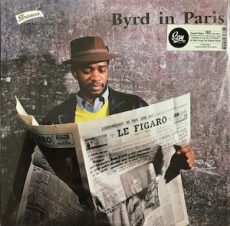
Byrd in Paris, Volume 1 ~ The Donald Byrd Quintet Featuring Bobby Jaspar | By Eddie Carter
The Donald Byrd Quintet enters this morning’s spotlight with Byrd in Paris, Volume 1 (Brunswick 87 903), the first of two albums taken from the group’s 1958 appearance at The Olympia Theatre. Its companion release is Parisian Thoroughfare, and both were recorded at the conclusion of the quintet’s tour to Europe. Byrd in Paris was initially a French release in 1958 and would make its way to the U.S. two years later. The personnel is Donald Byrd (tracks: A1, A2, B3) on trumpet, Bobby Jaspar on flute (B1) and tenor sax (A1, A2, B3), Walter Davis Jr. on piano, Doug Watkins on double bass, and Art Taylor (A1, A2, B2, B3) on drums. My copy is the 2014 Sam Records French Mono audiophile reissue, sharing the original catalog number.
The set opens with Dear Old Stockholm, and as the song begins, Donald is off in the distance behind the quintet. He brings the horn into the forefront as he walks to the microphone, and the ensemble completes the melody. Bobby opens with a marvelous first solo. Donald is equally loose and free in the following reading. Doug offers one of the song’s best musical moments in the closing statement preceding the theme’s reprise and finale. Donald introduces Paul’s Pal by Sonny Rollins next and all the remaining tunes. The group begins with a mid-tempo melody. Bobby starts the solos with an easygoing statement. Donald follows with a neatly paced reading, and then Walter greets the finale like an old friend before the group takes it out.
Side Two gets underway with Bobby Jaspar on flute for his tune, Flute Blues. Bobby and Doug introduce the song’s first chorus with a two-instrument conversation before Walter joins them. Bobby dives into the opening statement with a consummate feeling. Doug finds a few new things to say in the second solo, and then Bobby and Doug are in complete agreement in the closing interpretation, leading back to the theme. The spotlight is on the rhythm section in Ray’s Idea by Ray Brown. Donald and Bobby sit this one out, and the trio works in perfect balance on the song’s speedy melody. Walter is the first to solo and puts the piano through a vigorous workout, then he and Art share an energetic exchange into the theme’s reprise, climax and audience’s approval.
The Blues Walk by Sonny Stitt is off and running from the ensemble’s theme. Donald opens at a blistering pace; then Bobby continues blowing up a storm. Walter communicates his ideas confidently next, and then Doug makes a few quick remarks. Art generates considerable heat in an aggressive conversation with Donald and Bobby, leading to the song’s climax and a huge ovation from the audience. Bruno Coquatrix produced the original session, and the reissue was remastered from the original tapes. This Sam Records audiophile reissue was also pressed at Pallas in Germany on 180 grams of audiophile vinyl, and the front and rear covers are sturdy. The album possesses an excellent soundstage, placing the listener in the audience. Also included is an additional insert with a photo of Donald Byrd.
I thoroughly enjoyed listening to Byrd in Paris, Volume 1. After hearing this Sam Records reissue, I’m going to revisit a few other titles I have in the library and feature them in future columns. If you’re in the mood for a live hard bop album with great tunes and tight musicianship. I invite you to consider Byrd in Paris, Volume 1 by The Donald Byrd Quintet Featuring Bobby Jaspar, on your next record treasure hunt. It’s a wonderful live album that still sounds great over six decades later and shouldn’t be missed for a spot in any jazz library!
~ Parisian Thoroughfare (Brunswick 87 904) – Source: Discogs.com ~ Dear Old Stockholm – Source: Wikipedia.org © 2024 by Edward Thomas Carter
More Posts: choice,classic,collectible,collector,history,instrumental,jazz,music,trumpet