

Daily Dose Of Jazz…
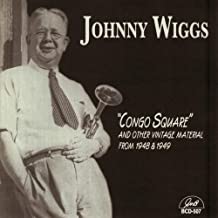
Johnny Wiggs, was born John Wigginton Hyman on July 25, 1899 in New Orleans, Louisiana. He started his music career on the violin but soon adopted the cornet. His main stylistic influences were Bix Beiderbecke and King Oliver, who Wiggs insisted did his best work in New Orleans in the years before he moved up North to New York City and was recorded.
Returning to New Orleans in the late 1920s, he took a job as a teacher in Louisiana and at night played in New Orleans jazz clubs. During this period in his life, he made his first recordings as John Hyman’s Bayou Stompers.
In the 1940s he returned to being a full-time musician, leading several bands and recording many songs. He used the pseudonym Johnny Wiggs, as jazz was still looked down on in some circles. He went on to be an important figure in the local traditional jazz revival.
The 1960s saw Wiggs performing part-time, remaining active until the Seventies. He mentored George Finola and Pete Fountain was one of his more famous pupils. He helped found the New Orleans Jazz Club and was a force behind the jazz revival in the 1940s.
Cornetist and bandleader Johnny Wiggs passed away on October 10, 1977 in his hometown of New Orleans.

More Posts: bandleader,cornet,history,instrumental,jazz,music

Daily Dose Of Jazz…
Alex Welsh was born on July 9, 1929 in Edinburgh, Scotland, Welsh and started playing in the teenage Leith Silver Band and with Archie Semple’s Capital Jazz Band. After a move to London in the early 1950s, he formed a band with clarinetist Archie Semple, pianist Fred Hunt, trombonist Roy Crimmins, and drummer Lenny Hastings. The band played a version of Chicago-style Dixieland jazz and was part of the traditional jazz revival in England in the 1950s.
In the 1960s, Welsh’s band played with Earl Hines, Red Allen, Peanuts Hucko, Pee Wee Russell, and Ruby Braff. During that period and into the early 1970s, Welsh frequently toured, including many visits to the United States. Influenced by his fellow trad jazz bandleader Chris Barber, he built up an extensive musical repertoire, working from popular music, jazz, and a large mainstream following for ensembles.
Welsh recorded under the Decca Record label from 1955 and had four records released that year, I’ll Build A Stairway To Paradise, Blues My Naughtie Sweetie Gives To Me, and What Can I Say After I Say I’m Sorry, and Dixielanders. Although none of these recordings charted, he found some success with the single Tansy from the film No My Darling Daughter.
In 1963 he was part of the biggest trad jazz event in Britain and would go on to tour internationally, playing festivals on both the American and European continents. He was a regular in the early 1970s, playing clubs around London and having continued success as a vocalist and playing Dixieland, and trad jazz. Singer, bandleader, cornetist, and trumpeter Alex Welsh passed away on June 25, 1982 in Hillingdon Hospital in London, England, at the age of 52.
More Posts: bandleader,cornet,history,instrumental,jazz,music,trumpet,vocal
Daily Dose Of Jazz…
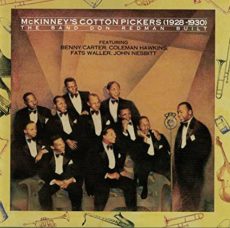
Joe “Fox” Smith was born Joseph Emory Smith on June 28, 1902 in Ripley, Ohio into a family of musicians. His father was a bandleader and his six brothers played trumpet or trombone.
Known throughout his childhood as “Toots”, he originally started as a drummer but was convinced by Ethel Waters that he was a far better trumpeter. By the time he reached New York in 1920, he had his own style, which achieved “the vocalized sound, the blues spirit, and the swing.
In 1921, Smith joined the Black Swan Jazz Masters in Chicago, Illinois directed at the time by Fletcher Henderson. He went on to work with the Jazz Hounds, the Broadway Syncopators, and finally with McKinney’s Cotton Pickers throughout the 1920s. He became famous from his work accompanying Bessie Smith, recording over 30 records. Some of the other artists he worked with include Billy Paige, Noble Sissle, Eubie Blake, and Allie Ross.
Trumpeter and cornetist Joe “Fox” Smith passed away from complications related to tuberculosis on December 2, 1937 in a Central Islip, New York asylum.

Daily Dose Of Jazz…
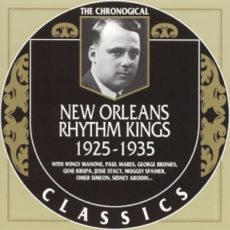
Paul Mares was born on June 15, 1900 in New Orleans, Louisiana and was self-taught on the cornet and trumpet and picked up his early experience laying the riverboat Capitol playing with the Tom Brown Band. Leaving his hometown in 1919 he moved to Chicago, Illinois and worked with Ragbaby Stevens before freelancing around the city.
In 1921 Paul formed the Friars Society Orchestra, a group that prominently featured trombonist George Brunies and clarinetist Leon Rappolo. From 1922-23, the band recorded for Gennett Records and became one of the best-regarded bands in the city. The band, which broke up in 1924, included up-and-coming jazz musicians, including the members of the Austin High School Gang and Bix Beiderbecke.
Mares who was influenced by King Oliver, played in New York for a short time, went back to New Orleans the following year and led a couple more sessions. In 1934, a move to Chicago the following year had him making a brief comeback and leading a recording session that resulted in four titles before he retired again.
By 1935 Mares he was playing trumpet and fronting a recording session with his band called Paul Mares and his Friars Society Orchestra. The name referred to the Friar’s Inn club where the Rhythm Kings had first played in Chicago. The 1935 band included the white New Orleanian and N.O.R.K. veteran Santo Pecora on trombone, the black New Orleanian Omar Simeon on clarinet and the Chicagoan altoist Boyce Brown, as well as George Wettling on drums, pianist Jess Stacey, bassist Pat Pattison, and guitarist Marvin Saxbe.
He then largely retired from playing to work in the family fur business, and the New Orleans Rhythm Kings passed into history. He ran a barbeque restaurant, did defense plant work during World War II, and returned to music in 1945, leading a final band from 1945-48 that unfortunately never recorded. Cornetist and trumpeter Paul Mares passed away on August 18, 1949 in Chicago.
More Posts: bandleader,cornet,history,instrumental,jazz,music,trumpet

Daily Dose Of Jazz…
Digby Fairweather was born Richard John Charles Fairweather in Rochford, Essex, England on April 25, 1946. Before becoming a professional musician, he was a librarian, which embarked him on a lifetime interest in jazz bibliography and archiving.
In 1971 he led his first band, Dig’s Half Dozen, and recorded in 1973 with Alex Welsh. Four years later he was a member of the band Velvet with Ike Isaacs, Len Skeat, and Denny Wright, then a member of the Midnite Follies Orchestra and the Pizza Express All-Stars.
The early 1980s saw Fairweather starting a band that performed music by Nat Gonella. He worked as a sideman for George Chisholm, Alex Welsh, Tiny Winters, and Brian Priestley. Through the 1980s and ’90s he led the Jazz Superkings, the Great British Jazz Band, and the Half Dozen.
From 1992 to 1998 he pursued a parallel career as a broadcaster on BBC Radio and Jazz FM, occasionally deputizing Humphrey Lyttelton on his show Best of Jazz and successively presenting Jazz Parade and Jazz Notes. He was also part of the Salute to Satchmo.
Fairweather and Stan Barker started the Jazz College charity to introduce improvisation in schools. He established the Association of British Jazz Musicians and the National Jazz Foundation Archive. He wrote Jazz: The Essential Companion in 1987 with Brian Priestly and Ian Carr. In 2000 it was renamed The Rough Guide to Jazz.
Digby’s Half Dozen toured and recorded with singer George Melly, and in the later years of his career from 2003 to 2007. Apart from his playing and group leading, Fairweather wrote the book How to Play Trumpet. In 2016, founded The Jazz Centre (UK), a charity whose aim is to promote, preserve and celebrate the culture of jazz in all its forms.
Cornetist, author, and broadcaster Digby Fairweather, who has recorded nineteen albums as a leader, published four books and has received several awards for jazz, continues his career as a musician.

More Posts: author,bandleader,broadcaster,cornet,history,instrumental,jazz,music