

Requisites
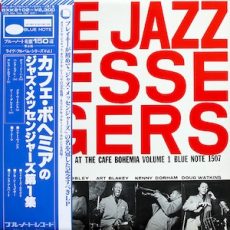
The Jazz Messengers at The Café Bohemia, Volume 1 | By Eddie Carter
The year 1955 was a remarkable one for Art Blakey, following his group’s performance at Birdland the previous year, which resulted in A Night at Birdland, Volumes 1, 2, and 3. All three releases were a triumph for the drummer, allowing him to establish a lasting band, The Jazz Messengers, which he co-led with Horace Silver. The inaugural lineup showcased some of the era’s brightest rising stars. Kenny Dorham on trumpet, Hank Mobley on tenor saxophone, Horace Silver on piano, and Doug Watkins on bass. The Jazz Messengers at The Café Bohemia, Volume 1 (Blue Note BLP 1507) documents the quintet’s performance at the jazz club on November 23, 1955. The copy I own is the 1978 King Record Company Japanese mono reissue, sharing the original catalog number.
Art greets the audience at the opening of the set, letting them know they’re in for a memorable cooking session, then cheerfully introduces The Jazz Messengers to everyone in attendance. The quintet starts the set with Soft Winds by Benny Goodman and Fred Royal. The song opens smoothly, with the ensemble’s melody at a relaxed pace. Hank leads the way, confidently captivating the audience and delivering each note of the opening statement efficiently. Kenny follows with a charming performance of lively agility, then Horace brings the solos to a rousing finish, ahead of the theme’s restatement and conclusion.
Kenny Dorham not only played trumpet on this album, but he also arranged every song the group performed. The Theme ends the first side on a thrilling note, with Blakey launching the song with a dazzling introduction before the ensemble’s brisk opening chorus. Dorham leads the charge first with surgical precision, then Silver enters next, building on the excitement in a performance that swings with a happy lift. Mobley takes the baton and lays down a fiery groove of intense heat. Silver returns for a second spirited reading, then Blakey delivers a powerful closing statement before the group’s return for the reprise and climax.
The second side kicks off with Kenny Dorham’s Minor’s Holiday, maintaining the high-spirited energy set by the previous tune. Blakey’s vigorous introduction sets the stage for the ensemble’s speedy theme. Dorham is again the first soloist and really cooks, cleverly weaving in hints of Sing, Sing, Sing throughout his performance. Mobley steps up enthusiastically with an energetic reading next. Silver follows with an exhilarating interpretation that races through each line with intense drive. Dorham then trades spirited riffs with Blakey’s speedy workout, culminating in the theme’s reprise and an electrifying finish.
Alone Together, by Arthur Schwartz and Howard Dietz, is a showcase for Hank, who introduces the song and leads the rhythm section in the pensively beautiful melody. As the song’s only soloist, he delivers an enchanting performance of gentle sensitivity ahead of the quartet’s reprise and soft summation. Prince Albert by Kenny Dorham and Max Roach closes the album and opens with a relaxed, inviting ensemble melody. Kenny takes the lead and gives a captivating solo. Hank follows with an easygoing groove that’s velvety smooth. Both horns share a brief dialogue with Art before the theme’s return.
Rudy Van Gelder oversaw the recording duties for this album and the companion volume two, ensuring that those who couldn’t be present at The Café Bohemia that evening could still enjoy an extraordinary listening experience. The reissue’s sound quality is superb, with an exceptional soundstage transporting the listener to the club’s cozy, vibrant atmosphere. The Jazz Messengers at The Café Bohemia, Volume 1 stands as a testament to the quintet’s outstanding performance on that special night. Every solo is inspired, and for those eager to expand their musical tastes, I highly recommend this album as an excellent addition to any jazz enthusiast’s library!
~ A Night at Birdland, Volume 1 (Blue Note BLP 5037), A Night at Birdland, Volume 2 (Blue Note BLP 5038), A Night at Birdland, Volume 3 (Blue Note BLP 5039) – Source: Discogs.com ~ Alone Together – Source: JazzStandards.com © 2026 by Edward Thomas Carter
The Jazz Messengers At The Cafe Bohemia: 1955 | The Jazz Messengers For the serious collector of jazz… #Jazz #Classic #Collectible #Music #Notorious
More Posts: choice,classic,collectible,collector,drums,ensemble,history,instrumental,jazz,music
Daily Dose Of Jazz…
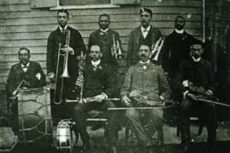
John Robichaux: The Forgotten King of New Orleans Dance Bands
Before there was Louis Armstrong, before jazz became the word on everyone’s lips, there was John Robichaux—a Creole musician born January 16, 1866, in Thibodaux, Louisiana, who quietly ruled New Orleans’ dance scene for nearly half a century.
A Multi-Instrumentalist’s Rise
Picture a young man learning brass bass, alto saxophone, and drums, then maturing into a 25-year-old bass drummer with the prestigious Excelsior Brass Band—one of New Orleans’ most respected musical institutions. But Robichaux wasn’t content to simply keep the beat. From 1892 to 1903, while still performing with the Excelsior, he was simultaneously leading his own ensembles and adding violin to his growing arsenal of instruments. The man believed in keeping busy.
The Bandleader New Orleans Trusted
Here’s what makes his story remarkable: Robichaux’s bands weren’t just popular—they were the bands to hire if you wanted class, precision, and professionalism. At one point in 1913, he was conducting a staggering 36-piece orchestra. Imagine coordinating that many musicians in the early 20th century, long before modern amplification or recording technology!
His reputation attracted New Orleans’ finest musicians—legends like guitarist Bud Scott, clarinetist Lorenzo Tio Jr., and cornetist Manuel Perez all played under his baton. When you could attract that caliber of talent, you weren’t just running a band—you were running an institution.
Forty-Six Years at the Top
For an astonishing 46 years, Robichaux was the most continuously active dance bandleader in New Orleans. Forty-six years! That’s longer than most entire careers, a testament to both his musical excellence and his business acumen in an incredibly competitive city.
When History Changed the Game
But history has a way of complicating even the greatest success stories. When Louisiana’s Black Code amendment passed in 1894, it reclassified Creoles of color, throwing Robichaux’s refined Creole orchestras into direct competition with the grittier Uptown Negro bands that played a rawer, more improvisational style. The musical landscape was shifting beneath his feet, gradually eroding the dominance he’d worked decades to build.
A Prolific Legacy
Still, Robichaux persisted with remarkable productivity. Over his career, he composed more than 350 songs and orchestral arrangements—a staggering output that speaks to both his creativity and work ethic. He remained primarily in New Orleans, occasionally touring with the traveling musical revue One Mo’ Time, but always returning to the city that made him.
The Bridge Between Eras
When John Robichaux died of natural causes in 1939, an entire era of New Orleans music died with him. He represents a crucial bridge between the city’s formal, European-influenced dance orchestras and the raw, revolutionary jazz that would soon conquer the world. His bands were where young musicians learned discipline, arrangement, and professionalism before they went off to create something entirely new.
History remembers the revolutionaries, but it often forgets the masters who created the foundation upon which revolutions are built. John Robichaux deserves better than footnote status—he deserves recognition as one of the architects of New Orleans’ musical golden age.
More Posts: bandleader,drums,violin
Daily Dose Of Jazz…
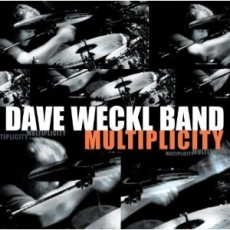
Dave Weckl: The Drummer Who Redefined Fusion
Born on January 8, 1960, in St. Charles, Missouri, Dave Weckl discovered his calling early. During his years at Francis Howell High School, he was already making heads turn behind the drum kit. His passion led him to the University of Bridgeport in Connecticut, where he immersed himself in jazz studies and refined the technical prowess that would soon make him one of the most sought-after drummers in the world.
Conquering the Big Apple
Fresh out of college, Weckl plunged into New York City’s electric fusion scene—and the city immediately took notice. His combination of precision, power, and musicality quickly caught the attention of major artists. Before long, he was laying down grooves for an eclectic mix of superstars: Paul Simon, Madonna, George Benson, Michel Camilo, Robert Plant, and bassist Anthony Jackson. Each collaboration showcased a different facet of his versatility.
The Chick Corea Years
Weckl’s profile skyrocketed when he joined forces with keyboard legend Chick Corea in 1985. Over the next seven years, he became an integral voice in both Corea’s groundbreaking Elektric Band and the more intimate Akoustic Band. These weren’t just gigs—they were masterclasses in contemporary jazz fusion that cemented Weckl’s reputation as a drummer’s drummer.
During this prolific period, Weckl somehow found time to maintain a busy session schedule, appear with the star-studded GRP All-Star Big Band, and record four albums with the Manhattan Jazz Quintet. His calendar was a testament to both his work ethic and his universal appeal.
Finding His Own Voice
After departing from Corea’s band in the early 1990s, Weckl embarked on new adventures—recording and touring with the brilliant guitarist Mike Stern while simultaneously launching his solo career. Since 1990, he has released ten albums as a leader, seven of them featuring his own Dave Weckl Band, each one pushing the boundaries of contemporary jazz and fusion.
Evolution and Education
Never content to rest on his laurels, Weckl has also shared his knowledge through a popular series of instructional videos that have influenced countless aspiring drummers. But perhaps his most dramatic transformation came around 1996, when his studies with the legendary teacher Freddie Gruber prompted a radical reimagining of both his playing style and drum setup—proof that even masters never stop learning.
Still Behind the Kit
Today, Dave Weckl continues to perform, record, and tour, bringing his distinctive blend of technical brilliance and musical sensitivity to audiences around the world. For anyone who loves the sound of perfectly executed rhythm married to genuine artistry, a Dave Weckl performance remains an essential experience.
More Posts: drums
JUSTICE MICHAEL
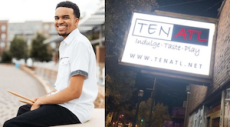
Drummer, producing and composing Justice Michael hits the stage with special guest Just grooving Band & DJ at TenAtl. Audiences are blown away by the rhythmic sounds that emit from this drummer, who makes his drum set seem like a natural extension of his limbs. Justice is known for his effortless deep pocket mixed with his own creative flare that hypnotizes the crowd. When he plays, it’s as simple as walking and talking to Justice.
Twenty two year old Justice graduated from the University of Miami’s Frost School of Music, with a Bachelor’s degree in Music. His major was Musicianship, Artistry Development, and Entrepreneurship (M.A.D.E.) with a minor in Music Business and Entertainment Industry.
He won Amateur Night at the Apollo on three separate occasions. Since then, Justice has been seen with his band, Anonymous DaBand, opening for jazz superstars such as Najee, Chrisette Michele, Pieces of a Dream, Bobby Caldwell, Lalah Hathaway and many more. With his growing experiences, Justice has become known in the drumming industry. He has performed at the 2024 Atlanta Jazz Festival and recently secured endorsements with Amedia Cymbals, and Prentice Practice Pads.
Cover: $15.00 ~ Early Bird Until 1.12 | $20.00 ~ Week Of Tickets
CashApp: $justicemmusic | Venmo: @justicemmusic
More Posts: adventure,bandleader,club,drums,genius,instrumental,jazz,music,preserving,travel
Daily Dose Of Jazz…
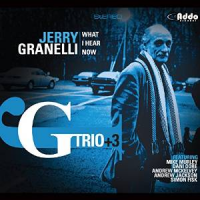
Jerry Granelli was born Gerald John Granelli on December 30, 1940 in the Mission District of San Francisco, California. Both his father and uncle played the drums and were passionate about jazz. He initially learned the violin for a year, before switching to drums. He spent a day with drummer Gene Krupa in 1948 and hanging out at the Blackhawk and Jimbo’s Bop City soaking in Ellington, Miles, Monk and Max Roach eventually led to him studying with Dave Brubeck drummer Joe Morello.
After two years with Morello he became a highly sought-after session player, Jerry eventually started playing, recording and touring with the Vince Guaraldi Band. He provides the unmistakable steady swing beats for the classic Charlie Brown “Peanuts” theme song.
In the Sixties he moved on to the Denny Zeitlin Trio with bassist Charlie Haden. A hugely successful recording and touring band, they tied with Miles Davis for Group of the Year in Downbeat magazine’s Critics and Readers Poll in 1965. Throughout the decade he performed with Jimmy Witherspoon, Mose Allison, Lou Rawls, John Handy, Sonny Stitt, Sly Stone, Ornette Coleman and Dewey Redman. His free-form improvisational trio held down the opening slot for comedian Lenny Bruce for three months in 1963, and shared bills with Jefferson Airplane, Big Brother and the Holding Company and the Grateful Dead.
From the mid-70s through the 90s he focused on teaching, first at the Naropa Institute in Boulder, Colorado and then Seattle Washington’s Cornish Institute, the Conservatory in Halifax, Nova Scotia and the Hochschule der Kunst in Berlin, Germany.
During the 80s he toured and recorded in a trio with Ralph Towner and Gary Peacock, and began recording his own projects. From the Nineties until his death, Granelli lived in Halifax and became a Canadian citizen in 1999. In 2010, he released his first solo album, 1313, toured jazz festivals and theaters with his show Tales of a Charlie Brown Christmas, which retold how the Charlie Brown Christmas TV special almost never came to be.
Suffering from a fall in December 2020 that resulted in internal bleeding, he spent three months recuperating in an intensive care unit before being discharged. He died seven months later at the age of 89 on the morning of July 20, 2021, at his home in Halifax.
More Posts: drums,history,instrumental,jazz,music