

Requisites
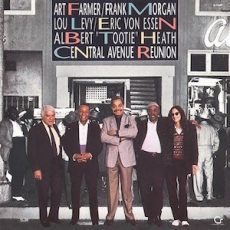
Central Avenue Reunion ~ Art Farmer, Frank Morgan, Lou Levy, Eric Von Essen, Albert “Tootie” Heath | By Eddie Carter
It’s wonderful to be back with you all after some time away to recuperate from two surgeries earlier this month. This morning’s album from the library, Central Avenue Reunion (Contemporary Records C-14057) spotlights two of my favorite artists, Art Farmer and Frank Morgan. Recorded live in 1989 over two memorable nights at Kimball’s East, it reunites Art Farmer on both flugelhorn (tracks: A2, A3, A4, B1) and trumpet (A1, B3), and Frank Morgan on alto saxophone (A1, A2, A4, B1 to B3). An outstanding rhythm section joins them: Lou Levy on piano, Eric Von Essen on bass, and Albert “Tootie” Heath on drums. I own the 1990 U.S. stereo release.
The set opens with Star Eyes by Gene De Paul and Don Raye. Art sets the solos in motion on muted trumpet, leading the group through the relaxing melody. Frank takes flight first with a spirited solo that’s crisp and precise. Art takes the second statement with smooth efficiency. Lou takes a cheerfully appealing turn, and Eric follows with a short walk towards the restatement of the theme. Farmer’s Market by Art Farmer takes off at a fast gallop for the quintet’s opening ensemble. Frank gets right down to business first, then Art sustains the momentum with passionate fire next. Lou follows with a vigorous statement, then all the soloists share a brisk exchange before the closing ensemble comes to a dead stop.
Art and the trio pay homage to George and Ira Gershwin with Embraceable You, opening with a gorgeous melody. Art begins with the first of two exceptionally gentle interpretations, showing off his sentimental side. Lou follows with a short solo filled with warmth and sensitivity. Art returns with a thoughtfully graceful reading, leading back to the soothing theme. Blue Minor by Sonny Clark brings the ensemble back for a medium-tempo melody. Frank sets the pace with a wailing opening statement. Art takes the wheel next and continues with a jubilant reading. Lou has the last word and neatly wraps up the solos before the theme returns.
I Remember You by Victor Schertzinger and Johnny Mercer begins with Lou’s lovely introduction, which segues into the quintet’s lively melody. Art is in top form first, with a good-hearted swing. Frank works out a few intriguing ideas next, then Lou’s piano flows like cool water in a relaxing river stream. Art and Frank share a brief conversation into the closing chorus. Don’t Blame Me by Jimmy McHugh and Dorothy Fields is a beautiful ballad from the thirties that begins elegantly, with Frank and the rhythm section’s melody moving like a couple’s Sunday evening stroll. He continues approaching the song’s only solo from the heart, anchored by the trio’s subtle support, into a gorgeous reprise and ending.
Sonny Clark’s Cool Struttin’ brings the set to a close with the ensemble’s collective midtempo theme, setting a good tone. Lou comes in first and skillfully navigates the rhythm section. Art takes the next spot on muted trumpet with carefree enthusiasm. Frank sparkles next with steady sureness, and Eric delivers a delightful finale before the group’s theme restatement earns the audience’s approval. Helen Keane produced Central Avenue Reunion. Danny Kopelson managed the recording console, and George Horn mastered the album. The sound quality is exceptional, placing the listener in the audience as the musicians perform.
If you’re searching for an exhilarating hard-bop live session to listen to after a long day, evening, or week, I invite you to join Art Farmer, Frank Morgan, Lou Levy, Eric Von Essen, and Albert “Tootie” Heath for a Central Avenue Reunion the next time you’re out record shopping. It’s a lively, spirited performance of standards and originals, with thoughtful arrangements and inspired solos that offers many hours of listening enjoyment and shouldn't be missed for a spot in your library!
~Donna Lee, Don’t Blame Me, Embraceable You, I Remember You, Star Eyes – Source: JazzStandards.com © 2026 by Edward Thomas Carter

More Posts: bass,choice,classic,collectible,collector,drums,fluegelhorn,history,instrumental,jazz,music,piano,saxophone,trumpet
JOBIM & THE MUSIC OF BRAZIL
In the 1960s, Antonio Carlos “Tom” Jobim brought the bossa nova craze to the United States, and this infectious and sensuous sound soon became beloved throughout the world. We celebrate Jobim’s centennial and the jazz genres of Brazil—including bossa nova, samba and choro with Shelly Berg and the Frost School of Music’s Henry Mancini Institute Orchestra.
Featured Special Guests:
Eliane Elias ~ Piano, Vocal
Anat Cohen ~ Clarinet
Trio da Paz ~ Guitar, Bass, Drums
Cover: $52.65 – $152.10 | Fees Included
More Posts: adventure,bandleader,bass,drums,genius,guitar,history,instrumental,jazz,music,piano,preserving,travel,vocal
Daily Dose Of Jazz…
Eddie Locke was born on August 2, 1930 and at a very young age the drummer became a part of the fertile and vibrant Detroit jazz scene during the 1940s and 1950s. This period spawned such great musicians including Hank, Thad and Elvin Jones, Kenny Burrell, Lucky Thompson, Tommy Flanagan, Barry Harris, among so many others.
He eventually formed a variety act with drummer Oliver Jackson called “Bop & Locke” which played the Apollo Theater. A move to New York City in 1954 had him working with Dick Wellstood, Tony Parenti, Red Allen, Willie “The Lion” Smith and Teddy Wilson, to name a few. During this time he came under the tutelage of the great Jo Jones, and eventually became known as a driving and swinging drummer who kept solid time and supported the soloist.
During the late 1950s Eddie formed two of his most fruitful musical relationships, one with Roy Eldridge and the other with Coleman Hawkins. His recording debut came with Eldridge in 1959 on “On The Town”, and he rounded out the Coleman Hawkins Quartet in the 1960s with band members Tommy Flanagan and Major Holley, that made many fine records including the exquisite album “Today and Now” in 1963.
Throughout the 1970s, he played with Roy Eldridge’s band at Jimmy Ryan’s on 54th Street, wound out his career freelancing, teaching youngsters the drums and appearing in the “A Great Day In Harlem” photograph. Drummer Eddie Locke passed away on September 7 2009, in Ramsey, New Jersey.
More Posts: drums
Requisites
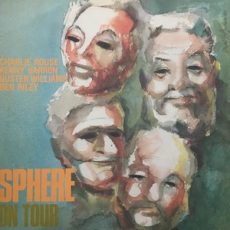
Sphere On Tour ~ Sphere | By Eddie Carter
This morning’s album from the library is a 1985 live recording by the bop quartet Sphere. Sphere on Tour (Red Record VPA 191) was the first of two live dates in their small discography and one of two records they recorded for the Italian label. Sphere took the pianist’s middle name and was originally formed to honor Thelonious Monk’s legacy after his death. The quartet quickly broadened its focus by recording albums that also featured its own original compositions. The group consists of two former members of Monk’s group, tenor saxophonist Charlie Rouse and drummer Ben Riley, and is anchored by pianist Kenny Barron and bassist Buster Williams. The copy I own is the 1986 Italian stereo release.
Dual Force by Buster Williams opens the set with the foursome’s lively melody setting the tone. Kenny gets things started with a spirited lead solo, then Charlie wails enthusiastically in a lengthy performance. Buster takes a short, scintillating statement leading to the theme’s restatement and an upbeat finish. Beautiful Friendship by Donald Kahn and Stanley Styne slows the pace when the rhythm section’s pretty introduction moves to an upbeat theme when Charlie enters. Kenny is up first to give a charming solo, then Charlie cooks at an easy groove next. Buster evokes a sense of intimacy in a short statement, and Ben has the last word before the theme returns and the song ends softly.
Scratch by Kenny Barron begins with the foursome’s offbeat introduction and melody. Charlie’s opening statement pushes his solo to the outer limits of musical boundaries. Kenny follows with a bit of quirky fun, then Buster takes an interesting walk, preceding the quirky theme reprise and abrupt stop. Tayamisha by Buster Williams starts Side Two at midtempo with the bassist’s introduction to the opening ensemble. Charlie leads the way with a smoothly flowing interpretation. Kenny comes in next for a delightful display of evident pleasure, then Buster takes us home in a short walk of consummate ease ahead of the quartet’s theme restatement and ending.
Up next is Spiral by Kenny Barron. Kenny brings the song to life, segueing into the quartet’s melody. Charlie sets the tone in the first solo with warmth, deep conviction and melodic beauty. Kenny follows with an exquisite, elegant statement, then Buster communicates his heart before the foursome regroups for the theme’s return. To conclude the album, the quartet dresses up one of Thelonious Monk’s most popular tunes, Well, You Needn’t, mistakenly listed as “Will, You Needn’t,” with a spirited introduction by Riley and the rhythm section, ahead of the ensemble melody. Charlie is off to the races with an intense drive. Kenny builds upon his solo with a steady attack, then Buster takes a short, swift walk leading back to the ending theme, band introductions and a pleasant goodnight to the audience.
Sphere on Tour was produced by Red Records co-founders Alberto Alberti and Sergio Veschi. Gianni Grassilli was the recording engineer, and the album’s sound quality is superb, with a soundstage that transports the listener to the audience as the musicians perform. The original group, consisting of Rouse, Barron, Williams, and Riley, recorded six albums from 1982 to 1988. They disbanded briefly after Rouse’s death, then made one final album with Gary Bartz in 1997. If you’re in the mood for live bop from a fabulous quartet who effortlessly blend innovation and tradition, I invite you to check out Sphere on Tour on your next record shopping trip. It’s a terrific introduction to their music collectively and might become a welcome addition to your jazz library!
~ A Beautiful Friendship, Well, You Needn’t – Source: Wikipedia.org
© 2026 by Edward Thomas Carter
More Posts: bass,choice,classic,collectible,collector,drums,history,instrumental,jazz,music,piano,saxophone
Daily Dose Of Jazz…
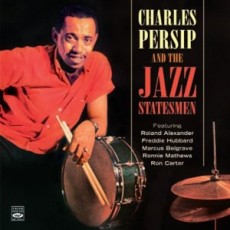
Charli Persip was born Charles Lawrence Persip on July 26, 1929 in Morristown, New Jersey. The drummer became known as Charlie but in the 1980s dropped the “e” to become Charli.
He played with Tadd Dameron in 1953, then toured and recorded with Dizzy Gillespie’s big and small bands between 1953 and 1958 before joining with Harry “Sweets” Edison quintet. He followed this stint with the Harry James Orchestra before forming his own group, the Jazz Statesmen, with Roland Alexander, Freddie Hubbard and Ron Carter in 1960.
During this period Persip also recorded with Lee Morgan, Dinah Washington, Melba Liston, Kenny Dorham, Zoot Sims, Red Garland, Gil Evans, Don Ellis, Eric Dolphy, Rahsaan Roland Kirk and Gene Ammons among others.
Charli would go on to record on the legendary “Eternal Triangle”, with Sonny Rollins and Sonny Stitt on “Sonny Side Up” and from 1960 to 1973 toured as a drummer and conductor with Billy Eckstine. As an educator has given drum and music instruction for Jazzmobile, Inc. in New York since 1974 and is currently an Associate Professor at the New School for Jazz and Contemporary Music.
In the mid 1980s Persip led Superband that evolved into Suppersound, his jazz big band. Supersound’s first album recorded for Stash titled Charli Persip and Superband was followed by Superband 11, No Dummies Allowed and Intrinsic Evolution. Drummer Charli Persip recorded 27 albums as a leader and a sideman and continued to record and perform until he died on August 23, 2020, at Mount Sinai Morningside in New York City at the age of 91.
More Posts: drums