


Jazz Poems
CHARLIE PARKER BIRTHDAY CELEBRATION, TOMPKINS SQUARE PARK
I was telling you about that junkie wannabefrom Wall Street who OD’ed last week
on Explosion 2000 on that street corner
right over there when KABOOM! You kissed me
smack on the lips just as “Confirmation” kicked in.
Just as Venusin two-toned dreadlocks and a skin-tight
smock danced from the band shell with her pet python,
Bodyguard, to “All the Things You Are.”
Just as punk rockers rocked, in-flowered on sheets,
sipped smoothies and smoked,
Their hair spirited to pastel auras, rosehip,
Island lime, a shade of blue just washed by rain.
Just as Ukraine checkmated, as twins seesawed,
As bikers cracked smiles in the Hari-Hari, the slap-
tongue of sax. At the mommies and the poppies. Just as.
And they were doing the brothers in descending order.
The three brothers Heath: Percy, Jimmy, call him “Little Bird,”
And Albert “Tootie” Heath. With Milt Jackson on vibes,
three score and twelve, and still working. Two boys in love
Grooved, one in white pants and sailor hat,
the other in a buffalo nickel belt that bedazzled.
They sat on the park bench eating falafel.
A man with one leg sold charms for a dollar. For luck.
For the music that day and the light, you could say it
was all bell-bottomed and swaybacked. Young-like.
And your kiss. All at once I was riding a sparkling gold Schwinn bike.
Something in my head went from full torpor to starburst:
as if whetted by some wild vibranto, your kiss,
the vibes’ licks cleared my vision of fizz for an instant.
What had been all Midnight Dragon was now
a Tropicana-Pure-Premium-sharpened C
delivered as of this morning to the Santa Barbara Deli
and Superetti down the street. Just like that.
In your arms and the music and the light, I thought I might
>go plumb or Penteostal, lay down on the grass, recite
Kahlil, take up knitting, eat pickles and marry you–
Tell that priest to stop playing Frisbee with the lab
so we can say our vows right here and now before “Tenor Madness”
ends! Opps! I forget we’re already married! Just as.
CATHERINE BOWMAN
from Jazz Poems ~ Selected and Edited by Kevin Young

More Posts: book,classic,collectible,history,jazz,library,poet
Daily Dose Of Jazz…
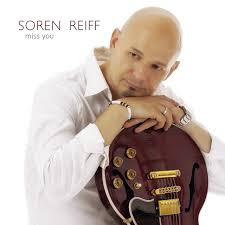
Søren Reiff born October 22, 1962, in Holbæk, Denmark to painter Tove Reiff and potter Erik Reiff. When he was ten years old he went to an Eric Clapton concert which sealed his fate to become a guitarist. A few years later he was invited to a recording session and that cemented his career choice.
In the mid-Eighties was the guitarist in house bands and as musical director on Danish National television, which led him to play with Toots Thielemans, Randy Crawford, Robert Palmer, Bonnie Tyler and others. The Nineties saw Reiff working as musical director for Chaka Khan, David Sanborn, Mark King, and many others on these television shows.
As an author Søren has published five books, released three albums as a recording artist. He has played on several American television shows, Studiojams and co-hosted the show The Color of Jazz. He was the founder of Den Rytmiske Højskole’s course for Songwriters and Producers.
Guitarist, producer, composer and author Søren Reiff, who was included in the International Who’s Who in Music, Volume Two, Popular Music, continues to perform and record.
More Posts: author,composer,guitar,history,instrumental,jazz,music,producer
Daily Dose Of Jazz…
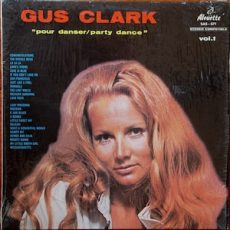
Gus Clark was born Gustave De Clercq on October 21, 1913 in Antwerp, Belgium. While still in his teens he led local dance bands and also played in the groups of musicians such as Harry Pohl, Maurice Pinto, and Jack Hoedemaeker.
In the 1930s Gus played with his own group in Brussels, Belgium, and Coleman Hawkins performed with this ensemble. He later set up a new ensemble of all-Black musicians in Belgium, which included Lauderic Caton as a sideman.
Clark performed with Jean Omer, Jean Robert, and Gus Deloof as a sideman, and continued recording as a leader in the 1940s and 1950s.
Pianist Gus Clark died in his native city on April 10, 1979.
More Posts: history,instrumental,jazz,music,piano
Requisites
Mulligan Meets Monk ~ Thelonious Monk and Gerry Mulligan | By Eddie Carter
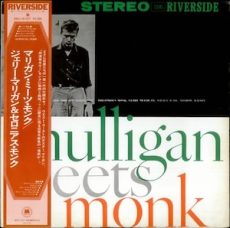
This morning’s record from the library, Mulligan Meets Monk (Riverside RLP 12-247/RLP 1106), is an excellent quartet date that brings together two giants, Gerry Mulligan and Thelonious Monk, for their only collaborative album. Their influence on bop and cool jazz is immeasurable. It hit the stores in 1957, and the personnel are Gerry Mulligan on baritone sax, Thelonious Monk on piano, Wilbur Ware on bass and Shadow Wilson on drums. My copy is the 1975 Victor Musical Industries Japanese Stereo reissue (Riverside SMJ-6107).
‘Round Midnight by Thelonious Monk, Cootie Williams, and Bennie Hanighen is one of The Great American Songbook’s most beautiful and recorded jazz tunes. It opens the first side with the quartet’s elegantly tender theme. Gerry delivers a mesmerizing first solo. Thelonious is next and gives a beautifully constructed reading ahead of the theme’s reprise and climax. Thelonious Monk’s Rhythm-a-ning picks up the pace with a lively introduction by Wilson segueing into the foursome’s spirited melody. Mulligan is up first with a statement of dynamic energy; then Monk speaks assertively in the second reading. Gerry returns with an excellent improvisation ahead of the theme’s restatement.
The group’s unique and refreshing approach to Sweet and Lovely by Gus Arnheim, Jules LeMare, and Harry Tobias starts with Gerry and Thelonious’ delicately graceful theme. Monk shows a considerable amount of respect in the opening solo. Mulligan’s exquisite softness in the closer precedes a gorgeous conclusion. Decidedly by Gerry Mulligan begins Side Two with a two-instrument dialogue between Gerry and Shadow, extending into the quartet’s brisk theme. Mulligan functions most effectively in the opening statement. Monk unwraps a pleasant surprise next. Wilbur takes a short, impressive walk, Gerry takes over briefly, and Shadow wraps things up before the close.
Straight, No Chaser is one of Thelonious Monk’s perfectly structured originals. The foursome’s bluesy theme sets up Gerry’s inspired opening statement. Wilbur’s bass goes to work next in a short reading, and then the pianist sums everything up nicely before the closing chorus and finale. I Mean You by Thelonious Monk and Coleman Hawkins begins with the pianist’s introduction, leading to the ensemble’s opening chorus. Monk steps into the spotlight first, cruising comfortably, and then Mulligan puts together a few good ideas in the second solo. Ware rounds out things with a breezy walk before the group reassembles to take the song out.
Mulligan Meets Monk was produced by Orrin Keepnews and recorded by Jack Higgins. The album’s sound quality is top-notch, with a superb soundstage that makes it feel like the quartet is performing right before you. Whether you’re a bop or cool jazz fan or new to the music of Gerry Mulligan and Thelonious Monk, Mulligan Meets Monk is a must-listen on your next record-shopping trip. It’s a delightful addition to both musicians’ discographies, showcasing their talents in a way that might make it a favorite in your library!
~ ‘Round Midnight, Straight, No Chaser, Sweet and Lovely – Source: JazzStandards.com
© 2024 by Edward Thomas Carter

More Posts: choice,classic,collectible,collector,history,instrumental,jazz,music,piano,saxophone
Daily Dose Of Jazz…
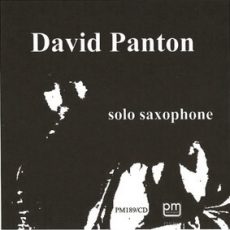
David Panton was born on October 20, 1946 in the Midlands, England where his formative musical experience revolved around singing in the local church choir and later with a mixed voice choir and an amateur operatic society. He began teaching himself classical piano from the age of twelve and by fifteen had begun to compose by improvising at the keyboard. At seventeen he joined the army as a bandsman, taking up the oboe and being posted for a year in 1964 to Kneller Hall, the Military School of Music. He later attended Birmingham School of Music for piano tuition under the late William Fellowes for a year from 1966. His composing took on a more modern direction which was largely unintelligible to his military colleagues.
After four years as bandsman he resigned to pursue a musical career back in civilization, taking up the alto saxophone as a result of hearing some of the American and British free jazz players of the time such as Ornette Coleman and Mike Osborne. He formed several groups and gave solo performances at the Birmingham Arts Lab, Midlands Arts Centre, Birmingham and Midlands Institue as well as numerous pubs. He made contact with London based musicians John Stevens, Evan Parker, Derek Bailey and Maggie Nichols which led to occasional appearances around the city.
He ventured into folk music with the group Forest, followed by the experimental theatre group Chameleon Laboratory Theatre. In 1979 he received an Arts Council jazz bursary, allegedly the first provincal based musician to do so, with a second following in 1981. By 1989 he abandoned music and started up an audio cassette duplication business. When the demise of the audio cassette undermined business viability, David opted to take up a civil service post in the late Nineties from which he retired in 2006.
In 2009 he was awarded the MA in Music from the Open University and has continued to pursue music activities in academia.
More Posts: bandleader,history,instrumental,jazz,music,piano,saxophone