

Daily Dose Of Jazz…
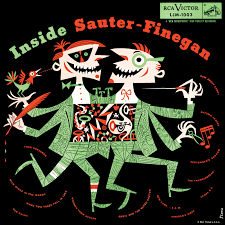
William James Finegan was born on April 3, 1917 in Newark, New Jersey and grew up in a household full of piano players. While growing up in Rumson, New Jersey, he attended Rumson-Fair Haven High School, and taught orchestration to schoolmate Nelson Riddle. He studied piano with Elizabeth Connelly, piano and musicianship with flautist/alto saxophonist Rudolph John Winthrop., and spent time studying at the Paris Conservatory.
He had his first professional experience leading his own piano trio before being offered a job as a staff arranger for Glenn Miller after Tommy Dorsey bought a copy of his Lonesome Road and recommended him. Finegan remained with Miller until 1942 and arranged such hits as Little Brown Jug, Sunrise Serenade, Song of the Volga Boatmen, Stardust, A Nightingale Sang in Berkley Square and Jingle Bells. He arranged these songs in collaboration with Glenn Miller, but also arranged music for films in which the band appeared in the early Forties. He then worked off and on for Tommy Dorsey from 1942 to 1952.
In the late Forties Bill studied in New York City, then lived in Europe from 1948-1950 where he studied with Darius Milhaud and Valérie Soudères. After returning to the States in 1952, along with Eddie Sauter formed an ensemble, the Sauter-Finegan Orchestra, which remained active until 1957.
Following this collaboration, Finegan found work in advertising, writing music for commercials. In the Seventies, he arranged for the Glenn Miller Orchestra and Mel Lewis’s orchestra. He taught jazz at the University of Bridgeport in the 1980s. He wrote arrangements for cornetist Warren Vaché and the vocal group Chanticleer until his death in 2008.
Pianist, composer and arranger Bill Finegan died from pneumonia on June 4, 2008 in Bridgeport, Connecticut at the age 91.
More Posts: arranger,composer,history,instrumental,jazz,music,piano
Jazz Poems
THE DAY LADY DIED It is 12:20 in New York a Friday three days after Bastille Day, yes it is 1959 and I go get a shoeshine because I will get off the 4:19 in Easthampton at 7:15 and then go straight to dinner and I don’t know the people who will feel me I walk up the muggy street beginning to sun and have a hamburger and a malted and buy an ugly NEW WORLD WRITING to see what the poets in Ghana are doing these days I go on to the bank and Miss Stillwagon (first name Linda I once heard) doesn’t even look up my balance for once in her life and in the GOLDEN GRIFFIN I get a little Verlaine for Patsy with drawings by Bonnard although I do think of Hesiod, trans. Richmond Lattimore or Brendan Behan’s new play or Le Balcon or Les Nègres of Genet, but I don’t, I stick with Verlaine after practically going to sleep with quandariness and for Mike just stroll into the PARK LANE Liquor Store and ask for a bottle of Strega and then I go back where I came from to 6th Avenue and the tobacconist in the Ziegfeld Theatre and casually ask for a carton of Gauloises and a carton of Picayunes, and a NEW YORK POST with her face on it and I am sweating a lot by now and thinking of leaning on the john door in the FIVE SPOT while she whispered a song along the keyboard to Mal Waldron and everyone and I stopped breathing FRANK O’HARAfrom Jazz Poems ~ Selected and Edited by Kevin Young

More Posts: book,classic,collectible,history,jazz,library,poet
Daily Dose Of Jazz…
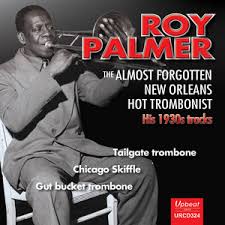
Roy Palmer was born on April 2, 1887 in New Orleans, Louisiana. He began his career in 1906 in New Orleans as a guitarist with the Rozelle Orchestra. He played trumpet and then trombone with Richard M. Jones, Freddie Keppard, Willie Hightower, Tuxedo Brass Band, and Onward Brass Band.
In 1917 he left New Orleans and moved to Chicago, Illinois where he worked with King Oliver, Lawrence Duhe, and Doc Cook. Palmer recorded with Johnny Dodds, Jelly Roll Morton, Ida Cox, the Alabama Rascals, and the State Street Ramblers.
In the 1930s, he was a factory worker and music teacher. Trombonist Roy Palmer died on December 22, 1963 in Chicago.
More Posts: educator,history,instrumental,jazz,music,trombone
Daily Dose Of Jazz…
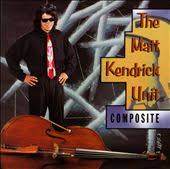
Matt Kendrick, was born in Winston-Salem, North Carolina on April 1, 1957 and attended the University of North Carolina School of the Arts. He moved to New York City in 1977 and for four years performed in numerous avant-garde venues. After studying with jazz educator Jerry Coker at the University of Tennessee, and playing in the Knoxville Symphony, he returned home in 1981.
As a composer, he has released to critical acclaim five compact discs, featuring more than forty of his own compositions. He has scored music for three films, leads the Matt Kendrick Unit,and has performed with Marian McPartland, Tierney Sutton, Archie Shepp and Jaki Byard.
He serves on the board of Music Carolina, is the music director for Carolina Music Ways, and is co-artistic director for Music Carolina, a non-profit arts presenting organization. As an educator Kendrick was on the faculty at Wake Forest University for 25 years.
With four decades under his belt, bassist Matt Kendrick continues to compose, perform, and teach.
More Posts: bandleader,bass,composer,history,instrumental,jazz,music
Requisites
Xocia’s Dance (Sue-sha’s Dance) ~ Harold Land | By Eddie Carter
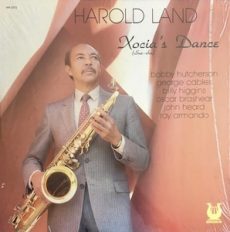
Harold Land takes the stage for this morning’s discussion with an excellent hard bop album, Xocia’s Dance (Sue-sha’s Dance) (Muse Records MR 5272). He was one of the best West Coast tenor saxophonists during the fifties and sixties. His resume includes playing with the Clifford Brown/Max Roach Quintet, The Curtis Counce Group, The Gerald Wilson Orchestra, and The Timeless All-Stars. Xocia’s Dance reunites Harold with Bobby Hutcherson, who co-led a quintet with him thirteen years earlier. He is joined on this date by Oscar Brashear on flugelhorn (track: B2) and trumpet (A1 to A3), Bobby Hutcherson (A2, A3, B2) on vibes, George Cables on piano, John Heard on bass, Billy Higgins on drums, and Ray Armando (B1) on percussion. My copy is the original 1982 U.S. Stereo release.
Side One opens with Dark Mood, an original by Harold Land that is introduced by the trio ahead of the quintet’s lively theme. Harold gets things started, and then Oscar follows with a clearly inspired performance. George approaches the third reading with driving enthusiasm; then, all three soloists share a moment before the closing chorus and vibrant ending. Daisy Forever is a pretty tune by Oscar Brashear that Bobby gets started ahead of the group’s lovely melody. Brashear leads the way with a solo of seductive warmth; then, Land shows great care in the following reading. Hutcherson enters for the first time and delivers a beautiful interpretation. Cables provides the final gentle verses leading to the group’s closing chorus and slow dissolve.
Xocia’s Dance (Sue-sha’s Dance) comes from the pen of Harold Land, Jr., and the pace moves upward to a lively beat. The trio’s introduction heads toward the ensemble’s medium theme. Harold Sr. has the first solo and gets into a remarkable groove. Oscar answers him with a tasty reading as sweet as honey, and then George provides an exclamation point into the theme’s restatement and close. Side Two opens with Ah, I See, a beautiful tune by Charles Tolliver that starts with Harold’s and Bobby’s tranquil yet haunting theme. Land picks up the pace for a sweetly melodic opening statement, then gives way to Hutcherson’s delightful interpretation. Cables comes in softly and with feeling next before Harold returns for a restrained ending.
The album ends with a romantic postscript by Harold Land. To Lydia, With Love is a touching tribute to his wife and the mood is delicately expressed in the introduction and theme. Harold begins the opening solo lovingly, succeeded by Bobby’s equally thoughtful reading. Oscar’s flugelhorn delights with a beautiful statement. George conveys the feeling of everlasting love in a short anecdote ahead of the ensemble’s closing chorus and fadeout. Esmond Edwards produced Xocia’s Dance, and Jim Mooney was the recording engineer. The album’s sound quality is good, except for a bit of harshness during the piano solo on Ah, I See. The music, however, is terrific and quite capable of brightening anyone’s mood after a long day or week.
In addition to Xocia’s Dance, Harold Land recorded fourteen albums as a leader and appeared in some of the best jazz albums as a sideman. He co-led groups with Billy Higgins, Blue Mitchell, and Red Mitchell. Land later became a professor at the University of California and joined the UCLA Jazz Studies. He passed away on July 27, 2001, from a stroke at age seventy-two but is still remembered as a brilliant improviser and one of the best to play the tenor sax. If you’re a fan of West Coast jazz, I invite you to check out Xocia’s Dance (Sue-sha’s Dance) by Harold Land on your next record shopping trip. It’s a hidden gem in his discography and a personally satisfying album that I can happily recommend for a spot in your library!
~ Harold Land – Source: Wikipedia.org © 2024 by Edward Thomas Carter
More Posts: choice,classic,collectible,collector,history,instrumental,jazz,music,saxophone