

Daily Dose Of Jazz…
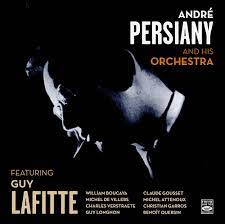
André Persiany was born on November 19, 1927 in Paris, France. His father taught him violin and piano as a child, and by 1945, he had formed his own ensemble. He was a member of the Be Bop Minstrels with Hubert and Raymond Fol in 1947, then played with Michel Attenoux, Eddie Bernard, Bill Coleman, Buck Clayton, Raymond Fonsèque, Lionel Hampton, Guy Lafitte, Mezz Mezzrow, and Tony Proteau.
Relocating to New York City in the mid-1950s, saw him playing at Birdland and working extensively with Jonah Jones. In 1969 he returned to Paris and held a residency as the pianist at Le Furstenberg from 1970 to 1988. His associations in the 1970s included Cat Anderson, Milt Buckner, Eddie Chamblee, Arnett Cobb, Al Grey, Budd Johnson, and Charlie Shavers.
Pianist André Persiany, whose son Stéphane became a double-bassist, transitioned on January 2, 2004 in Paris.

More Posts: bandleader,history,instrumental,jazz,music,piano
Daily Dose Of Jazz…
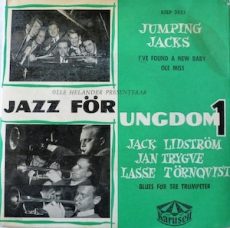
Lasse Törnqvist was born Lars Törnqvist on November 18, 1935 in Bromma, outside Stockholm, Sweden. Between 1952 and 1957 he played traditional jazz with the Midnight Stompers. He took a music hiatus but picked up playing again in 1973 in more swing and mainstream influenced sextest and septets, like the Olle Orrjes Jazz Band and Lasse Törnqvist’s Blue Stars.
He experimented with small bands in order to achieve a more acoustic sound. During the 1980s he often played with a cornet and piano duo. In 1992 he put a trio together with guitar and bass which became the Sweet Jazz Trio.
Cornetist Lasse Törnqvist, at 98 years old, no longer plays.
More Posts: bandleader,cornet,history,instrumental,jazz,music
Daily Dose Of Jazz…
David Werner Amram III was born November 17, 1930 in Philadelphia, Pennsylvania. He studied at the Oberlin Conservatory of Music in 1948–1949, and earned a bachelor’s degree in European history from George Washington University in 1952. In 1955 he enrolled at the Manhattan School of Music, where he studied under Dimitri Mitropoulos, Vittorio Giannini, and Gunther Schuller. Under Schuller he studied French horn.
As a sideman or leader, David has worked with Aaron Copland, Thelonious Monk, Dizzy Gillespie, Charles Mingus, Jack Kerouac, Sonny Rollins, Lionel Hampton, Stan Getz, George Barrow, Jerry Dodgion, Paquito D’Rivera, Pepper Adams, Arturo Sandoval, Oscar Pettiford, Allen Ginsberg, Mary Lou Williams, Kenny Dorham, Ray Barretto, Wynton Marsalis, and others that included a wide range of folk, pop, and country figures.
In 1956, producer Joseph Papp hired Amram to compose scores for the New York Shakespeare Festival, the next year staged one of the first poetry readings with jazz, and in 1966 Leonard Bernstein chose Amram as the New York Philharmonic’s first composer-in-residence.
He went on four international musical tours to Brazil, Kenya, Cuba and the Middle East. He conducted a 15 piece orchestra for Betty Carter’s What Happened To Love? album, became an advocate for music education. He composed scores for the Elia Kazan films Splendor in the Grass, and The Arrangement and for the John Frankenheimer films The Young Savages and The Manchurian Candidate.
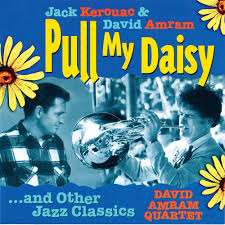
French hornist and pianist David Amram, who also plays Spanish guitar, penny whistle, sings and composes, has recorded nineteen albums as a leader and twenty-eight as a sideman.
More Posts: bandleader,composer,french horn,guitar,history,instrumental,jazz,music,penny whistle,piano,vocal
Daily Dose Of Jazz…
Elmer “Sonny” Dunham was born November 16, 1911 in Brockton, Massachusetts and attended local schools, taking lessons on the valve trombone at the age of 7. He changed to the slide trombone at the age of 11, and was playing in local bands at 13. He began his musical career as a trombone player in the Boston, Massachusetts area.
By the late 1920s he had moved to New York City where he played with Ben Bernie for six months before moving on in 1929 to Paul Tremaine’s Orchestra. He remained there for two years and while working as an arranger and vocalist with Tremaine’s group he switched to the trumpet.
In 1931 he left Tremaine and for a few months led his own group, calling it Sonny Dunham and his New York Yankees. That same year along with clarinettist Clarence Hutchenrider, trombonist-singer Pee Wee Hunt and singer Kenny Sargent, he was recruited by Glen Gray for Gray’s Casa Loma Orchestra. During the golden years of Casa Loma, he was a popular soloist, scoring a big hit with his trumpet work on Memories of You. He stayed until 1936, when he formed another more unusual group, Sonny Lee and The New Yorkers Band, which featured 14 pieces, with ten of his musicians doubling on trumpet.
Moving to Europe for three months, he then returned to the Casa Loma Orchestra, remaining until 1940 when he tried again to form his own group, this time, with more success. They debuted in 1940 at the Glendale Auditorium in Los Angeles, California and toured and held talent searches throughout the United States. After returning to New York in 1941, they were on nightly radio broadcasts at the Roseland Ballroom, and the Meadowbrook at Cedar Grove, New Jersey.
On the road in California the band played Los Angeles, were featured in the Universal picture Behind the Eight Ball with the Ritz Brothers and he served as musical director for this film, and was part of a vaudeville revue. Over the next couple of decades he would divide his time between New York and Los Angeles with stints in Chicago, Illinois. Dunham briefly experimented with dual female vocalists, Mickie Roy and Dorothy Claire, which did not turn out due to professional temperament.
Dissolving the band in 1951 Sonny joined Tommy Dorsey’s band as trumpet player, then reorganized the next year, remaining active until the decline of the big-band business. By the 1970s obscurity set in, however, he recorded playing trombone on a few LPs with Don Goldie’s Dixieland revival bands.
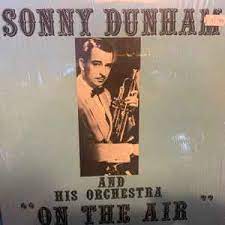
In the 1980s trumpeter, trombonist and bandleader Sonny Dunham, who was living in a trailer in Miami, Florida and still involved in booking bands for cruises and playing occasionally, transitioned from cancer on July 9, 1990, aged 78.
More Posts: bandleader,history,instrumental,jazz,music,trombone,trumpet
Daily Dose Of Jazz…
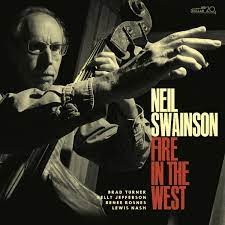
Neil James Sinclair Swainson was born November 15, 1955 in Victoria, British Columbia, Canada. He started his career in his hometown when he supported visiting American musicians Herb Ellis, Barney Kessell, and Sonny Stitt, among others. In 1976 he moved to Vancouver, British Columbia and after playing with the Paul Horn Quintet, he led a band for two years. He moved to Toronto, Quebec in 1977
In the 1980s he played with local and visiting acts including Tommy Flanagan, Rob McConnell, Ed Bickert, Slide Hampton, James Moody, Jay McShann, Moe Koffman, Lee Konitz, Joe Farrell, George Coleman, and Woody Shaw. He went on to collaborate with Woody Shaw appearing on two of his recordings: In My Own Sweet Way and Solid. He toured with Shaw often in New York City and on many European tours.
A collaboration between Swainson and pianist George Shearing would form in 1986, after he replaced Don Thompson in 1988. Their relationship continued until Shearing’s passing in 201 and during their time together they toured across North America, Great Britain, Europe, Australia, Hong Kong, and Japan. They played with musicians including Joe Williams, Nancy Wilson, Diana Krall, Robert Farnon and Mel Tormé.
Together the two recorded eight recordings and he recorded his own album; 49th Parallel on Concord Jazz in 1987. His recordings feature Woody Shaw on trumpet, and Joe Henderson on saxophone along with numerous other musicians such as Jay McShann, Geoff Keezer, Doc Cheatham, Sam Noto, Don Thompson, Peter Leitch, Pat LaBarbera, Joe LaBarbera, Rob McConnell, Ed Bickert, Lorne Lofsky, Kirk MacDonald and JMOG, a cooperative band featuring, Kevin Dean and Pat LaBarbera.
Swainson has also recently toured worldwide with the singer Roberta Gambarini and as well with pianist Gene DiNovi in Japan. As an educator he works at Humber College as a professor in the Bass department after receiving a music degree. Bassist Neil Swainson continues to compose music and freelance in Toronto.
More Posts: bandleader,bass,history,instrumental,jazz,music