


Daily Dose Of Jazz…
Denis Alphonso Charles was born December 4, 1933 in St. Croix, Virgin Islands and first played bongos at age seven with local ensembles. 1945 saw him moving to New York City, and gigging frequently around town. Nine years later he was working with Cecil Taylor and the pair collaborated until 1958. Following this he played with Steve Lacy, Gil Evans, and Jimmy Giuffre. Befriending Ed Blackwell, the two influenced each other.
He went on to record with Sonny Rollins on a calypso-tinged set, and then returned to Lacy, with whom he played until 1964. He worked with Archie Shepp and Don Cherry in 1967, but heroin addiction saw him leave the record industry until 1971. In the 1970s and 1980s, he played regularly on the New York jazz scene with Frank Lowe, David Murray, Charles Tyler, Billy Bang, and others. He also played funk, rock, and traditional Caribbean music. He released three discs as a leader between 1989 and 1992. , and died of pneumonia in his sleep in New York in 1998.
Drummer Denis Charles, who released three albums as a leader, thirty-four as a sideman and several with the BMC Trio, transitioned four days after a five week European tour on March 26, 1998 from pneumonia.

More Posts: bandleader,drums,history,instrumental,jazz,music
Daily Dose Of Jazz…
Melissa Aldana was born on December 3, 1988 in Santiago, Chile and began playing the saxophone when she was six under the influence and tuition of her father Marcos Aldana, also a professional saxophonist. She began with alto, influenced by Charlie Parker, Cannonball Adderley and Michael Brecker. However, upon first hearing the music of Sonny Rollins, she switched to tenor, picking up her grandfather’s Selmer Mark VI.
Performing around hometown jazz clubs while in her early teens, in 2005 she was invited by pianist Danilo Pérez to play at the Panama Jazz Festival as well as auditions at music schools in the USA. This resulted in Melissa attending the Berklee College of Music in Boston, Massachusetts studying under Joe Lovano, George Garzone, Frank Tiberi, Greg Osby, Hal Crook, Bill Pierce, and Ralph Peterson. After graduating she relocated to New York City to study with George Coleman.
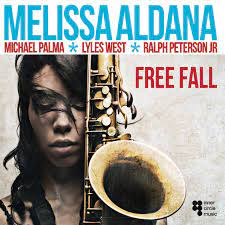
Aldana recorded her debut album, Free Fall, released in 2010 on Greg Osby’s Inner Circle Music label. Two years later she released her sophomore project, Second Cycle, and by age 24, she was the first female and South American musician to win the Thelonious Monk International Jazz Saxophone Competition, in which her father had been a semi-finalist in 1991. The prize was a $25,000 scholarship, and a recording contract with Concord Jazz.
Aldana has been awarded the Altazor National Arts Award of Chile, and the Lincoln Center’s Martin E. Segal Award. She has played concerts alongside artists such as Peter Bernstein, Kevin Hays, Christian McBride, Jeff “Tain” Watts, Jimmy Heath and Wynton Marsalis.
She has formed the group, Melissa Aldana & Crash Trio, with Cuban drummer Francisco Mela and Chilean bassist Pablo Menares, and in addition her most recent configuration in 2017, the Melissa Aldana Quartet includes Aldana on tenor saxophone, pianist Sam Harris or guitarist Lage Lund, bassist Pablo Menares and drummer Kush Abadey.
Tenor saxophonist Melissa Aldana continues to explore and expand her vocabulary as she performs and records.
More Posts: bandleader,history,instrumental,jazz,music,saxophone

Daily Dose Of Jazz…
Charlie Ventura was born Charles Venturo on December 2, 1916 in Philadelphia, Pennsylvania. During the 1940s, he played saxophone for the Gene Krupa and Teddy Powell bands. In 1945 he was named best tenor saxophonist by DownBeat magazine.
During the Forties he led big bands and led a band which included Conte Candoli, Bennie Green, Boots Mussulli, Ed Shaughnessy, Jackie Cain, and Roy Kral. By the 1950s he formed the Big Four with Buddy Rich, Marty Napoleon, and Chubby Jackson. He was a sideman with Krupa through the 1960s, then worked in Las Vegas with comedian Jackie Gleason. By the 1980s he slowed down until finally retiring from music.
Tenor saxophonist and bandleader Charlie Ventura transitioned from lung cancer on January 17, 1992 in Pleasantville, New Jersey at age 75. was an American from
More Posts: bandleader,history,instrumental,jazz,music,saxophone
Daily Dose Of Jazz…
Lurlean Hunter was born in Clarksdale, Mississippi on December 1, 1919 and was taken to Chicago, Illinois when she was two months old. She attended Englewood High School in Chicago.
Her first paid singing performance came when she appeared with Red Saunders and his orchestra at Club DeLisa on Chicago’s South Side. Hunter was signed by Discovery Records in 1950 and subsequently was a featured performer with George Shearing and his quintet at Birdland in New York City.
In 1951 Lurlean was among a group of rising young stars of jazz, that were presented at the Streamliner night club in Chicago. She performed at the Cloister Inn, where an initial four-week booking turned into a 2.5-year stay. She went on to work in New York and Ottawa, Ontario, Canada.
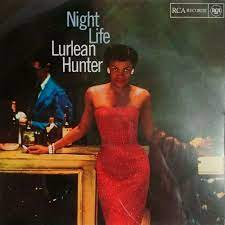
Leaving Discovery, she began recording for Atlantic Records in 1961, with Blue and Sentimental as her first album for that label. She later recorded for RCA Victor. By 1963, Hunter became the first Black performer hired by WBBM radio in Chicago. After a successful on-air audition, she became a member of the staff of the all-live Music Wagon Show. Five years later the National Educational Television jazz broadcast featured her, accompanied by the Vernel Fournier Trio.
In 1958, she sued RCA Record Division after it used her image and her name on the cover of its, not her Lonesome Gal record album. The suit alleged “unfair competition, infringement of trade name, unfair business practices, unjust enrichment and invasion of the right of privacy.” Though the court acknowledged that the album contained the song “Lonesome Gal”, and that the use of one song’s title for an album’s title was common practice in the recording industry, it ruled in Hunter’s favor on the basis that she was the first person to “adopt and establish the name Lonesome Gal as a personality” and that name was exclusively associated with her. Damages of $22,500 were awarded to Hunter, and the company was ordered to destroy all material containing Hunter’s likeness in conjunction with “Lonesome Gal”.
Vocalist Lurlean Hunter, who was a contralto and made commercials for products such as peas and telephone directories, transitioned on March 11, 1983 in Kalamazoo, Michigan.
More Posts: bandleader,history,instrumental,jazz,music,vocal
Daily Dose Of Jazz…
Bill Reichenbach was born William Frank Reichenbach Jr. on November 30, 1949 in Takoma Park, Maryland. He began playing in high school for bands in the Washington, D.C. area and also sat in with his father’s group, playing with Milt Jackson, Zoot Sims, and others.
He went to Rochester, New York to study at the Eastman School of Music with the legendary teacher Emory Remington and after graduating joined the Buddy Rich band. He would go on to work in the Toshiko Akiyoshi – Lew Tabackin Big Band in Los Angeles, California in the mid/late 1970s. After that move he became known for music for television and film.[2]
He played trombone on The Wiz and, with the Seawind Horns including Jerry Hey on Michael Jackson’s albums Off the Wall, Thriller, and HIStory. He was a composer for Cartoon All-Stars to the Rescue.
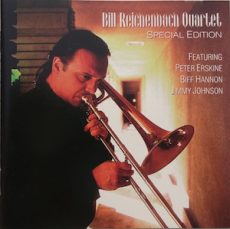
He recorded a solo album, Special Edition, where he is featured on bass trombone as well as tenor. Trombonist, euphoniumist, composer and session musician Bill Reichenbach, who has collaborated on eighty-six albums with artists from Al Jarreau and George Benson to Barbra Streisand, Patti Austin and Bette Midler to Christopher Cross and Selena, continues his career in television, films, cartoons, and commercials.

More Posts: bandleader,composer,euphonium,history,instrumental,jazz,music,trombone