

Daily Dose Of Jazz…
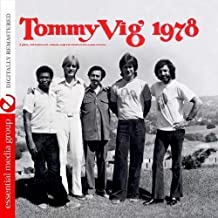
Tommy Vig was born on July 14, 1938 in Budapest, Hungary. Internationally recognized as a child prodigy by the age of 6, he played drums with his father, clarinetist Gyorgy Vig and performed concerts on Budapest State Radio, at the City Theatre, the Academy of Music, and the National Circus. By age 8, he made the album The World Champion Kid Drummer with Austrian jazz players in Vienna, Austria including Hans Koller, Ernst Landl, and the Hot Club of Vienna for Elite Special. The following year his drumming won him the 1947 MGM-Jazz Competition in Budapest and as a result made several recordings with the Chappy’s Mopex Big Band for His Master’s Voice.
Completing his studies at the Bartók Conservatory in 1955 and the Ferenc Erkel Music High School in 1956, due to the crushing of the Hungarian Revolution of 1956, he fled to Vienna, where he played concerts with Fatty George and Joe Zawinul. A move to the United States saw him on scholarship at Juilliard School of Music. Since then he has been writing and conducting concerts.
In 1970 Vig relocated to Los Angeles, California where he worked in the studios of Warner Bros., Fox, Universal, CBS, Columbia, ABC, Disney, Goldwyn, MGM, and Paramount. He played on 1500 studio sessions in Hollywood, two Academy Awards, and produced, directed, and conducted the official 1984 Olympic Jazz Festival for the Los Angeles Olympic Organizing Committee. He wrote the music for 30 films and television shows, and added percussion on the recording of Quincy Jones’s soundtrack to Roots.
Vig has worked with Red Rodney, Don Ellis, Cat Anderson, Terry Gibbs, Art Pepper, Milcho Leviev, Joe Pass, the Miles Davis-Gil Evans Big Band. Frank Sinatra, Sammy Davis Jr., Tony Curtis, Woody Allen, Judy Garland, Tony Bennett and Rod Stewart.
Since 2006, vibraharpist, drummer, percussionist, xylophonist and marimba player Tommy Vig, who has won several awards, has been performing concerts with his wife, appearing on radio and television, and recording albums.

More Posts: bandleader,drums,educator,history,instrumental,jazz,marimba,music,percussion,vibraharp,xylophone

Three Wishes
The Baroness asked Oscar Peterson what his three wishes would be and he said:
1. “I wish I could play the piano the way I want to.”
2. “I wish everyone was born with innate understanding of all art forms.”
3. “Love throughout the world, individual to individual.”
*Excerpt from Three Wishes: An Intimate Look at Jazz Greats ~ Compiled and Photographed by Pannonica de Koenigswarter

More Posts: baroness,history,instrumental,jazz,music,pannonica,piano,three,wishes

Daily Dose Of Jazz…
Pedro Iturralde Ochoa was born in Falces, Spain on July 13, 1929. He began his musical studies with his father and performed in his first professional engagements on saxophone at age eleven. GraduatING from the Royal Conservatory of Music in Madrid, he had studied clarinet, piano, and harmony.
When he was 20 years old he composed Czárdás for saxophone and dedicated the present version of the work, orchestrated by his brother Javier, to a friend, saxophonist Theodore Kerkezos. He went on to lead his own jazz quartet at the W. Jazz Club in Madrid, Spain and experimented with the combined use of flamenco and jazz, and making recordings for the Blue Note label.
In 1972 he undertook further study in harmony and arranging at the Berklee College of Music in Boston, Massachusetts. He taught saxophone at the Madrid Conservatory from 1978 until his retirement in 1994. He appeared in Spain and abroad as a soloist with the Spanish National Orchestra under the baton of Frühbeck de Burgos, Celibidache, Markevitch, and others.
He made recordings with the renowned flamenco guitarists Paco de Lucia, Paco de Algeciras and Pepe de Antequerra, and Paco Cepero. He also recorded with jazz vocalist Donna Hightower on her I’m In Love with Love album and arranged/conducted on her El Jazz y Donna Hightower album.
Saxophonist, teacher and composer Pedro Iturralde Ochoa passed away on November 1, 2020. in Madrid on November 1, 2020.
More Posts: bandleader,history,instrumental,jazz,music,saxophone
Daily Dose Of Jazz…
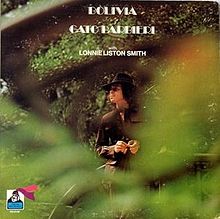
Jean-François “J.F.” Jenny-Clark was born July 12, 1944 in Toulouse, France. Together with drummer Aldo Romano he provided the rhythm section for Don Cherry’s 1965 European quintet of 1965. During the Seventies he recorded with Steve Lacy, performed in concerts with Keith Jarrett (around 1970) and for Jasper van’t Hof’s Pork Pie group and played with Charlie Mariano.
As a member of Diego Massons ensemble Musique Vivante he was interpreting contemporary music compositions by John Cage, Luciano Berio, Mauricio Kagel, Karlheinz Stockhausen, Pierre Boulez, or Vinko Globokar.
Along with Albert Mangelsdorff he led the German-French Jazz Ensemble from 1984 to 1987. Since 1985 Jenny-Clark was mainly working in an acclaimed trio with German pianist Joachim Kühn and Swiss drummer Daniel Humair.
His recording as a leader was minimal but as a sideman he recorded over a hundred albums. Double bassist Jean-François Jenny-Clark, one of the most important bass players of European jazz, passed away on October 6, 1998 in Paris, France.
More Posts: bandleader,bass,composer,history,instrumental,music
Requisites
My One And Only Love ~ Franco D’Andrea | By Eddie Carter
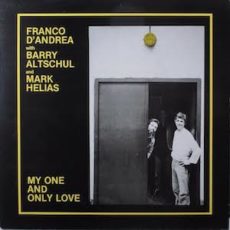
This morning’s choice from the library is My One and Only Love (Red Record NS 201), a recent acquisition introducing me to the Italian pianist, Franco D’Andrea. His career began in 1963 with bandleader Nunzio Rotondo. He’s also played with Franco Ambrosetti, Gato Barbieri, Conte Candoli, Dave Douglas, Johnny Griffin, Lee Konitz, Steve Lacy, Max Roach, Frank Rosolino, Phil Woods, and other Italian musicians. D’Andrea is one of Italy’s most famous pianists and has an extensive discography of two hundred albums as a leader and sideman. Franco also taught at Conservatorio “F.A. Bonporti” from 1994 to 2006 and currently teaches at Mitteleuorpean Jazz Academy and Siena Jazz. On this date, he’s joined by Mark Helias on bass and Barry Altschul on drums. My copy used in this report is the 1983 Italian Stereo pressing.
Side One begins with the first of three tunes from the pianist’s pen, Nord E Sud is a pretty composition that starts slowly but grows to a medium tempo with Franco displaying fine finger work on the opening chorus. He continues holding our attention on an enchanting performance with consummate pacing ascending to a gorgeous climax. Mark takes over for a brief display of creative imagination on the closing solo before the threesome concludes exhibiting a simple lyrical beauty. The pace picks up for the medium-fast blues, Slalom Speciale beginning with a quick introduction by Altschul segueing into a brisk theme and superbly crafted, adventurous first reading by D’Andrea. The pianist and Altschul share a spirited interchange of ideas next, then the drummer breaks loose with a majestic interpretation ahead of the trio’s return to the theme.
Quiet Children, a delicately gentle ballad describing boys and girls at their most peaceful, when they’re sleeping starts Side Two. The ensemble embarks upon a lovely melody transmitting their joy collectively. The leader delves deeply into each child’s dreams with elegant warmth on the first solo. Mark follows with a thoughtful interpretation culminating with the threesome’s serene ending. My One and Only Love by Guy Wood and Robert Mellin is a 1953 jazz standard allowing each member ample solo space. The opening statement by D’Andrea provides an ideal setting to display his talents with delightful humor as it unfolds. Helias follows with a neatly paced reading expressing fervent admiration for the beautiful woman the lyrics describe. Altschul adds some marvelous energy to the final statement before the group’s reprise ends with a bit of collective free jazz improvisation.
The man behind the dials on My One and Only Love is Italian engineer, composer, and multi-instrumentalist, Giancarlo Barigozzi. His work has created a beautiful pressing with stunning stereo separation where the instruments come alive in your listening room crystal clear. Now that I’ve been introduced to this superb pianist, I’ll be looking for some of his other releases for my library. If you’re in the mood for some contemporary jazz, I submit for your consideration, My One and Only Love by Franco D’Andrea. The trio is strong in all three positions with bass and drums participating equally with the piano and their interplay working seamlessly. This album scores on all counts, and in my opinion, should not be overlooked on your next vinyl hunt!
~ My One and Only Love – Source: JazzStandards.com © 2020 by Edward Thomas Carter
More Posts: choice,classic,collectible,collector,history,instrumental,jazz,music,piano