

Daily Dose Of Jazz…
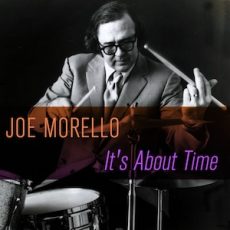
Joseph Albert Morello was born July 17, 1928 in Springfield, Massachusetts of French and Italian ancestry. Suffering from partial vision from birth, he devoted himself to indoor activities. He began studying the violin when he was six and three years later, he was a featured soloist with the Boston Symphony Orchestra, playing Mendelssohn’s Violin Concerto, and again three years later.
By fifteen he met the violinist Jascha Heifetz, decided that he would never be able to equal Heifetz’s sound and switched to drumming. He first studied with show drummer Joe Sefcik and then with educator and author George Lawrence Stone. He was so impressed with Morello’s ideas that he incorporated them into his next book. Further study led him to Radio City Music Hall percussionist, Billy Gladstone.
Moving to New York City, he worked with Johnny Smith, Tal Farlow, Stan Kenton, Phil Woods, Sal Salvador, Marian McPartland, Jay McShann, Art Pepper, and Howard McGhee. After a period of playing in McPartland’s trio, Joe declined invitations from Benny Goodman and Tommy Dorsey, favoring a two-month tour with the Dave Brubeck Quartet in 1955. This turned into a performing and recording residency that lasted for well over a decade, departing in 1967.
As an educator Morello became an in-demand clinician, teacher and bandleader, whose many of his former students went on to become well known in their chosen genres. He authored several drum books, including Master Studies, published by Modern Drummer Publications, made instructional videos and received many awards, and was inducted into several Halls of Fame.
Drummer Joe Morello, who appeared on over 120 albums, died at his home in Irvington, New Jersey on March 12, 2011 at the age of 82.

More Posts: author,bandleader,drums,educator,history,instrumental,jazz,music

Daily Dose Of Jazz…
Frederick Walker was born in St. Louis, Missouri on July 16, 1942. He received his high school equivalency from the United State Armed Forces Institute, then went on to study criminal justice for two years from 1873 to 1975 at St. Louis Community College.
In 1980, Fred founded Star City/St. Louis Records and produced two 45 releases with the Nightwind Band titled Later For That and Why Can’t We. He eventually formed Star City Enterprise encompassing Star City Productions, Star City/St. Louis Records and Saxy Jazz.
His Star City Productions deals with the production of recorded music and the small studio offers digital recording capabilities, CD label production, graphic design and other services related to the production of recorded sound. It also offers copyright registration assistance, music society membership, ISRC encoding and much more.
Soprano and alto saxophonist Fred Walker continues to perform, record and grow his company with new individuals and groups signing on.
More Posts: bandleader,history,instrumental,jazz,music,record producer,saxophone
On The Bookshelf
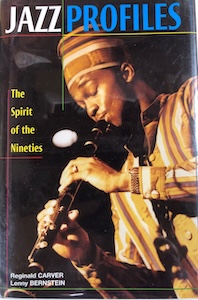
Jazz historian Reginald Carter and jazz photographer Lenny Bernstein present an introduction to the young lions of jazz. Most of these musicians have decided to forgo post-1960s jazz developments, instead mining the treasures of the bop/hard-bop masters. The profiles include a short biography, photo notes, a wonderful black-and-white photograph, recent interview excerpts, and a select discography.
The artists’ thoughts on the upswing in jazz’s popularity and on balancing performing, composing, and recording, provide an overall sense of where these musicians find themselves within the jazz culture.
Arranged according to instrumental groupings, the book features such musicians as Terence Blanchard, Roy Hargrove, Wynton Marsalis, Nicholas Payton, Wallace Roney, Branford Marsalis, James Carter, Joshua Redman, Bobby Watson, Don Byron, Craig Handy, Steve Turre, Bill Frisell, Russell Malone, Geri Allen, Cyrus Chestnut, Marcus Roberts, Christian McBride, Reginald Veal, Cindy Blackman, Jeff “Tain” Watts, and vocalists Dee Dee Bridgewater and Kevin Mahogany.
In this compendium we see those forty musicians who have individually taken the music to its evolutionary continuance.
Daily Dose Of Jazz…
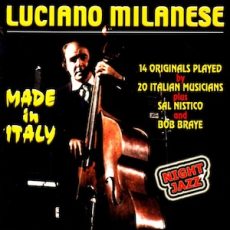
Luciano Milanese was born on Juy 15, 1950 in Genoa, Italy. Little is known about his family life during his early years, however, he learned to play the bass during his formative years. Over the course of his continual career he went on to play in Italy with numerous American jazz musicians including Harry “Sweets” Edison, Art Farmer, Chet Baker,Eddie “Lockjaw” Davis, Johnny Griffin, Sal Nistico, James Moody, George Coleman, Steve Grossman, Slide Hampton, Ray Bryant, Kenny Drew, Walter Bishop, Barney Kessel, Joe Pass, Louis Hayes, Alvin Queen, and Bobby Durham, to name a few.
Bassist Luciano Milanese currently continues to perform and record with important Italian musicians like Gianni Basso, Andrea Pozza, Dado Moroni, Tullio De Piscopo.

More Posts: bandleader,bass,history,instrumental,jazz,music
Daily Dose Of Jazz…
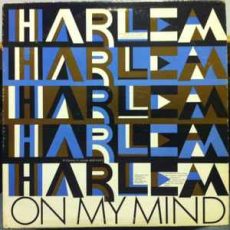
Hank Johnson was born Stuart H. Tresser on July 14, 1949 in the Bushwick section of Brooklyn, New York. He began piano study early in life at age three with Mrs. Henryetta Klein as his first piano teacher. Graduating from George W. Wingate High School in 1967, he continued his education and in 1970 was awarded an AAS Degree in Graphic Arts and Advertising Technology, from New York City Community College. In 1973 a BFA degree was awarded from New York Institute of Technology, with a major in Communication Arts.
He continued his private piano instruction with classical pianist Ms. Malady, who taught piano at the Brooklyn Conservatory of Music. He also received lessons fromMorty Kessler, and Morty Reed, a showband pianist in Las Vegas, Nevada, as well as from Horace Parlan and Teddy Wilson..
Hank learned to write music, and developed the friendship and guidance of Ray Cox, who worked for Machito, as a copyist and arranger. In 1977 Johnson had replaced Jimmy Nottingham’s trio at the Village Door Restaurant and Supper Club in Jamaica, Queens, New York. It was at the Village Door that he got the hands-on experience that ignited his passion to be the best piano player.
He founded the independent record label Jazzbone Records. Presently pianist Hank Johnson is the Director of Tresser Printing Office, a security printer, and a division of Tresser Music, music publishers.
More Posts: bandleader,history,instrumental,jazz,music,piano