

Daily Dose Of Jazz…
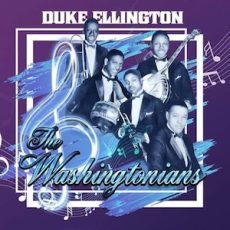
Frederick L. Guy was born in Burkeville, Virginia on May 23, 1897 and was raised in New York City. He played guitar and banjo with Joseph C. Smith’s Orchestra.
In the early 1920s, Guy joined Duke Ellington’s Washingtonians, switching from banjo to guitar in the early Thirties. He remained with Ellington’s orchestra until 1949.
Retiring from music he moved to Chicago, Illinois and for twenty years ran a ballroom. On December 22, 1971 he committed suicide. He was 74 years old.

Daily Dose Of Jazz…
Barron W. “Barry” Rogers was born on May 22, 1935 in The Bronx, New York descended from Polish Jews whose name was originally Rogenstein, and was raised in Spanish Harlem. His father and several of his uncles sang in a choir and his mother taught in Africa and Mexico, inspiring an interest in music from other nations. Mambo and jazz were popular in his neighborhood.
As a student of jazz trombonists Jack Teagarden, Lawrence Brown, and J. C. Higginbotham’s playing, he began performing Latin music in the mid-1950s and would be most associated with it from then on. He developed his style while working with Eddie Palmieri, and Willie Colón regarded Rogers as his strongest musical influence and would feature him in many of his productions. Bobby Valentín would feature Rogers in his song El Jíbaro y la Naturaleza, which led Marvin Santiago to nickname him El Terror de los Trombones for the record.
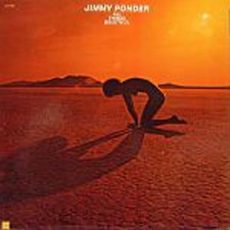
Rogers worked with Israel “Cachao” López, Machito, Manny Oquendo, Celia Cruz, Tito Puente, Cheo Feliciano, Johnny Pacheco, Chino Rodríguez, and the Fania All-Stars. He was a founding member of the band Dreams with Michael Brecker, Randy Brecker, and Billy Cobham. He also worked with George Benson, David Byrne, Ron Carter, Aretha Franklin, Don Grolnick, Bob James, Elton John, Chaka Khan, Bob Moses, Todd Rundgren, Carly Simon, Spyro Gyra, James Taylor, Jimmy Ponder and Grover Washington Jr. as well as others too numerous to name in pop, r&b and rock genres.
Trombonist Barry Rogers, who performed in the jazz and salsa mediums, died suddenly in Washington Heights, Manhattan at the age of 55 on April 18, 1991.
More Posts: history,instrumental,jazz,music,trombone
Daily Dose Of Jazz…
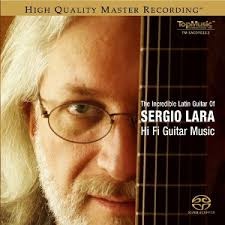
Sergio Lara was born on May 21, 1959 in Mexico City, Mexico and started playing guitar at age nine. Very early he discovered and began studying several musical styles with his greatest influences being John McLaughlin, Jorge Strunz, Paco de Lucia, Tony Rice, Norman Blake, Sam Bush and David Grisman, among others.
Lara appeared on the international music scene in 1983 with the release of his first solo album titled Sergiology. During the following years he formed his own band, New Acoustic Unit, in Nashville, Tennessee and San Antonio, Texas. In 1994 he released a sophomore album Guitarras Hermanas, the first one for Higher Octave Music. This album of all original music, also included a new instrumental version of the very popular and romantic song Sabor a Mi.
1996 saw Sergio releasing his next product titled Two Guitars-One Passion, which received worldwide attention because of its original combination of different musical styles. Throughout the balance of the 1990s he recorded two more albums with instrumental versions of classic songs and his original compositions.
Omn the new millennium he continued to record albums for his new independent label Fusion Acustica Music. With a career that covers many years and more than ten albums under his name, he has shared the stage with Al Di Meola, Larry Carlton, Bireli Lagrene, Dr. John, Craig Chaquico, Joe Sample, Strunz & Farah, Bela Fleck, Sam Bush, Paquito D’Rivera, Julio Iglesias and Ray Charles.
Guitarist Sergio Lara continues to explore new possibilities inside the world of contemporary instrumental music and sharing improvisation.
More Posts: bandleader,guitar,history,instrumental,jazz,music
On The Bookshelf
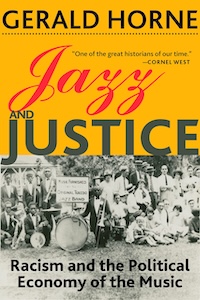
Jazz and Justice explores the rich, complex origins of jazz, the historical American art form born in the late 19th century, most likely in the brothels of Storyville in New Orleans, Louisiana from the cultural traditions of the newly emancipated African Americans. Rooted in the blues, a genre that gave voice to the pain, endurance, and aspirations of the oppressed Black communities under Jim Crow. Jazz emerged from the discarded instruments of post–Civil War military bands and quickly evolved into a profound cultural force.
In this revelatory work, historian and professor Gerald Horne examines the social, economic, and political dynamics that shaped jazz into a singular Black American contribution to global arts and culture. He chronicles the struggles musicians faced in a deeply segregated and exploitative society, contending with organized crime, white supremacist groups like the Ku Klux Klan, and the pervasive racism of American society and the entertainment industry.
Horne gives overdue recognition to the groundbreaking contributions of women artists, such as pianist Mary Lou Williams and trombonist Melba Liston, while also highlighting the influence of musicians with Native American heritage. Jazz and Justice is both an incisive historical investigation and a tribute to the resilience of an art form that gave voice to generations.
Jazz & Justice: 2019 | Gerald Horne
Monthly Review Press
Daily Dose Of Jazz…
Jimmy Henderson was born on May 20, 1921 in Wichita Falls, Texas and began studying piano at age six, picking up the trombone a few years later. By the time he was thirteen he had joined a musicians’ union and was first chair at the Wichita Falls Symphony Orchestra.
Winning several trombone competitions by age fourteen, Jimmy started his own orchestra while still in his teens, in addition to studying at the Cincinnati Conservatory of Music. Henderson toured with the big bands of Hal McIntyre, Jimmy Dorsey, and Tommy Dorsey.
In 1954, he moved to Los Angeles, California where he steadily worked as a session musician for some 20 years. Among his credits in the studios was the soundtrack for Bonanza. From 1957 to 1960, he was also a member of Lawrence Welk’s orchestra in which he appeared weekly on the Maestro’s television show.
He led his own orchestra for fifteen years, and was the musical director for the Emmy Awards, Television Academy Honors, and Directors Guild of America Awards In the 1970s, he led the Glenn Miller Orchestra ghost band before retiring in 1980.
Trombonist and bandleader Jimmy Henderson died at the age of 77 on June 10, 1998 in New York City, New York.
More Posts: bandleader,history,instrumental,jazz,music,trombone