


Requisites
No Blues ~ The Horace Parlan Trio | By Eddie CarterThere’s nothing I enjoy more than listening to a piano trio album and that’s what prompted this morning’s discussion. The Horace Parlan Trio steps into the spotlight with their 1976 album, No Blues (SteepleChase Records SCS-1056). Horace was born in Pittsburgh, Pennsylvania, and was stricken with polio as a child, partially paralyzing his right hand. As a result, he developed a left-hand chord-voicing style and an ability to play with the right hand effectively. Parlan was discovered by Charles Mingus and spent two years with his Jazz Workshop. Over his lengthy career, he recorded with some of the elite musicians in jazz as a leader and sideman. On this date, Horace is joined by a burning rhythm section, Niels-Henning Ørsted Pedersen on double bass, and Tony Inzalaco on drums. The copy used in this report is a friend’s original Danish Stereo release.
Side One gets underway with the trio’s mid~tempo theme on Miles Davis’ No Blues. Horace swings blissfully into the opening solo with flawless execution. Niels-Henning bounces into the second statement with efficient ease, and Tony executes some nifty drumming in a conversation with the piano ahead of the threesome’s reprise and exit. My Foolish Heart by Victor Young and Ned Washington is one of the prettiest jazz standards in The Great American Songbook. Parlan has the solo showcase to himself and applies an equal amount of warmth and tenderness with Pederson and Inzalaco gracefully moving in the background towards a gentle ending. The tempo moves up rapidly for Richard Rodgers and Lorenz Hart’s Have You Met Miss Jones? Tony takes flight first on a brief intro, then Horace kicks off the melody swiftly. Parlan and Inzalaco make it a brightly swinging affair with two energetic readings before the close.
A Theme For Ahmad is Horace’s very moving tribute to Ahmad Jamal. As the song’s only soloist, he gives an elegant performance that’s quite beautiful with Niels-Henning and Tony adding their subtle support into a gorgeous finale. Side Two starts with one of the best-known tunes by Randy Weston, Hi-Fly. Parlan begins with a very pretty introduction segueing into the threesome’s laid-back and tasty opening chorus. Horace takes the lead and swings easily with sprightly notes, then Tony adds a short soulful statement ahead of the ending theme. Up next is a beautiful song by Austin Wells, West of Eden. The rhythm has a bouncing beat and tropical flavor that the ensemble portrays on the melody. Parlan has the only solo spotlight again and gives a delightful interpretation preceding the group’s slow disappearance into nothingness.
The pace picks up for the album’s closer, Holy Land by Cedar Walton. The trio gets into a good groove from the outset of the melody. Horace gives a vivid impression with a fleet lead reading, then Niels-Henning keeps things moving with a joyful excursion into the trio’s reprise and exit. No Blues was produced by Nils Winther and the recording engineer was Freddy Hansson. The sound quality is crystal-clear with superb fidelity that’s audiophile class and the interaction between the trio is exceptional. If you’re a fan of jazz piano or are just discovering Horace’s music for the first time, I invite you to audition No Blues by The Horace Parlan Trio for a spot in your library. It’s an album of beautiful music that’s sure to please your ears with each listen!
~ Darn That Dream, My Foolish Heart, Have You Met Miss Jones? – Source: JazzStandards.com ~ Hi-Fly – Source: Wikipedia.org © 2021 by Edward Thomas Carter

More Posts: choice,classic,collectible,collector,history,instrumental,jazz,music,piano
Daily Dose Of Jazz…
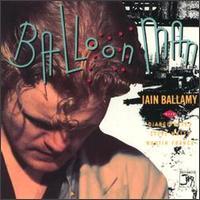
Iain Ballamy was born Guildford, England on February 20, 1964. Taking piano lessons from age of 6 to 14, he received further education at George Abbot School from 1975 to 1980. He went on to study Musical Instrument Technology from 1980 to 1982 at Merton College.
Discovering the saxophone in 1978 with three lessons, his first professional gig was in 1980, playing Ronnie Scotts as the Iain Ballamy Quartet at age 20. He was a founding member of Loose Tubes in 1984. His first recording was with Billy Jenkinsthe following year, and his first solo album, Balloon Man, was released in 1988.
During his career, his performances and recording sessions reads like a who’s who list, including but not limited to Gil Evans, Hermeto Pascoal, Carla Bley, Dewey Redman, George Coleman, London Sinfonietta, Françios Jeanneau, Randy Weston, Clare Martin, Charlie Watts Orchestra, Jeremy Stacey, Jane Chapman, Bryan Ferry, Everything But The Girl, Ian Shaw, Slim Gaillard, Ronnie Scott, Gordon Beck, and one of his closest musical collaborators, Django Bates.
In 1999, Ballamy founded the record label Feral Records, in partnership with graphic artist and filmmaker Dave McKean. He composed the musical score for the movie MirrorMask and the score for the film Luna, both directed by McKean.
Bellamy is currently a visiting professor at the Royal Academy of Music, Birmingham Conservatoire, Trinity College of Music, and the Royal Welsh College of Music & Drama. Modern saxophonist and composer Iain Ballamy continues to explore jazz.

More Posts: bandleader,composer,educator,history,instrumental,jazz,music,saxophone
Daily Dose Of Jazz…
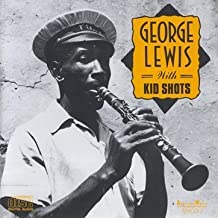
Louis “Kid Shots” Madison was born on February 19, 1899 in New Orleans, Louisiana. He studied cornet under David Jones, Louis Dumaine, and Joe Howard.
In 1915, he becames the drummer in the Colored Waif’s Home band with Louis Armstrong. By 1923, he was playing second cornet with the Tuxedo Brass Band. During the 1930s, he played with the WPA Brass Band and in the Forties he performed as a member of the New Orleans Eureka Brass Band.
In January 1948, cornetist Kid Shots Madison suffered from a stroke and transitioned eight months later in September in his hometown.
More Posts: cornet,history,instrumental,jazz,music

Daily Dose Of Jazz…
Lajos Dudas was born February 18, 1941 in Budapest, Hungary and studied at the Béla Bartók Conservatory and the Franz Liszt Academy of Music in his home city. He then appeared on concert tours throughout in Europe, not only as a jazz and rock musician but also as a soloist in works such as Carl Maria von Weber’s Clarinet Quintet, Igor Stravinsky’s Solo Pieces for Clarinet and Alexander Glazunov’s Concerto for Alto Saxophone. He won international recognition with his successful composition Urban Blues at the 11th International Jazz Competition in Monaco in 1982.
In the 1980s he was ranked high year after year in the Top People Poll of the International Jazz Forum. After his period as a freelance musician from 1963 to 1973, Dudas has been a lecturer at the School of Music in Neuss/GER and also taught from 1975 to 1985 at the Rheinland College of Education. In addition, since 1976, after a spell concentrating on classical music, he was recorded, worked radio productions and tours with Karl Berger, Gerd Dudek, Albert Mangelsdorff, Tom van der Geld, Charles Tolliver, Howard Johnson, Attila Zoller, Philipp van Endert, Leonard Jones, Theo Jörgensmann, Tommy Vig…
Over the course of his career Lajos has composed works commissioned by among several others, Frankfurt Radio Jazz Group, West German Radio & Television/Cologne, and Bavarian Radio Munich, and has performed at major European festivals.
Between 1996 and 2006 he was Artistic Director for the Concert Series in Neuss/GER. He also composed works for clarinet, woodwind chamber music and a Clarinet Method in 2 volumes. Clarinetist Lajos Dudas continues to explore jazz and other genres of music.
More Posts: bandleader,clarinet,composer,history,instrumental,jazz,music
Daily Dose Of Jazz…
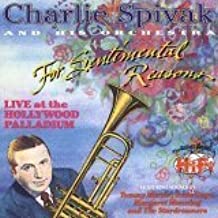
Charlie Spivak was born on February 17, 1905 in Kyiv, Ukraine and learned to play trumpet when he was ten years old. He played in his high school band, going on to work with local groups before joining the Johnny Cavallaro Orchestra.
He went on to play with Paul Specht’s band for most of 1924 to 1930, then spent time with Ben Pollack early Thirties, and the Doresy Brothers to the middle of the decade. Ray Noble was his next stop prior to the Glenn Miller Orchestra in 1935. He spent the next two years working mostly as a studio musician with Gus Arnheim, Glenn Miller, Raymond Scott’s radio orchestra, and others, followed by periods with Bob Crosby, Tommy Dorsey, and Jack Teagarden to the end of the Thirties.
Finally, with the encouragement and financial backing of Glenn Miller, he formed his own band in late 1939. His first attempt was a failure within a year, but his second proved successful, one of the most successful bands in the 1940s, and survived until 1959. He scouted top trumpeter Paul Fredricks (formerly of Alvino Rey’s Orchestra) just as Fredricks left the service at the end of World War II, in 1946. Trumpeter Paul Fredricks was recruited after WWII service and became instrumental in the band’s success in the coming years as it reached its peak.
Spivak’s experience playing with jazz musicians had little effect on his own band’s style, which was straight dance music, made up mainly of ballads and popular tunes. Trombonist Nelson Riddle, saxophonist Manny Albam and Sonny Burke arranged for the band. When the orchestra broke up he went to live in Florida, where he continued to lead a band until illness led to his temporary retirement in 1963. On his recovery, he continued to lead large and small bands, first in Las Vegas, Nevada and then moved to Greenville, South Carolina in 1967, where he led a small group featuring his wife as vocalist.
Trumpeter and bandleader Chalie Spivak, known during his heyday as The Man Who Plays The Sweetest Trumpet In The World, continued to play and record until his transition on March 1, 1982 in Greenville.
More Posts: bandleader,history,instrumental,jazz,music,trumpet