

Daily Dose Of Jazz…
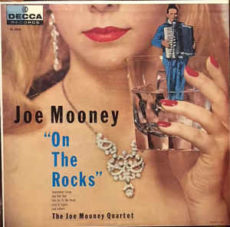
Joe Mooney was born in Paterson, New Jersey on March 14, 1911 and went blind when he was around 10 years of age. His first job, at age 12, was playing the piano for requests called in to a local radio station. He and his brother, Dan, played together on radio broadcasts in the late 1920s, and recorded between 1929 and 1931 as the Sunshine Boys and the Melotone Boys, both sang while Joe accompanied on piano. They continued performing together on WLW in Cincinnati, Ohio until 1936, after which time Dan Mooney left the music industry.
In 1937, he began working as a pianist and arranger for Frank Dailey, a role he reprised with Buddy Rogers in 1938. Through the early 1940s, Joe arranged for Paul Whiteman, Vincent Lopez, Larry Clinton, Les Brown, and The Modernaires. Putting together his own quartet in 1943, he sang and played the accordion with accompaniment on guitar, bass, and clarinet.
In the last half of the 1940s his group experienced considerable success in the United States. By 1946, a newspaper columnist wrote that Mooney’s music “has the most cynical hot jazz critics describing it in joyous terms, such as exciting, new, the best thing since Ellington, and as new to jazz as the first Dixieland jazz band was when it first arrived”. As for Mooney himself, the columnist wrote that he “played in virtuoso fashion … a fellow who knows not only his instrument, but jazz music, both to just about the ultimate degree.”
In the 1950s, Mooney sang with the Sauter-Finegan Orchestra and played with Johnny Smith in 1953. After moving to Florida in 1954 he concentrated more on the organ and recorded in 1956. 1963 saw a group of friends form a company to produce a record, Joe Mooney and His Friends. He recorded again in the middle Sixties. Accordionist, organist, and vocalist Joe Mooney passed away after a stroke at age 64, on May 12, 1975, in Fort Lauderdale, Florida.

More Posts: accordion,bandleader,history,instrumental,jazz,music,organ,vocal
Daily Dose Of Jazz…
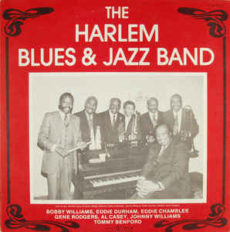
Johnny Williams, Jr. was born on March 13, 1908 in Memphis, Tennessee he learned to play the violin as a child, switched to tuba as a teenager, playing both tuba and the stand-up bass while playing in regional territory bands in the southern states.
A move to New York City in 1936, had him working with jazz luminaries such as Red Allen, Buster Bailey, Sidney Bechet, Benny Carter, J.C. Higginbotham, Billie Holiday, Harry James, James P. Johnson, the Mills Blue Rhythm Band, Frankie Newton, and Teddy Wilson.
In the early 1940s he also played in the bands of Coleman Hawkins and Louis Armstrong before joining Teddy Wilson’s band once again. He and Edmond Hall recorded together in 1944 and worked together until 1947. Following this collaboration, Williams played with Tab Smith and then with Johnny Hodges in the mid-1950s.
From the 1960s onward, Williams was less active, though he worked occasionally with musicians such as Buddy Tate in 1968, Red Richards in the Seventies, and Bob Greene from 1978 to 1982. Tubist and double-bassist Johnny Wiliams Jr. performed with the Harlem Blues and Jazz Band from 1978 to1998 until he had a stroke and passed away later that year on October 23, 1998 in New York City.
Daily Dose Of Jazz…
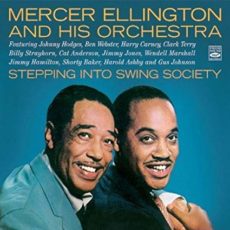
Mercer Kennedy Ellington was born on March 11, 1919 in Washington, D.C. and is the only child of the composer, pianist, and bandleader Duke Ellington and his high school sweetheart Edna Thompson. He grew up primarily in Harlem from the age of eight and by the age of eighteen, he had written his first piece to be recorded by his father, Pigeons and Peppers. He attended New College for the Education of Teachers at Columbia University, New York University, and the Juilliard School.
In 1939, 1946 through 1949, and 1959, Mercer led his own bands, many of whose members later performed with his father, or achieved a successful career in their own right including Dizzy Gillespie, Kenny Dorham, Idrees Sulieman, Chico Hamilton, Charles Mingus, and Carmen McRae. During the 1940s, in particular, he wrote pieces that became standards, Things Ain’t What They Used to Be, Jumpin’ Punkins, Moon Mist, and Blue Serge. He also wrote the lyrics to Hillis Walters’ popular song, Pass Me By in 1946), which was recorded by Lena Horne, Carmen McRae, and Peggy Lee.
Composing for his father from 1940 until 1941, he later worked as the road manager for Cootie Williams’ orchestra in 1941 until 1943 and again in 1954. Ellington returned to work for his father playing alto horn in 1950, and then as general manager and copyist from 1955 until 1959. In 1960, he became Della Reese’s musical director, then later went on to take a job as a radio DJ in New York for three years beginning in 1962. He again returned to his father’s orchestra in 1965, this time as trumpeter and road manager. When his father died in 1974, Ellington took over the orchestra, traveling on tour to Europe in 1975 and 1977.
In the early 1980s, Ellington became the first conductor for a Broadway musical of his father’s music, Sophisticated Ladies which ran from 1981 until 1983. Mercer’s Digital Duke won the 1988 Grammy Award for Best Large Jazz Ensemble Album. From 1982 until the early 1990s, the Duke Ellington Orchestra included Barrie Lee Hall, Rocky White, Tommy James, Gregory Charles Royal, J.J. Wiggins, Onzy Matthews, and Shelly Carrol among others.
Trumpeter, composer, arranger, and bandleader Mercer Ellington, who recorded ten albums as a leader and arranged Clark Terry’s Duke With A Difference album, passed away from a heart attack on February 8, 1996 at age 76 in Copenhagen, Denmark.
More Posts: and bandleader,arranger,composer,history,instrumental,jazz,music,trumpet
Three Wishes
Gil Coggins had only one answer when asked what his three wishes would be:
- “A cold bottle of ale! No, seriously, I don’t know yet.”
*Excerpt from Three Wishes: An Intimate Look at Jazz Greats ~ Compiled and Photographed by Pannonica de Koenigswarter

More Posts: baroness,history,instrumental,jazc,pannonica,piano,three,wishes

Daily Dose Of Jazz…
Ofer Assaf was born in Israel on March 10, 1976 and started learning to play the saxophone as a youth. He attended the Thelma Yellin High School of the Arts dividing his time between his two passions ~ music and dance the latter actually training as a professional ballet dancer at the age of eight before switching over to a full-time jazz career. As a member of the Air Force and IDF Orchestras of the Israeli Army, he performed for former President Bill Clinton, former Prime Minister Yitzhak Rabin, for Jerusalem’s 3,000th-anniversary celebration. During the Nineties, he was a member of the Tel Aviv Big Band as well as performing on a diverse array of national TV and radio shows.
After moving to New York City, he entered The New School University’s jazz program and studied with tenor saxophonist Billy Harper, bassist Reggie Workman, pianist Richie Beirach, trumpeter Jimmy Owens, percussionists Bobby Sanabria and Jamey Haddad. In 2002 upon graduation he performed with Wayne Shorter and Herbie Hancock at Carnegie Hall as part of the JVC Jazz Festival.
In 1991 he won the Israeli National Competition in Jazz and Contemporary Music for young musicians, received scholarships and awards from the Eubie Blake National Jazz Institute from 1999 to 2001, and was pre-nominated for the Grammy Awards in the “Best Jazz Instrumental Album” category in 2009 for his debut album Tangible Reality on Summit Records. He was joined by trumpeter Jim Rotondi, Don Pate and Essiet Essiet on the bass and drummer Bruce Cox. With the Bernie Worrell Orchestra, he was awarded “Best Funk/Fusion/Jam Song of the Year” at the 12th annual Independent Music Awards in 2013. Tenor saxophonist, composer and educator Ofer Assaf continues to perform and record.
More Posts: bandleader,history,instrumental,jazz,music,saxophone