

Requisites
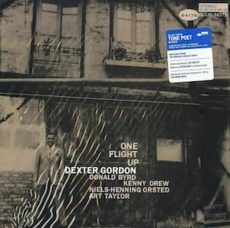
It happened like this; I was choosing several albums to listen to for my next column when a delightful surprise showed up at my door. After auditioning it, I wanted to share my thoughts with you. I first heard this morning’s subject of discussion by Dexter Gordon, One Flight Up (Blue Note BLP 4176/BST 84176) in 1967 during one of my Saturday visits to Record Rendezvous in Cleveland, Ohio. This was his sixth Blue Note album and his second release since moving overseas from the United States. Dexter was a staple on the jazz scene since the forties when he was a member of Billy Eckstine’s Big Band. He was a major influence for two other tenor giants, John Coltrane, and Sonny Rollins. He moved abroad because he was treated more fairly and as an equal than in the US. There was also plenty of work for him and other musicians in some of the best jazz clubs Europe and France had to offer.
In this album, the tenor saxophonist leads a first-class ensemble of Donald Byrd on trumpet, Kenny Drew on piano, Neils-Henning Orsted Pedersen on bass, and Art Taylor on drums. My copy used in this report is the 2021 Blue Note Tone Poet Series Stereo Audiophile reissue sharing the original catalog number. Side One is occupied by Donald Byrd’s Tanya allowing the tenor, trumpet, and piano three lengthy solo opportunities. The rhythm section opens with a brief introduction segueing into a dreamy collective theme. Dexter works his magic first on nearly six minutes of immaculate execution. Donald follows, appealing at every turn on the next reading. Kenny speaks proudly with a firm articulation on the finale that keeps us captivated by Neils-Henning’s and Art’s stylish foundation ahead of the quintet’s closing chorus and gentle dissolve.
Side Two starts with Kenny Drew’s, Coppin’ The Haven. The trio eases into the song with a brief introduction leading to Byrd and Gordon stating the melody to the rhythm section’s infectious beat. Dexter crafts the opening solo with a touch of the blues that sustains its momentum until the conclusion. Donald comes in next with an exquisite reading as smooth as glass. Kenny serves up an impressive final statement preceding the climax. The album ends with the beautiful 1939 standard, Darn That Dream by Jimmy Van Heusen and Eddie DeLange. This is a gorgeous quartet performance opening with a gentle trio introduction. Dexter is the centerpiece here and he produces a beautifully seductive melody and tender first reading. Kenny expresses a gentle warmth on the second interpretation, then Gordon returns to close with a sensuously smooth ending.
One Flight Up was recorded by the French engineer, Jacques Lubin. This Tone Poet reissue was supervised by Joe Harley, and the mastering is by Kevin Gray at Cohearent Audio. The sound quality is spectacular with refreshing clarity and a stunning soundstage that transports the musicians to your listening room. The record was pressed on 180-gram audiophile vinyl and is silent until the music starts. Then, the gatefold photos inside could adorn any wall proudly. Over his nearly forty-year career, Dexter recorded for a host of labels, Bethlehem, Columbia, Decca, Dial, Dootone, Prestige, Savoy, and SteepleChase. However, it was the five years he was at Blue Note (1961-1966) that are among his finest records in my opinion. He passed away on April 25, 1990, at age sixty-seven from kidney failure and cancer of the larynx. If you’re a Hard-Bop fan, I highly recommend One Flight Up by Dexter Gordon. It’s an excellent album where the music speaks to you in a way that’s rewarding listening for any jazz library!
~ Darn That Dream – Source: JazzStandards.com ~ Dexter Gordon – Source: Wikipedia.org © 2021 by Edward Thomas Carter

More Posts: choice,classic,collectible,collector,history,instrumental,jazz,music,saxophone
Daily Dose Of Jazz…
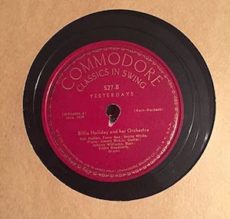
Eddie Dougherty was born July 17, 1915 in Brooklyn, New York. Playing drums from age 13, then started working with Billy Gusak before Dickie Wells’s band at 18 in Harlem, New York by the beginning of the 1930s. He gigged regularly up through 1940 with Kenny Watts & His Kilowatts. His recording career started as a sideman in the 1930s, with Taft Jordan, Frank Froeba, Mildred Bailey, Harry James, Billie Holiday, Frankie Newton, Pete Johnson, and Meade Lux Lewis.
Alongside this he held a gig as the drummer for Keny Watts and his Kilowatts through 1940. He subbed for Dave Tough in the Bud Freeman Orchestra in 1940, then played with Art Tatum, Joe Sullivan, Benny Carter, Benny Morton, and others in the first half of the 1940s. He worked with James P. Johnson several times, including on 1944 recording sessions. His later work included recordings with Cliff Jackson, Mary Lou Williams, Clyde Bernhardt, Wilbur De Paris, Teddy Wilson, and Albert Nicholas. He was still active into the 1980s.
When he finally retired from full-time music decades later, he had amassed a list of credits that not only rivals the length of some short stories, but represented a thorough involvement in many different styles of jazz, vocal music, and rhythm & blues. Drummer Eddie Dougherty passed away on December 14, 1994 in Brooklyn.
More Posts: drums,history,instrumental,jazz,music
Daily Dose Of Jazz…
John James Chilton was born on July 16, 1932 in London, England to working-class parents and was evacuated to Northamptonshire, where he began playing the cornet at the age of 12. Switching to trumpet at 17, after doing two years in the RAF, in 1952 he formed his own jazz band.
He worked in Bruce Turner’s Jump Band from 1958 to 1963 which also had a film of their exploits called Living Jazz in 1961. He went on to play in Alex Welsh’s Big Band. During the 1960s he played piano on some pop recordings, worked in Mike Daniels’ Big Band. He formed his own Swing Kings band which backed touring American jazz musicians including Buck Clayton, Ben Webster, Bill Coleman and Charlie Shavers. He also recorded The Song of a Road, one of the radio ballads by folk singers Ewan MacColl and Peggy Seeger in the 1950s for the BBC.
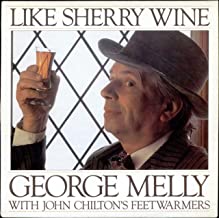
He would go on to work with cartoonist Wally Fawkes, form John Chilton’s Feetwarmers, and began accompanying jazz singer George Melly. Together they made records and toured the world for nearly 30 years. In 1983 and 1984 they had their own BBC television series called Good Time George, and appeared on countless other TV shows.
A songwriter and composer, one of his songs, “Give Her A Little Drop More”, was used in the film St Elmo’s Fire. John is one of the few European writers to win a Grammy Award for his album notes on Bunny Berigan and was nominated again in 2000. He won the British Jazz Award for Writer of the Year, his Who’s Who of Jazz was described as one of the essential jazz books, and he wrote award winning books on Coleman Hawkins, Louis Jordan Sidney Bechet and Louis Armstrong. Trumpeter John Chilton continued to play trumpet with the clarinetist Wally Fawkes in London until he passed away on February 25, 2016 in London.
More Posts: author,bandleader,history,instrumental,jazz,music,trumpet
The Quarantined Jazz Voyager
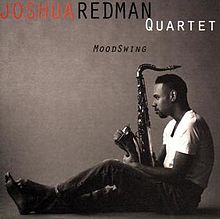
Masking and social distancing are still my mantra in maintaining my health and this time has given me a steady flow of opportunities to sit and listen to albums I have in my collection. So this I am revisiting music that was recorded over a quarter of a century ago. This week I turn to tenor and soprano saxophonist Joshua Redman and his 1994 studio album by his quartet titled Moodswing. All compositions on this album are original and released on the Warner Bros. The album was re-released on vinyl in 2009.
Track Listing | 69:39- Sweet Sorrow
- Chill
- Rejoice
- Faith
- Alone in the Morning
- Mischief
- Dialogue
- The Oneness of Two (In Three)
- Past in the Present
- Obsession
- Headin’ Home
- Joshua Redman ~ tenor, soprano saxophone
- Brad Mehldau ~ piano
- Christian McBride ~ bass
- Brian Blade ~ drums

Recorded on March 8~10, 1994 at the Power Station in New York City. The production team was led by producer Matt Pierson, Jennifer Zeitlin ~ production coordinator, James Farber was the recording/mixing engineer, Greg Calbi and Scott Hull ~ mastering engineers, and Rory Romano, Tony Black ~ engineer assistants. The art direction and design was by Jeri Heiden and Tom Recchion, Jim Merrill did the photography of the band and Marc Hom took the photographs of Joshua. Mary Ann Topper was responsible for management and booking.
Track Listing | 69:39- Sweet Sorrow
- Chill
- Rejoice
- Faith
- Alone in the Morning
- Mischief
- Dialogue
- The Oneness of Two (In Three)
- Past in the Present
- Obsession
- Headin’ Home
- Joshua Redman ~ tenor, soprano saxophone
- Brad Mehldau ~ piano
- Christian McBride ~ bass
- Brian Blade ~ drums
More Posts: adventure,album,club,genius,jazz,museum,music,preserving,restaurant,saxophone,travel
Daily Dose Of Jazz…
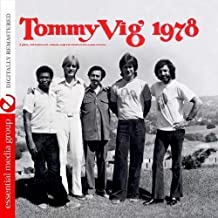
Tommy Vig was born on July 14, 1938 in Budapest, Hungary. Internationally recognized as a child prodigy by the age of 6, he played drums with his father, clarinetist Gyorgy Vig and performed concerts on Budapest State Radio, at the City Theatre, the Academy of Music, and the National Circus. By age 8, he made the album The World Champion Kid Drummer with Austrian jazz players in Vienna, Austria including Hans Koller, Ernst Landl, and the Hot Club of Vienna for Elite Special. The following year his drumming won him the 1947 MGM-Jazz Competition in Budapest and as a result made several recordings with the Chappy’s Mopex Big Band for His Master’s Voice.
Completing his studies at the Bartók Conservatory in 1955 and the Ferenc Erkel Music High School in 1956, due to the crushing of the Hungarian Revolution of 1956, he fled to Vienna, where he played concerts with Fatty George and Joe Zawinul. A move to the United States saw him on scholarship at Juilliard School of Music. Since then he has been writing and conducting concerts.
In 1970 Vig relocated to Los Angeles, California where he worked in the studios of Warner Bros., Fox, Universal, CBS, Columbia, ABC, Disney, Goldwyn, MGM, and Paramount. He played on 1500 studio sessions in Hollywood, two Academy Awards, and produced, directed, and conducted the official 1984 Olympic Jazz Festival for the Los Angeles Olympic Organizing Committee. He wrote the music for 30 films and television shows, and added percussion on the recording of Quincy Jones’s soundtrack to Roots.
Vig has worked with Red Rodney, Don Ellis, Cat Anderson, Terry Gibbs, Art Pepper, Milcho Leviev, Joe Pass, the Miles Davis-Gil Evans Big Band. Frank Sinatra, Sammy Davis Jr., Tony Curtis, Woody Allen, Judy Garland, Tony Bennett and Rod Stewart.
Since 2006, vibraharpist, drummer, percussionist, xylophonist and marimba player Tommy Vig, who has won several awards, has been performing concerts with his wife, appearing on radio and television, and recording albums.
More Posts: bandleader,drums,educator,history,instrumental,jazz,marimba,music,percussion,vibraharp,xylophone