
Daily Dose Of Jazz…
John Fraser MacPherson was born on April 10, 1928 in Saint Boniface, Manitoba, Canada. He moved with his parents to Victoria, British Columbia, Canada as a child where he learned piano, clarinet, and alto and tenor saxophones. After relocating to Vancouver, British Columbia to continue a commerce degree, he played in bands led by Ray Norris, Dave Robbins, Paul Ruhland, and Doug Parke.
He led his own groups and eventually took over the leadership of the Cave supper club band.In 1958 Fraser took a year’s leave to study in New York City, adding flute to his list of instruments.
Throughout the 1960s and 1970s MacPherson was a first-call studio player in Vancouver, as well as leading the house band at the Cave supper club. He also taught briefly in the Jazz and Commercial Music department at Vancouver Community College, where his students included future Powder Blues Band baritone saxophonist Gordie Bertram and New Orleans based saxophonist and jazz educator John Doheny.
Fraser’s debut album as leader of a small jazz group, Live at the Planetarium, was recorded for broadcast on the French-language CBC radio network. He leased the master tapes and released them on his own independent label, West End Records. The album was re-released by Concord Records, and he recorded several other releases for them. He also recorded for Sackville and Justin Time record labels.
In the summer of 1993, Pacific Music Industry Association (PMIA) created the Fraser MacPherson Scholarship Fund which annually awards grants of $2000 to four to eight aspiring music students.
Fraser MacPherson, who won a Juno Award for Best Jazz Album and was awarded the Order of Canada, transitioned in Vancouver at the age of 65 on September 27, 1993.
More Posts: bandleader,clarinet,history,instrumental,jazz,music,piano,saxophone

Requisites
It’s A Blue World ~ The Red Garland Trio | By Eddie Carter
The Red Garland Trio enters the spotlight to begin this discussion with It’s A Blue World (Prestige PRLP 7838/PRST 7838), an excellent 1958 trio session that didn’t hit the stores until 1970. It was Red’s tenth release for Bob Weinstock’s label, and he’s working with a stellar rhythm section, Paul Chambers on bass, and Arthur Taylor on drums. My copy is the 1972 US Stereo reissue (Prestige PRT-7838). Side One starts with This Can’t Be Love by Richard Rodgers and Lorenz Hart from the 1938 musical, The Boys From Syracuse. The trio opens the song at a medium tempo with the pianist’s light touch stating a charming melody. Paul goes first and takes a pleasant walk with the bass; then Red entertains us with a highly satisfying reading while Art’s brushwork keeps them moving into the reprise and close.
The pace slows slightly for Buddy Johnson’s beautiful ballad Since I Fell For You. The album’s longest song allows Garland and the rhythm section a broader canvas on which to work as they cruise through the theme. Red opens with a relaxing interpretation as enjoyable as a day at the beach, and Paul takes a carefree stroll in the closing solo preceding the climax. Crazy Rhythm by Irving Caesar, Joseph Meyer, and Roger Wolfe Kahn begins Side Two at a lively tempo for the trio’s melody. It comes from the musical, Here’s Howe and was initially heard on his 1962 album, Dig It! Red’s opening solo is full of energy, then Paul has a few crisp choruses next, and Art delivers a stirring performance preceding the finale.
In their rendition of the jazz standard, Teach Me Tonight, by Gene De Paul and Sammy Cahn, the trio offers the listener a delightful treat. Garland leads off with a delicately tender opening chorus into a graceful interpretation. Chambers follows with an exquisitely beautiful solo, and then Red returns for a few final thoughts just before the theme’s restatement and a quiet ending. It’s A Blue World by Robert Wright, and George Forrest picks up the pace one final time and closes the album on an upbeat note. The mood is jubilant from the opening notes of the melody. Red starts the solos with a vibrant performance, then steps aside for Paul to walk briskly. Art shares the finale with Red in a lively conversation ahead of the closing chorus.
Bob Weinstock supervised It’s A Blue World, and Rudy Van Gelder was behind the dials of the recording. Despite the album’s stereo being electronically remastered, it’s a solid recording with a splendid soundstage that emerges from your speakers vibrantly. If you’re a fan of Red Garland and enjoy jazz piano trios, as I do, I invite you to consider It’s A Blue World on your next vinyl shopping trip. It’s an excellent album, perfect for listening to any time of day or evening, and it should also make an excellent addition to any jazz library!
~ Dig It! (Prestige PRLP 7229/PRST 7229) – Source: Discogs.com ~ Crazy Rhythm, Since I Fell For You, This Can’t Be Love – Source: JazzStandards.com ~ Teach Me Tonight – Source: Wikipedia.org © 2023 by Edward Thomas Carter
More Posts: choice,classic,collectible,collector,history,instrumental,jazz,music,piano

Daily Dose Of Jazz…
Sharkey Bonano was born Joseph Gustaf Bonano on April 9, 1904 in the Milneburg neighborhood of New Orleans, Louisiana near Lake Pontchartrain. In the 1920s he was in the local bands of Freddie Newman and Chink Martin. After moving to New York City he found work as a member of the Wolverines and with Jimmy Durante.
He worked next to Frankie Trumbauer and Bix Beiderbecke as a member of the Jean Goldkette orchestra. At the end of the 1920s, he led a band which included Louis Prima. During the 1930s he formed the Sharks of Rhythm and played in the Original Dixieland Jass Band. His sidemen during this period included Santo Pecora and Thurman Teague.
After World War II he toured Europe, Asia, and South America, played residencies in Chicago and New York, and then was a regular on Bourbon Street in the New Orleans French Quarter. In 1949, he appeared at the Roosevelt Hotel’s Blue Room and the Famous Door Bar.
Trumpeter Sharkey Bonano transitioned on March 27, 1972, at the age of 67.
More Posts: history,instrumental,jazz,music,trumpet

Daily Dose Of Jazz…
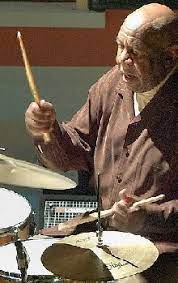
Derek Hogg was born April 8, 1928 in Oldham, England and started playing early in his career with marching bands. He began working in professional ensembles in the Fifties, including those of Freddy Randall, Don Rendell, Joe Saye, Ken Moule, Buddy Featherstonhaugh, Kenny Baker, Sandy Brown and Al Fairweather’s All Stars group.
He played with Vic Lewis in 1959-1960, then with The Squadronaires and Dudley Moore in the first few years of the decade. In 1962 he began working with Danny Moss, with whom he would continue to perform until the end of his career. Hogg went on to perform with Rosemary Clooney, Tony Coe, Digby Fairweather, Budd Johnson, Colin Purbrook, Benny Waters and Teddy Wilson.
Drummer Derek Hogg retired from active performance in 1987.
Confer a dose of an Oldham drummer to those seeking a greater insight about the musicians around the world who are members of the pantheon of jazz…
Derek Hogg: 1928 | DrumsMore Posts: drums,history,instrumental,jazz,music