

Daily Dose Of Jazz…
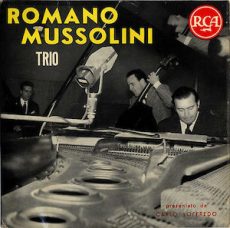
Romano Bruno Mussolini was born on September 26, 1927 in Villa Carpena, Forlì,Italy. He was the fourth child and youngest son of Il Duce, Benito Mussolini. He studied music as a child, playing classical pieces with his father on the violin. After World War II, he started playing jazz under the alias Romano Full.
By the mid-1950s, he formed a trio and in 1956 released a self-titled record featuring Lilian Terry on vocals and trumpeter Nunzio Rotondo on RCA Records. The Sixties saw him form the Romano Mussolini All Stars, which became one of Italy’s foremost jazz bands.
The All Stars recorded a well-received record Jazz Allo Studio 7 in 1963 with At the Santa Tecla following a year later. Romano’s band toured internationally with Dizzy Gillespie, Duke Ellington, Helen Merrill and Chet Baker, among others. In the 1990s he recorded two more albums, Perfect Alibi and Soft and Swing.
His playing style has been described as “like a slightly melancholic Oscar Peterson. Occasionally inspired, he was always efficient; he made the refrains run on time.
Pianist Romano Mussolini, who was also a painter and film producer, transitioned on February 3, 2006, at the age of 78, in a hospital in Rome, Italy from heart problems.

More Posts: bandleader,history,instrumental,jazz,music,piano
Daily Dose Of Jazz…
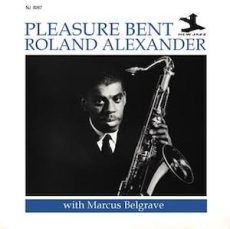
Roland Alexander was born in Boston, Massachusetts on September 25, 1935 and grew up with his parents and sister, Gloria, in Cambridge, Massachusetts. He earned a bachelor’s degree in music composition from the Boston Conservatory in 1958.
A prolific composer and arranger, Alexander wrote and played for many of the better known bands in Boston during the 1950s, associating himself with Sabby Lewis, Preston ‘Sandy’ Sandiford, Richie Lowery, Jaki Byard and many more. He co-led a group called the Boston All Stars that featured trumpeter Joe Gordon, and after Joe Gordon left to play with Dizzy Gillespie’s band, he was replaced by Wajid Lateef (Crazy Wilbur Lucaw), and Gordon Wooly.
In 1956 he recorded High Step as a sideman with bassist Paul Chambers before moving to New York City the year he graduated from the conservatory. In addition to a 1961 and 1978 release as a leader, he played and recorded with John Coltrane, Howard McGhee, Max Roach, Sonny Rollins, Roy Haynes, Philly Joe Jones, Blue Mitchell, Sam Rivers, Archie Shepp, and Mal Waldron.
Post bop saxophonist Roland Alexander, who in addition to playing tenor and soprano saxophone was also a pianist, transitioned on June 14, 2006.
More Posts: bandleader,history,instrumental,jazz,music,piano,saxophone
The Jazz Voyager
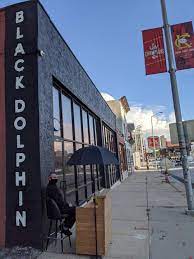
Last week the Jazz Voyager was in Nashville checking out Rudy’s Jazz Room and had a great experience. This week he’s on his way and looking forward to another wonderful experience in Kansas City, Missouri at The Black Dolphin located at 1813 Grand Boulevard. Planning to catch an early set with the Tim Whitmer Quartet, I’ll be hanging around for the late hit by the Reyes Brothers Trio, both on Friday night..
Depending on which set you catch you can dine in or eat beforehand and then enjoy a full bar of cocktails, mocktails, wine and beer. The first set begins at 6:30~9:30pm followed by the second set 10:00pm ~ 1:00am. Rated $$, come and enjoy an evening of good music. For additional information, the number is 816-215-2954.
More Posts: adventure,album,club,festival,genius,jazz,museum,music,piano,preserving,restaurant,travel
Daily Dose Of Jazz…
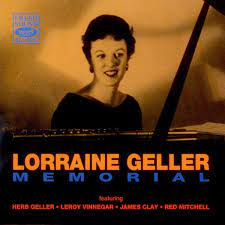
Lorraine Winifred Geller was born Lorraine Walsh on September 11, 1928 in Portland, Oregon. She started out with the all-female big band Sweethearts of Rhythm, based in New York. She met saxophonist Herb Geller, married him in 1951, and together they moved to Los Angeles, California where they played with many musicians on the West Coast jazz scene, such as Shorty Rogers, Zoot Sims, Stan Getz, and Red Mitchell. She also did sessions with Charlie Parker and Dizzy Gillespie.
In 1957, she accompanied Kay Starr and the following year, concentrating on raising her daughter, she pared down her performances. She did, however, play at the first Monterey Jazz Festival. On October 13, 1958 pianist Lorraine Geller transitioned in Los Angeles, attributed to heart failure or pulmonary infection.
More Posts: bandleader,history,instrumental,jazz,music,piano
Daily Dose Of Jazz…
Herman Davis Burrell was born September 10, 1940 in Middletown, Ohio and grew fond of jazz at a young age after meeting Herb Jeffries. He studied piano and music at the University of Hawaii from 1958 to 1960, then starting in 1961 he attended the Berklee College of Music in Boston, Massachusetts. 1965 saw him walking across the stage to receive degrees in composition/arranging and performance. While in Boston, he played with Tony Williams and Sam Rivers.
After graduation Dave moved to New York City, where he worked and recorded with Grachan Moncur III, Marion Brown, and Pharoah Sanders. He also started the Untraditional Jazz Improvisational Team with saxophonist Byard Lancaster, bassist Sirone, and drummer Bobby Kapp. Three years later he co-founded The 360 Degree Music Experience with Moncur and Beaver Harris, recording two albums with the group. The following year, Burrell began an association with Archie Shepp, with whom he would play the 1969 Pan-African Festival in Algiers, Algeria. They would go on to record nearly twenty albums.
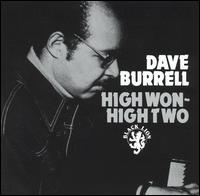
Burrell’s debut as a leader was an album titled High Won-High Two that was released in 1968. This was followed by Echo and La Vie de Bohème recorded in Paris in 1969, and Round Midnight for Nippon Columbia.
In 1978, with Swedish poet and lyricist Monika Larsson he composed a jazz opera entitled Windward Passages, with an album of the same name, based on the opera, released in 1979. Their touring and recording collaborations resulted in four more albums. He would later appear on seven David Murray albus recorded between 1988 and 1993.
Burrell tours and performs as a soloist and as a leader of a duo, trio, and larger ensembles. His recordings have received high praise from Down Beat, Village Voice, Jazz Times and others. Into the new millennium he has continued to perform, record and release several albums including a live recording in Italy. In 2022, pianist Dave Burrell donated his archive to the Center for American Music in the University of Pittsburgh Library System. He continues to be active in jazz.
More Posts: bandleader,composer,history,instrumental,jazz,music,piano