

Daily Dose Of Jazz…
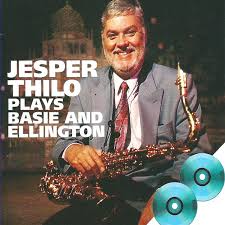
Jesper Thilo was born on November 28, 1941 in Copenhagen, Denmark to a pianist-actress mother and architect father. He started to play clarinet at age 11 and from 1955 to 1960 he played clarinet and trombone in various amateur Dixieland jazz bands with the occasional paid jobs as a musician. Early he knew that he wanted to become a professional jazz musician but to get an education he chose to study classical clarinet at the Royal Danish Academy of Music.
While at the Academy, Thilo joined Arnved Meyer’s orchestra from 1960 to 1964 and again from 1967 to 1974 and it was Meyer who convinced him to shift to saxophone. He would go on to play with Ben Webster, Benny Carter, Harry Edison, Roy Eldridge and Coleman Hawkins. During this part of his career his virile swing style was chiefly inspired by Webster and Hawkins and his own quintet which he put together in 1965 and co-lead with Torolf Mølgaard and Bjarne Rostvold.
From 1966 to 1989, he was a member of the DR Big Band under bandleaders Palle Mikkelborg and Thad Jones. He mainly played alto saxophone but occasionally also tenor saxophone, soprano saxophone, baritone saxophone, concert flute, clarinet or bass clarinet. Through the Eighties, Jesper played in Ernie Wilkins’ Almost Big Band. Other collaborators have included Wild Bill Davison and Niels Jørgen Steen.
By 1989, leaving the DR Big Band and Ernie Wilkins’s orchestra he led his own bands with Søren Kristiansen, Olivier Antunes, Hugo Rasmussen og Svend-Erik Nørregaard. He first recorded as a leader for Storyville Records in 1973 and in the 1980s on Storyville his sidemen at various times included Kenny Drew, Clark Terry and Harry “Sweets” Edison, and appeared on the Miles Davis album Aura.
Considered to be one of the top European straight-ahead jazz musicians of the post-1970 period, tenor saxophonist, alto saxophonist, clarinetist and flutist Jesper Thilo continues to perform and record.

More Posts: bandleader,clarinet,flute,history,instrumental,jazz,music,saxophone
Requisites
Cannonball Adderley Live! | By Eddie Carter
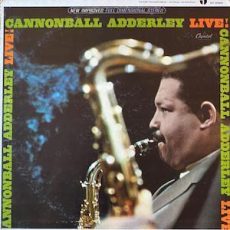
Alto saxophonist Cannonball Adderley steps into the spotlight of this morning’s discussion with his first live album after leaving Riverside. Cannonball Adderley Live! (Capitol Records T 2399/ST 2399) is a live date highlighting his sextet’s performances over three nights at Shelly’s Manne Hole in 1964! It hit the stores a year later and he’s joined on stage by brother Nat Adderley on cornet, Charles Lloyd on flute and tenor sax, Joe Zawinul on piano, Sam Jones on bass, and Louis Hayes on drums. Lloyd joined Cannonball’s group after Yusef Lateef left, and this is the only album I’m aware of that he recorded with the sextet. My copy used in this report is the original US Stereo release.
Cannonball introduces the set’s first tune, Little Boy With The Sad Eyes by Nat Adderley. Charles sets the introduction for the sextet’s collective theme on flute with a tender interlude by Joe. Nat paves the way for the others with a vivacious statement. Cannonball plants some firm roots on the second reading, next Charles adds an abundance of swinging ideas preceding leading the ensemble into a soft summation. Up next is Nat’s contemporary jazz classic, Work Song. Cannonball begins this tune with a concise introduction anchored by the group ahead of their feisty melody. The altoist is up first with a mesmerizing interpretation. Nat responds with a spirited solo leading to the ending theme and the leader’s remarks.
Sweet Georgia Bright, the first of two tunes by Charles Lloyd begins Side Two at a frenzied pace as the sextet rips into the torrid theme furiously. Charles has the first say and wails like the Road Runner traveling at breakneck speed. Nat moves with the fury of a violent whirlwind preceding the ensemble’s swift reprise and abrupt exit. The Song My Lady Sings is a very pretty ballad that could fit perfectly in a love story soundtrack. Cannonball and the rhythm section open the song tenderly. Nat and Charles add their haunting horns to complete the melody. Cannonball caresses each note of the first solo delicately. Nat enters next using the mute to build a warm, moving reading, next Joe delivers a luxuriously rich four-minute performance ahead of Cannonball’s postscript and gentle ending.
The Theme aka Unit 7 by Sam Jones allows Cannonball to address the audience and acknowledge his bandmates who end the set on an upbeat note. Cannonball Adderley Live! was produced by David Axelrod. It’s unknown who the recording engineer was, but the sound quality is quite good, placing the listener in the audience each night. A decade after this album was released, Cannonball suffered a stroke from a cerebral hemorrhage. He passed away at age forty-six on August 8, 1975. He also recorded for Blue Note, EmArcy, Fantasy, Mercury, and Riverside over his two-decade career and his legacy is an extensive discography including some albums as a leader and sideman that have stood the test of time. If you’re in the mood for some good live jazz, I invite you to check out Cannonball Adderley Live! It’s an underappreciated and overlooked gem deserving of a wider audience and a title I recommend for your library!
~ Cannonball Adderley – Source: Wikipedia.org ~ © 2022 by Edward Thomas Carter
More Posts: choice,classic,collectible,collector,history,instrumental,jazz,music,saxophone
Daily Dose Of Jazz…
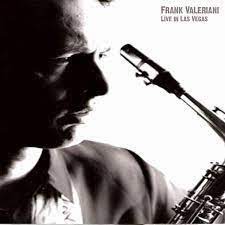
Frank J. Valeriani was born in Newark, New Jersey on November 26, 1966. He started studying saxophone at age of 15. When his family moved to Italy he put together his first mediterranean blues oriented band. While living in Italy he graduated magna cum laude from the music conservatory in Naples. After the conservatory years he started several bands, including jazz, fusion and latin jazz, and peformed at several festivals before moving north to Milano, Italy.
In Milano He studied songwriting, arranging and jazz at the alternative contemporary music school, Professional Music Center, graduating with excellent scores. During his Italian years he performed with Wess, Rocky Roberts, Cristiano Malgioglio, Peppino Gagliardi, Nello Daniele and others. He was music coordinator and conductor of the folk show Quanno Tramonta ‘o Sole that toured all over Italy for several years. He also toured with Maestro Gianni Mazza and performed on Italian tv networks.
Deciding to move back to the states he chose Las Vegas, Nevada for its musical activity. He performed with some of the best musicians in town, such as The Platters, The Drifters, jazz singers Nancy Kelly and Tony Bennett. Frank also performs with the Frank Valeriani Band all over the town.
He plays jazz, smooth jazz, and pop, doubles on percussion, rhythm guitar & keyboards and enjoys back up singing when required. As an educator he teaches saxophone and harmony in music schools. Saxophonist Frank Valeriani is also a composer and arranger and continues to perform and teach.
More Posts: arranger,bandleader,composer,history,instrumental,jazz,music,saxophone

The Jazz Voyager
Getting back on a plane once more and in an enclosed space I continue to mask up to protect myself because these variants are steadily morphing. People are still dying daily, maybe not at the rate of its height but nonetheless keep yourself safe.
This Jazz Voyager has decided to head up the East coast and make the sojourn to New England as his next stop. This is where a day earlier I will resume visualizing the autumn colors of this neck of the woods, as they say. I hope to get near some lake water to see the reflection which I’ve missed for many years. So my next stop is Old Lyme, Connecticut for a jazz encounter with bassist Matthew Parrish and saxophonist Houston Person at The Side Door. Located within the Old Lyme Inn at 85 Lyme Street 06371.
These two musicians, an elder master and a mature performer are perfectly matched to bring not only the romance but the heat as they most definitely swing together. This 68 seat venue brings an air of intimacy to every performance. For more information visit notoriousjazz.com/event or thesidedoorjazz.com. The club’s number is 860.434.2600.
More Posts: adventure,album,bass,club,festival,genius,jazz,museum,music,preserving,restaurant,saxophone,travel

Three Wishes
Baroness Pannonica asked Jimmy Heath if he was given three wishes what would they be. He replied:
- “I wish it would be possible that the statement they make, that “you have paid your debt to society,’ would be true. I mean, when you’ve been to prison, when you come home, it’s suppose to be cool. But you still have a record, it still follows you. It’s always there.”
- “If the world is made over, I would like everyone to be made the same color. Then everyone would be judged by their merits, individually.”
- “I wish I could transfer this wish to my wife.”

More Posts: baroness,history,instrumental,jazz,music,pannonica,saxophone,three,wishes