

Daily Dose Of Jazz…
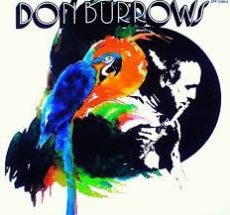
Donald Vernon Burrows was born on August 8, 1928 Marrickville, New South Wales, Australia and attended Bondi Public School. In 1937, visiting flutist and teacher Victor McMahon inspired him to start learning the flute, beginning on a B-flat flute. By 1940 he was captain of the Metropolitan Schools Flute Band and studying at the Sydney Conservatorium of Music.[2]
In 1942, Burrows had begun playing clarinet and appeared on The Youth Show, a Macquarie Radio show. In 1944 he was invited to play and record with George Trevare’s Australians. He became well-known in Sydney jazz circles and was performing in dance halls, nightclubs and radio bands.
During the 1960s and 1970s, Burrows had many engagements in Australia and the United States, including six years performing at the Wentworth Hotel in Sydney. In 1972, he was invited to perform at the Montreux Jazz Festival[4] and later the Newport Jazz Festival.
He received his first gold record in 1973 for his record Just the Beginning, instigating the first jazz studies program in the southern hemisphere, at the New South Wales Conservatorium of Music. He was appointed a Member of the Order of the British Empire (MBE) and appointed Chair of Jazz Studies at the conservatorium.
Though he mostly performed to classical music audiences through tours with Musica Viva and the Australian Broadcasting Corporation concert series, he had an extensive recording career with his groups and performed on albums by others. He also worked with Frank Sinatra, Dizzy Gillespie, Nat King Cole, Oscar Peterson, Tony Bennett, Stéphane Grappelli, Cleo Laine, and the Sydney Symphony Orchestra.
His arthritis from age 38, though making it somewhat difficult to play, never stopped him. In later years he had Alzheimer’s disease and lived in a nursing home in northern Sydney. Saxophonist, flutist and clarinetist Don Burrows transitioned on 12 March 12, 2020, aged 91.

More Posts: bandleader,clarinet,flute,history,instrumental,jazz,music,saxophone

Requisites
Cherry ~ Stanley Turrentine With Milt Jackson | By Eddie Carter
Two of my favorite musicians are the subject of this morning’s discussion, Stanley Turrentine With Milt Jackson. Cherry (CTI Records CTI 6017) hit the stores in 1972 and was Turrentine’s fourth album on CTI. On this date, the tenor saxophonist’s leading an all-star sextet. Milt Jackson on vibes, Bob James on piano (track: A2), electric piano (tracks: A1, A3, B1 to B3), Cornell Dupree on guitar, Ron Carter on bass, and Bill Cobham on drums. My copy used in this report is the original US Stereo release.
Side One starts with the rhythm section’s spirited introduction to Speedball by Lee Morgan. The ensemble’s theme leads off this happy swinger, then Stanley cruises into the opening solo. Milt gets into a bluesy groove next, and Bill exchanges the finale with Stanley, Milt, and Bob ahead of the climax.
I Remember You by Johnny Mercer and Victor Schertzinger is a beautiful 1941 ballad that was first heard in the film, The Fleet’s In, a year later. Milt and the rhythm section introduce the song discreetly, segueing into a gentle opening chorus. Jackson is up first with a tender reading, then Turrentine gives an elegant presentation leading to a serene ending. The Revs by Milt Jackson swings at a leisurely tempo with the sextet in unison during the melody. Stanley steers a nice course for everyone with a carefree, bouncy first solo. Milt follows with melodic lines that emerge effortlessly from his vibes. Bob and Cornell close out the statements with two lightly swinging readings preceding the sextet taking the song out.
Side Two starts with Sister Sanctified by Weldon Irvine Jr who also arranged this tune. The sextet starts this swinging jazz service with a funky groove on the melody that’s sure to get the listener snapping their fingers and tapping their toes. Turrentine sets the tone on the opening statement with a soulful sermon. Jackson preaches the second solo rocking all the way. Dupree hits the sweet spot on the next reading and Cobham makes a brief comment leading to the theme’s reprise and fade-out. Cherry by Ray Gilbert and Don Redman begins with the vibist setting down a subtle theme at a slow tempo. Stanley opens with a wonderful expression of incredible beauty, then Milt responds with a delicately pretty performance moving towards a gorgeous finale.
Weldon Irvine Jr. also composed and arranged the album’s closer, Introspective. This is a mid tempo jaunt of pure pleasure leading off with Turrentine’s cheerful theme and lighthearted opening solo. Jackson comes in next for a delightful interpretation. James follows with a fine reading and Cobham swings the door shut with his brushwork. Cherry was produced by Creed Taylor and the man behind the dials was Rudy Van Gelder. This is a great recording and an excellent vinyl pressing for a 1970s album with a splendid soundstage. The instruments come through your speakers vividly and surround your sweet spot with music that’s sure to make you smile. Both Stanley Turrentine and Milt Jackson are a joy to hear together with a wonderful supporting cast. If you’re a fan of either musician, I recommend and invite you to check out Cherry on your next vinyl hunt. It’s a great album that still stands up fifty years later and your ears will thank you for adding it to your library!
~ I Remember You – Source: JazzStandards.com © 2022 by Edward Thomas Carter

More Posts: choice,classic,collectible,collector,history,instrumental,jazz,music,saxophone,vibraphone
Daily Dose Of Jazz…
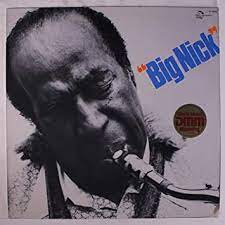
George Walker “Big Nick” Nicholas was born August 2, 1922 in Lansing, Michigan. Picking up the tenor saxophone during his teen years, he was strongly influenced by his hero, Coleman Hawkins. He started playing professionally during the 1940s with Hank and Thad Jones, Earl Hines, and Tiny Bradshaw prior to military service.
Once discharged from the Army late in the decade he went on to work with bands led by Sabby Lewis, J. C. Heard, and Lucky Millinder. He would go on to play with Duke Ellington, Cab Calloway, Charlie Parker, and Charlie Mingus.
Nicholas contributed the 16-bar solo to Dizzy Gillespie’s classic 1947 African-Cuban jazz composition Manteca. At that time, he also started playing with Hot Lips Page, a working relationship that continued until 1954. He then joined Buck Clayton in 1955.
Big Nick influenced a young John Coltrane to compose his tribute Big Nick, included on the 1962 album Duke Ellington & John Coltrane.
Saxophonist and singer Big Nick Nicholas transitioned from heart failure in Queens, New York on October 29, 1997 at the age of 75.
More Posts: bandleader,history,instrumental,jazz,music,saxophone

Daily Dose Of Jazz…
Walt Weiskopf was born in Augusta, Georgia on July 30, 1959 and grew up outside of Syracuse, New York. His father, a physician by profession, was also a serious classical pianist. Classically trained, it wasn’t the albums of Al Hirt or Herb Alpert his mother brought home but Miles Ahead that turned his attention. Already filled with Charlie Parker, Stan Getz, Dexter Gordon and John Coltrane at 14 he set his sight in earnest on jazz. At 16, he began playing alto saxophone in a local big band alongside the great tenorist J.R. Monterose, who became his first mentor.
Heading to the Eastman School of Music in Rochester, New York, Walt acquired a B.A. and after a move to New York City at twenty in 1980 he made a name for himself in jam sessions and was drafted into the Buddy Rich Big Band, adding tenor to his arsenal. By 1983, he began a 14-year association with Toshiko Akiyoshi, touring and recording with her jazz orchestra and small group.
The late ’80s, saw him playing with and writing for his first quartet that included his brother Joel, bassist Jay Anderson, and drummer Jeff Hirshfield. In 1989, he released his debut album as a leader, Exact Science, with that band. A sextet album followed as his sophomore project with Conrad Herwig, Andy Fusco, Joel Weiskopf, Peter Washington, and Billy Drummond. This began a long association with Criss Cros,s Jazz in which eleven albums were recorded and released.
His latest project, the debut of the European Quartet takes him further into his composing, arranging and thematic compositions. The group has released a number of albums, such as Worldwide, Introspection and Introspection 2.0, and a three song ep A Little Christmas Music.
As outstanding as this output is and all of his efforts as a sideman are (he is especially great on Billy Drummond’s Dubai), Weiskopf is best known to many fans for his work with Steely Dan over the past 20 years—before and after the untimely passing of its genius co-founder Walter Becker in 2017.
As an educator he has taught at numerous schools including the Eastman School of Music, Temple University, New Jersey City University and the New School. He published numerous books, Intervalic Improvisation, Around the Horn, and Understanding the Diminished Scale. Moving to Virginia, he retired from teaching and working commercially and is concentrating on practicing and composing.
Tenor saxophonist, composer, arranger and educator Walt Weiskopf, who was a 20 year staple of the studio-only jazz rock fusion band Steely Dan, continues to push the realm of his music.

More Posts: arranger,bandleader,composer,educator,history,instrumental,jazz,music,saxophone

Daily Dose Of Jazz…
Darnell Howard was born on July 25, 1895 in Chicago, Illinois and began playing violin at age seven, picking up clarinet and saxophone later in his youth. He began playing professionally with John H. Wickcliffe’s Ginger Orchestra from 1913 to 1916.
Moving to New York City in 1917, Darnell played and recorded as a violinist with W. C. Handy, then headed back to Chicago, where he led his own band, played with Charlie Elgar before joining James P. Johnson’s Plantation Days Band, which toured London, England in 1923. The following year he toured Europe again as a member of the Singing Syncopators that also played in Shanghai later in the decade.
His Chicago years saw him playing with Carroll Dickerson, King Oliver, and Erskine Tate, Jerome Carrington, Dave Peyton and Earl Hines. He led a quartet in 1928, but his jazz violin is featured on the Hines band’s February, 1933 recording of the Earl Hines/Jimmy Mundy swing composition Cavernism.
In the late 1930s, Howard was freelancing into the Forties and playing with Fletcher Henderson and Coleman Hawkins, and putting together another band in Chicago from 1943 to 1945. He would go on to play with Kid Ory in California for part of 1945, then returned to Chicago and back again in 1948 with Muggsy Spanier until 1953. His only recordings as a leader were done while he worked with Bob Scobey in 1950, amounting to only four sides.
Through the 1950s he played with Jimmy Archey, rejoined Earl Hines to play Dixieland in San Francisco, California and recorded with Don Ewell on his 1956–1957 albums. Sometime after 1962 Darnell suffered a prolonged illness and after recuperating he played with Elmer Snowden, Burt Bales, and his own groups. His final tour in 1966, was in Europe as a member of the New Orleans All-Stars, then he fell ill again. Clarinetist, violinist and alto saxophonist Darnell Howard transitioned on September 2, 1966 in San Francisco.
More Posts: bandleader,clarinet,history,instrumental,jazz,music,saxophone,violin