

The Quarantined Jazz Voyager
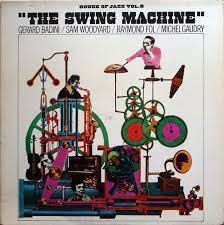
Closing out the final week of the month is The Swing Machine. It’s another offering from the continent that this Jazz Voyager has discovered not in his collection but one that requires sharing.The title really says it all so aptly named by tenor saxophonist Gérard Badini in preparation for a good time!
The album was recorded May 30, 1975 at the Hoche Studio in Paris, France and was produced by Jacques Lubin. The recording engineer was Gerhard Lehner, the liner notes were written by Alexandre Rado, and the photography by Christian Rose.
Tracks | 44:48- It Don’t Mean A Thing (Duke Ellington, Irving Mills) ~
- Let’s Do It (Cole Porter) ~
- Sam Woodyard Is Back In Town (Gérard Badini) ~
- Cute (Neal Hefti)
- Asphodèle (Raymon Fol) ~
- Stomp, Lok And Listen ( Duke Ellington) ~
- Michel Gaudry ~ Double Bass
- Drums – Sam Woodyard ~ Drums
- Raymond Fol ~ Piano, Celesta
- Gérard Badini ~ Tenor Saxophone

More Posts: adventure,album,club,genius,jazz,museum,music,preserving,restaurant,saxophone,travel
T.K. BLUE/BILLY HARPER
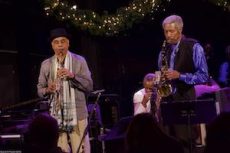
T.K. Blue/Billy Harper: “The Magic of Randy Weston and Melba Liston”
T.K. Blue and Billy Harper in collaboration for a tribute to T.K.’s long-time band-leader and mentor NEA Jazz Master Dr. Randy Weston and the extraordinary Trombonist/Arranger/Composer/Educator Melba Liston! Enjoy 3 nights of performances Live & Online at Keystone Korner Baltimore, Fri-Sun, July 8-10!
T.K.Blue, alto and soprano sax, flute, kalimba
Billy Harper, tenor sax
Eric Kennedy, drums
Janelle Gill, piano
Obasi Akoto, bass
Showtimes: 7:30 & 10:00 pm
Streaming: Fri, Sat, Sun ~ $10 + $1.70 fee
Live: Fri, Sat, Sun ~ $35 – $45 + $3.46 – $4.16 fee
More Posts: adventure,album,club,genius,jazz,museum,music,preserving,restaurant,saxophone,travel

Daily Dose Of Jazz…
Luther Thomas was born on June 23, 1950 in St. Louis, Missouri. Known for his free jazz playing and drawing from funk. Coming out of the Black Artists Group (BAG) of St. Louis in the late Sixties, he was one of the original voices from a scene that also bred such names as Oliver Lake, Julius Hemphill, Baikida Carroll, John Zorn and Joseph Bowie.
Luther played in the Human Arts Ensemble with Charles Bobo Shaw in the 1970s, and led a group called Dizzazz in the early 1980s. He played saxophone for James Chance and the Contortions.
As a leader he had recording sessions from the early 1970s he has recorded eleven albums. They have been reissued on CD as part of Atavistic Records’ Unheard Music Series. In 1998 he settled in Denmark and became a cult musician in Christiania Freetown, performing there weekly.
Alto saxophonist and multi-instrumentalist Luther Thomas was a completely intuitive improvisor and a free spirit who reached a level of intensity on the saxophone reached by very few others, transitioned at the age of 59 on September 8, 2009 in Denmark.

More Posts: bandleader,history,instrumental,jazz,music,saxophone
Daily Dose Of Jazz…
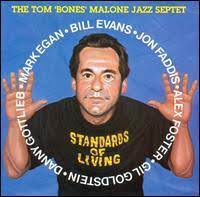
Thomas “Bones” Malone was born June 16, 1947 in Honolulu, Hawaii. He began playing professionally as lead trumpeter for Brenda Lee at a club in Jackson, Mississippi while enrolled at the University of Southern Mississippi. In response to a call from Warren Covington, leader of the Tommy Dorsey Orchestra, he began contracting musicians. After transferring to North Texas State University, Malone continued working as both a player and a contractor for groups. He graduated from North Texas State University with Lou Marini, and both were members of the One O’Clock Lab Band at North Texas.
After graduation, he worked in bands of Woody Herman in 1969, and during the early Seventies he worked with Duke Pearson, Louie Bellson, Doc Severinsen, Frank Zappa, and Blood, Sweat & Tears. In 1973, Malone began a close, fifteen-year association with Gil Evans, whom he has called a mentor. He recorded albums with Evans and toured Europe, Japan, and the Far East. In 1975 Malone toured with Billy Cobham and in 1976 with The Band.
From 1975 to 1985 he worked as arranger for Saturday Night Live and from 1981 to 1985 as musical director. He wrote the chart for the skit that introduced John Belushi and Dan Aykroyd as the Blues Brothers and worked on the film score for Blues Brothers 2000. He joined the CBS Orchestra in 1993, and contributed more than 1,600 arrangements to the Late Show with David Letterman.
As a studio musician, he has been heard on more than 1,000 records, more than 3000 radio and television commercials, and over 4,000 live television shows. In 2007 Bones was invited by music director Geoffrey Moull to arrange and perform a concert with the Thunder Bay Symphony Orchestra. In 2011 Malone was a guest artist with the University of Southern Mississippi Symphony Orchestra.
Trombonist, arranger, and producer Tom Malone, who also plays saxophone, trumpet, tuba, flute, and bass guitar, continues to expand his creative reach.
More Posts: bass guitar,flute,history,instrumental,jazz,music,saxophone,trombone,trumpet,tuba
The Quarantined Jazz Voyager
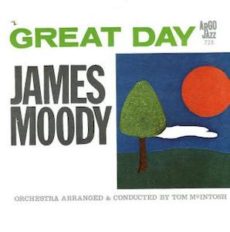
Once again the Jazz Voyager selects another rare gem from the stacks in his library and dusting it off places it on the turntable for another listen. This week it is an album by James Moody titled Great Day. The album was recorded on two simultaneous sessions, June 17 -18, 1963 at the Nola Penthouse Studio in New York City, produced by Esmond Edwards and released the same year on the Argo Records label.
The saxophone and flute work from Moody is always reliable and excellent for the avid listener. He has a penchant for switching from soul jazz to hard bop to mainstream, as he plays straight-ahead originals, standards, and ballads.
Benny Golson wrote the liner notes, Don Bronstein designed the cover and Esmond Edwards painted the cover art. The Great Day sessions historical significance is it is the first documented encounter for Thad Jones and Mel Lewis, who would go on to lead the Thad Jones~Mel Lewis Orchestra.
Tracks | 33:06 All compositions by Tom McIntosh, except as indicated- Great Day ~ 4:00
- The Search ~ 4:35
- Let’s Try ~ 3:22
- One Never Knows (John Lewis) ~ 5:18
- Opales’que (Dennis Sandole) ~ 5:01
- Blues Impromptu (James Moody) ~ 5:30
- Malice Toward None ~ 5:20
- James Moody ~ alto saxophone, tenor saxophone, flute
- Johnny Coles, Thad Jones ~ trumpet
- Hubert Laws ~ flute
- Hank Jones, Bernie Leighton ~ piano
- Jim Hall ~ guitar
- Richard Davis ~ bass
- Mel Lewis ~ drums
- Tom McIntosh ~ arranger, conductor, composer
More Posts: adventure,album,club,flute,genius,jazz,museum,music,preserving,restaurant,saxophone,travel