

Daily Dose Of Jazz…
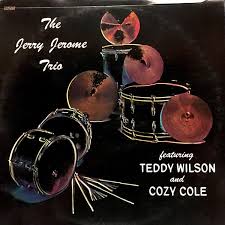
Jerry “Buck” Jerome was born on June 19, 1912 in Brooklyn, New York and he didn’t begin playing the saxophone until he was in high school in Plainfield, New Jersey.
Jerome became part of a national tour in 1936 with bandleader Harry Reser and his Clicquot Club Eskimos. He joined Glenn Miller’s original orchestra in 1937 and was a member until it broke up in 1938. He played and soloed on the Glenn Miller recording Doin’ the Jive. He then joined the Red Norvo band which was followed by his joining the Benny Goodman orchestra in 1938.
When Goodman broke up his band in 1940, he joined the Artie Shaw Orchestra. While with Shaw he appeared the same year he joind the band in the film Second Chorus, starring Fred Astaire and Burgess Meredith. By the end of the 1940s, Jerry became involved in broadcasting, working various positions as a conductor, composer, arranger and musical director.
Tenor saxophonist Jerry Jerome, who composed the Winston tastes good like a cigarette should jingle for the tobacco company, transitioned on November 17, 2001 at the age of 89.

More Posts: history,instrumental,jazz,music,saxophone

PETER WHITE, MINDI ABAIR, VINCENT INGALA
Over the years, Peter White has maintained a reputation as one of the most versatile and prolific acoustic guitarists on the contemporary jazz landscape. Armed with an unparalleled combination of lyricism and energy, he combines elements of jazz, pop and classical guitar to create a sound that is singular and at the same time accessible to a broad audience.
Born in 1954 in Luton, a small town north of London, White and his family moved to nearby Letchworth shortly after he was born. As a child, he learned to play several musical instruments, including the clarinet, trombone, violin and piano. And of course, like so many youngsters growing up during the heyday of the Beatles and the Rolling Stones, he gravitated to the guitar.
He learned his first chords on an acoustic guitar, then bought his first electric guitar in his early teens and studied the recordings of the reigning guitar gods of the day – Jimi Hendrix, Eric Clapton and Jimmy Page. But his musical aspirations ultimately veered back in an acoustic direction following an accident that doomed his beloved electric guitar. The axe was destroyed in a fire, one that White’s younger brother Danny – an aspiring pianist – accidentally started.
“The funny thing is that Danny didn’t actually admit to setting that fire for at least twenty-five years,” says White. “I had been kind of obsessed with the electric guitar at that point in my life, so that episode kind of forced me to go back to playing the acoustic. In retrospect, that’s a good thing.”
Indeed, White’s interests after the accident shifted more toward the music of acoustic artists like Crosby, Stills and Nash, James Taylor, and Joni Mitchell. Plugged or unplugged, he had decided by his late teens that music was his calling, and his first professional gig was at a holiday resort in England when he was 19 years old.
Barely a year later, he was invited to join Al Stewart’s band as a keyboardist for a tour of England, Scotland, and the U.S. in 1975. In addition to opening for artists like Linda Ronstadt, Billy Joel and Queen, White worked with Stewart in the studio in the making of Year of the Cat, which became a huge hit for Stewart in 1976. The tour and the album marked the beginning of a twenty-year association with Stewart. In that time, the two musicians co-wrote numerous songs, including Stewart’s 1978 hit, “Time Passages.”
By the beginning of the ‘80s, White and Stewart had relocated to Los Angeles, formed a band called Shot in the Dark, and established a music publishing company called Lobster Music. Around the same time, Danny White – he of the burning guitar incident several years earlier – formed a group called Matt Bianco, which included a talented Polish singer named Basia Trzetrzelewska. Danny White and Basia splintered off to launch the singer’s solo career with the 1987 debut album, Time and Tide, which featured Peter White on guitar.
After fifteen years as a backup musician and a session player, White launched his solo recording career with the 1990 release of Reveillez-Vous (French for “Wake up,” a title chosen by White in honor of his French mother). The album included several unused songs that White had written for Stewart, and it became a favorite among contemporary jazz radio stations.
He followed with three records on the Sindrome label – Excusez-Moi (1991), Promenade (1993) and Reflections (1994) – before signing with Columbia for the 1996 release of Caravan of Dreams. He maintained an ambitious release schedule through the ‘90s and beyond, but also found time to appear on recordings by many of his friends, including Dave Koz, Rick Braun, Richard Elliot, Jeff Golub, Lee Ritenour, Kirk Whalum, Boney James and many others.
On the road, he has participated in numerous “Guitars and Saxes” tours with the aforementioned players, and has established an annual “Peter White Christmas Tour” – the latter enterprise fueled by the success of his two highly regarded holiday albums, Songs of the Season (1997) and A Peter White Christmas (2007).
Good Day, released in 2009 on Peak Records, a division of Concord Music Group, was White’s first collection of original songs in several years. “I just started going through my backlog of material – songs that I’d never finished, some going as far back as ten or fifteen years – and I discovered that I had a lot of gems that I really wanted to show to the world,” he says. “I wanted to record them in my own time and in my own way, without any outside influence or interference.”
White released Here We Go in 2012 on Heads Up International, a division of Concord Music Group. The 11-song set, produced by White and DC (George Benson, Larry Carlton, Bob James, Patty Austin), featured several high-profile guest musicians, including saxophonists David Sanborn and Kirk Whalum, and pianist Philippe Saisse, and included a range of original material written in the recent and distant past. “I wanted variety,” says White. “I wanted songs that moved me, in the hopes that they’ll move the listener as well. I’m on a journey, and I want to bring with me anyone who’s willing to follow.”
Smile, released on October 7, 2014, is the final CD in White’s trilogy of albums consisting entirely of his own material. Co-produced with DC, the recording features ten tracks – some were written recently, some White wrote along the way with close friends and some were from the vault. Special guests include Mindi Abair (vocals), Rick Braun (horns), Euge Groove (soprano sax) and Philippe Saisse (keyboards, piano and orchestra programming). White’s daughter, Charlotte, plays violin on one song.
In a career that spans nearly four decades, over a dozen solo recordings and countless performances, White insists that it’s the faces in the crowd and the fans that keep the experience fresh. “I’ll play a live show, and someone will come to me afterward and say, ‘Oh, I loved this CD,’ or ‘This song helped me through a bad time,’” he explains. “Or I get emails from people saying, ‘Oh, I love the way you covered one of my favorite songs on your record back in 1994.’ The idea that someone can write me an email and tell me about something I did on a record that was released fifteen years ago – you can’t buy that. That’s priceless. That’s what keeps me going – the idea that people out there really care about what I do, the idea that I’ve made a difference for someone.”
Parking: $30.00 advanced purchase | $35.00 day of
Valet: $40.00 advanced purchase | $45.00 day of (if not sold out)
More Posts: adventure,festival,genius,guitar,jazz,music,preserving,saxophone,travel
HOWARD HEWETT & MICHAEL LINGTON
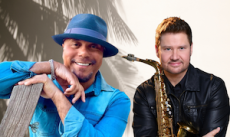
Howard Hewett is one of the most gifted vocalists in the Post-Marvin Gaye era of pop R&B.
He started singing as a child, fronting his older sisters in The Hewett Singers. The group toured the gospel circuit. As a teen, Hewett sharpened his crooner skills in a funk band called Lyfe. In 1976, Hewett moved to Los Angeles and formed a group put together by the owners of the historic Maverick’s Flat, called Beverly Hills.
Hewett got his mainstream break as the male vocal lead in Shalamar, a centerpiece of Dick Griffey’s SOLAR (Sound of Los Angeles Records) label. His tenor voice mixed beautifully with the bright vocals of Jody Watley, the dancing skills of Jeffery Daniels and the writing and production of Leon Sylvers III. The group gave the world feel-good dance favorites The Second Time Around and A Night to Remember, the baby-making classic For the Lover in You, as well as a number of beautiful B-side ballads like You Can Count On Me and Somewhere There’s a Love. When Watley and Daniels left the group in 1983, Hewett continued to lead Mickey Free and Delisa Davis in the reconstituted Shalamar. This version of the group was best known for soundtrack contributions on Footloose and Beverly Hills Cop with Dancing in the Sheets and the Grammy-winning Don’t Get Stopped in Beverly Hills, respectively.
In the mid-eighties, Howard sets out on his solo career, releasing I Commit to Love in 1986 on Elektra and from the first single Hewett made magic, giving his amorous voice and whimsical lyrics to Stay, I’m For Real and the title track. Most beloved track on this freshman release would be his spiritually grounded Say Amen. This single soared on the Inspirational charts and has enjoyed the status of a modern gospel classic.
Subsequent projects have solidified Hewett’s place in the high ranks of R&B balladeers by writing and collaborating and lending his voice within an intimate group of crooners, including George Duke, Quincy Jones, James Ingram, Anita Baker, Prince and Stanley Clarke. With Elektra, he released Forever and Ever (1988- Once, Twice, Three Times), Howard Hewett (1990- Show Me) and Allegiance (1992- Can We Try Again).
Later work shows increasing authenticity as Hewett rips song lyrics straight from his soul. It’s Time (1994- This Love is Forever), written and produced almost exclusively with long time friend and collaborator Monte Seward, displays all the vulnerability involved in falling and staying in love. In 2001, Hewett released the all inspirational album The Journey, where he shows us that his faith can’t be separated from his heart and soul.
Hewett continues to seduce audiences and eardrums as he is constantly touring and intermittently releasing new music.
“Of all the fine vocalists working today, Howard Hewett is one of the finest.” – Babyface
Michael Lington is an award winning saxophonist, songwriter, producer, recording artist and a purveyor of soul and contemporary jazz.
Powering full steam ahead into the next phase of his dynamic 25 year solo career, saxophonist Michael Lington captures all the freewheeling magic, energy and optimism we’re feeling post-pandemic with his latest perfectly titled Billboard single “Play” – a funked out, fun-spirited, perfect for summertime jam that marks his first time co-writing and co-producing with longtime friend and fellow horn master and hit maker Darren Rahn. The groove-intensive track also features Paul Jackson Jr.’s blistering guitar fire and the non-stop grooves of bassist Mel Brown and drummer Tarell Martin. While creating a forward minded way to keep joy and hope flowing in turbulent times, “Play” – from Lington’s upcoming EP and first set of original tunes since 2018’s Silver Lining – also reflects the multi-talented artist’s ever-bustling role as a first time dad to his son Landon and the passion he’s bringing to his latest endeavor, hosting his own Friday radio show on Smooth Jazz 247.
He has released 12 solo albums and has 27 singles that have charted on the Billboard and Radio & Records (R&R) contemporary jazz radio charts.
Over the course of his career, Lington has collaborated with Michael Bolton, Barry Manilow, Randy Crawford, Bobby Caldwell, Kenny Lattimore, Booker T. Jones, Ray Parker, Jr., Taylor Dayne, Brian Culbertson, William Bell, Dave Stewart, Vince Gill and many others.
He has toured regularly his entire career, averaging 60-80 shows per year. In recent years, Lington joined Michael Bolton on tour as his opening act & special guest. Lington and Bolton performed over 350 shows together in more than 40 countries.
Barry Manilow invited Lington to join his “One Last Time” arena tour. Michael opened the show and joined Manilow on the song “Brooklyn Blues” during the headliner’s main set.
In Nov. 2016, Lington performed for the Memphis Music Hall Of Fame ceremony, honoring 2016 inductee Charles Lloyd. Stax Records soul singer William Bell and Snoop Dogg also performed at the induction ceremony.
In September 2019 it was announced that Michael would join the Dave Koz and Friends; Gifts Of The Season Christmas tour alongside Koz, Jonathan Butler, Melissa Manchester and Chris Walker. The 22-date concert tour traveled across the U.S. between November 29 and December 23, 2019.
In 2020 during the pandemic, Michael become one of the leading music artists producing hi-quality virtual shows, which earned him a most innovative artist award by Stageit!
Lington is signed to the The Reliant Talent agency for worldwide representation and has a publishing administration deal with Kobalt Music Publishing. He is an ASCAP songwriter/publisher and a 25-year voting member of the Recording Academy.
Parking: $30.00 advanced purchase | $35.00 day of
Valet: $40.00 advanced purchase | $45.00 day of (if not sold out)
More Posts: adventure,festival,genius,jazz,music,preserving,saxophone,travel,vocal

Daily Dose Of Jazz…
Lou Gare was born Leslie Arthur Gare on June 16, 1939 in Rugby, Warwickshire, England. He is best known for his works with the improvised music ensemble AMM and recorded six albums with the group and another two as a soloist.
Eventually settling in the West Country, he still played in relative obscurity. Then Lou joined a big band that became The Uncommon Orchestra. He remained with them until health problems limited his participation.
Throughout his career he played with musicians such as Eddie Prévost, Mike Westbrook, Cornelius Cardew, Keith Rowe and Sam Richards
Free-jazz tenor saxophonist Lou Gare transitioned on October 6, 2017.
More Posts: history,instrumental,jazz,music,saxophone
Three Wishes
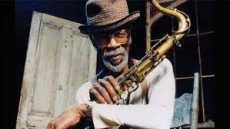
Joe Henderson and the Baroness was having a conversation when she inquired what his three wishes would be if granting them was possible and he replied:
- “I wish there would be one that would cover all three. I mean, something very crazy and earthy. I’ve got it! That love would be paramount to everything – possibly except food. That’s it! That’s the only way I can get it together, Nica: love, love, love!”
*Excerpt from Three Wishes: An Intimate Look at Jazz Greats ~ Compiled and Photographed by Pannonica de Koenigswarter

More Posts: baroness,history,instrumental,jazz,music,pannonica,saxophone,three,wishes