

Daily Dose Of Jazz…
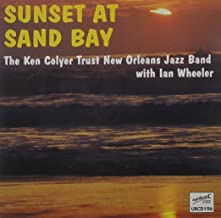
Kenneth Colyer was born on April 18, 1928 in Great Yarmouth, Norfolk, England, but grew up in Soho, London, and served as a member of his church choir. Listening to his elder brother’s jazz records which influenced him. He joined the Merchant Navy at 17, travelled around the world and heard famous jazz musicians in New Orleans, Louisiana.
In the UK, Colyer played with various bands and joined the Crane River Jazz Band in 1949 with Ben Marshall, Sonny Morris, Pat Hawes, John R. T. Davies, Julian Davies, Ron Bowden and Monty Sunshine. Rejoining the Merchant Navy, and jumping ship in Mobile, Alabama, he travelled to New Orleans, where he played with his idols in George Lewis’ band. Though offered the job of lead trumpeter on a tour, he was caught by the authorities, detained and deported.
Ken went on to join the Chris Barber Band and made their first recordings on the Storyville in 1953. Parting company the following year, then briefly joined a band in the mid-1950s with clarinetist Acker Bilk and trombonist Ed O’Donnell.
Then he put together his own band with Mac Duncan, Ian Wheeler, Johnny Bastable, Ron Ward, Colin Bowden and Ray Foxley. This band played together until the early 1960s before incorporating a new lineup.
After a bout with stomach cancer in 1972 he stopped being a bandleader but continued to work, occasionally associated with Chris Blount’s New Orleans Jazz Band. A biography, Goin’ Home, was compiled by Mike Pointon and Ray Smith. Trumpeter and cornetist Ken Colyer, who was known for skiffle interludes and devoted to New Orleans jazz, passed away on March 8, 1988.
More Posts: bandleader,cornet,history,instrumental,jazz,music,trumpet
The Quarantined Jazz Voyager
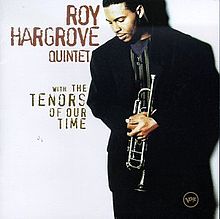
Having completely adapted to a new modus operandi for living this glorious life, I remain vigilant in my social distancing and reminding myself of music I haven’t listened to in a long time. This week I’m pulling out the late great Roy Hargrove who had the vision to record With The Tenors of Our Time. It’s a 1994 release on the Polygram Record label that was recorded at Teatro Mancinelli and Giani Grascinelli Sound Service with executive producer Richard Seidel. The album’s art direction and design is by David Lau, photography by James Minchin, liner notes by Jimmy Katz.
>Others in the team contributing to the production of this album were Larry Clothier ~ production, engineering, mixing; Ed Rak ~ engineering, mastering, mixing; Robert Friedrich ~ assistant engineering; Troy Halderson ~ mastering; Camille Tominaro ~ production coordination; and Nelly Muganda ~ make-up and hair stylist.
Track Listing | 72:56- Soppin’ the Biscuit (composer Roy Hargrove, featuring Stanley Turrentine) ~ 7:59
- When We Were One (composer Johnny Griffin, featuring Johnny Griffin) ~ 5:59
- Valse Hot (composer Sonny Rollins, featuring Branford Marsalis, Ron Blake) ~ 6:57
- Once Forgotten (composer Pamela Watson, featuring Ron Blake on tenor and soprano saxophone) ~ 5:45
- Shade of Jade (composer Joe Henderson, featuring Joe Henderson) ~ 5:24
- Greens at the Chicken Shack (composer Cyrus Chestnut, featuring Johnny Griffin) ~ 5:45
- Never Let Me Go (composer Jay Livingston and Ray Evans, featuring Rodney Whitaker) ~ 5:36
- Serenity (composer Joe Henderson, featuring Joe Henderson) ~ 5:35
- Across the Pond (composer Roy Hargrove, featuring Joshua Redman) ~ 6:47
- Wild Is Love (composer Robert Mickens and G. Brown, featuring Stanley Turrentine) ~ 6:50
- Mental Phrasing (composer Roy Hargrove, featuring Ron Blake, Joshua Redman) ~ 6:25
- April’s Fool (composer Ron Blake) ~ 3:54
- Roy Hargrove – trumpet, flugelhorn (2,4,7,10), production
- Cyrus Chestnut – piano
- Rodney Whitaker – bass
- Gregory Hutchinson – drums
- Ron Blake – soprano, tenor saxophone
- Johnny Griffin – tenor saxophone
- Joe Henderson – tenor saxophone
- Branford Marsalis – tenor saxophone
- Joshua Redman – tenor saxophone
- Stanley Turrentine – tenor saxophone

More Posts: adventure,album,club,genius,jazz,museum,music,preserving,restaurant,saxophone,travel,trumpet
Daily Dose Of Jazz…
Theodore “Wingy” Carpenter was born on April 15, 1898 in St. Louis, Missour. Losing his left arm as the result of an accident during his early teens, the amputation was performed by a noted surgeon who was an uncle of jazz musician Doc Cheatham. Sometime later, he took up the trumpet and by 1920 he was working in traveling carnival shows. In 1921 he toured with Herbert’s Minstrel Band.
By 1926 he had settled in Cincinnati, Ohio, where he worked with Wes Helvey, Clarence Paige, Zack Whyte, and Speed Webb. In 1927, he played in Buffalo, New York, with Eugene Primus. Off and on from late 1926 through 1928, he was featured on the Whitman Sisters’ Show with pianist Troy Snapp’s band.
During the early 1930s, Wingy was featured with Smiling Boy Steward’s Celery City Serenaders and another Florida band led by Bill Lacey. In the mid-1930s, he began regular touring with bandleaders including Jack Ellis, Dick Bunch, and Jesse Stone. In the late 1930s, he settled in New York City, where he worked with Skeets Tolbert and Fitz Weston.
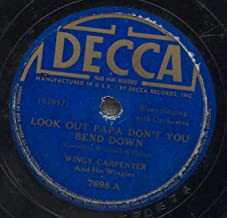
From 1939 on working as the leader of his own band, Carpenter had periods at well-known clubs such as The Black Cat, The New Capitol, Tony Pastor’s The Yeah Man, and other venues. He continued to lead his band through the 1960s, playing occasional dance dates. Several of his works are still accessible as MP3 downloads, including Look Out Papa Don’t You Bend Down, Preachin’ Trumpet Blues, Put Me Back in the Alley, Rhythm of The Dishes and Pans, and Team Up.
Trumpeter, vocalist and bandleader Wingy Carpenter, one of several one-armed trumpeters who worked in the music business, passed away on July 21, 1975, in New York City.
More Posts: bandleader,history,instrumental,jazz,music,trumpet,vocal
Daily Dose Of Jazz…
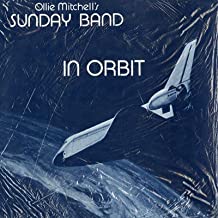
Oliver Edward Mitchell was born April 8, 1927 in Los Angeles, California. He was the son of Harold Mitchell, lead trumpeter for MGM Studios, who taught him to play the trumpet.
Mitchell would go on to play in big bands for Harry James, Buddy Rich and Pérez Prado, among others, as well as the NBC Symphony Orchestra. In the 1960s, he joined The Wrecking Crew, a group of studio and session musicians who played anonymously on many records for popular singers of the time, as well as theme songs for television, film scores, and advertising jingles.
Mitchell was an original member of Herb Alpert’s Tijuana Brass. He would go on to have his own bands, Ollie Mitchell’s Sunday Band, and the Olliephonic Horns
Moving to Puako, Hawaii in 1995 he founded the Horns. In 2010, he published his memoir, Lost, But Making Good Time: A View from the Back Row of the Band. He stopped playing the trumpet toward the end of his life, due to macular degeneration and hand problems from an automobile accident.
Trumpeter Ollie Mitchell, who recorded with Chet Baker, Harry James, Stan Kenton, Irene Kral, Shorty Rogers, Pete Rugolo, Dan terry and Gerry Wilson among others, suffered from cancer and passed away on May 11, 2013.
More Posts: bandleader,history,instrumental,jazz,music,trumpet
Daily Dose Of Jazz…
William Franklin Hardman, Jr. was born on April 6, 1933 in Cleveland, Ohio and growing up there worked with local players including Bobby Few and Bob Cunningham. While in high school he played with Tadd Dameron, and after graduation he joined Tiny Bradshaw’s band.
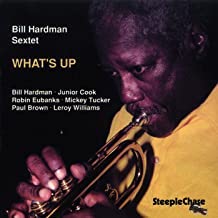
Hardman’s first recording was with Jackie McLean in 1956 and following this he played with Charles Mingus, Art Blakey and the Jazz Messengers, Horace Silver, and Lou Donaldson. He led a group with Junior Cook and as a leader recorded Saying Something on the Savoy label, receiving critical acclaim in jazz circles, but was little known to the general public.
He had three periods in as many decades with Art Blakey’s Jazz Messengers, however, his misfortune was not to be with him during their popular Blue Note recording years. Bill would go on to record three albums for Muse and one for Steeplechase record labels. He recorded forty-three albums as a sideman between 1956 and 1987 working with among others Hank Mobley, Charles Earland, Walter Bishop Jr., Curtis Fuller, Eddie Jefferson and Benny Golson.
On December 5, 1990 hard bop trumpeter and flugelhornist Bill Hardman, whose most prolific recording period as a sideman was with Blakey, passed away of a brain hemorrhage in Paris, France at the age of 57.
More Posts: bandleader,flugelhorn,history,instrumental,jazz,music,trumpet