

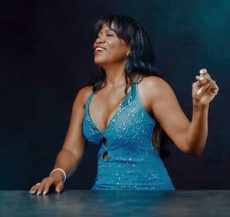
EUGENIE JONES
As part of the Ellensburg Music Festival happening on July 28th & 29th, Eugenie Jones will be performing as part of the lineup performing at various venues in downtown Ellensburg.
Singer/Songwriter Eugenie Jones is an exceptional vocalist and cleverly gifted lyricist who has released highly-praised, primarily original, vocal projects. Her current release – Players – was a Best Jazz Vocal Album Grammy® contender and internationally ranked #7 on Jazz Week’s top 50 charts. Jones is additionally an Earshot Jazz Vocalist of the Year award recipient and the first vocal recording artist to receive Earshot’s Recording of the Year Golden Ear award.
Friday, July 28 – Saturday, July 29, 2023 | 5:00 pm – 12:00 am
Tickets: Weekend Pass – $70 | Friday & Saturday Day Pass – $50
More Posts: adventure,club,festival,genius,jazz,music,preserving,travel,vocal
Daily Dose Of Jazz…
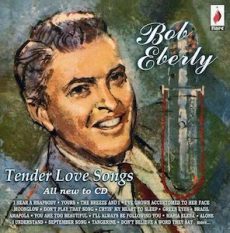
Robert Eberly was born Robert Eberle on July 24, 1916 in Mechanicville, New York. He changed the spelling of his surname slightly to the homonymous Eberly. His father was a policeman, sign-painter, and tavern-keeper.
He was hired by the Dorsey Brothers Orchestra in 1935 shortly after winning an amateur hour contest on Fred Allen’s radio show. He stayed with Jimmy Dorsey after Tommy left to form his own band and would be a fixture with the orchestra until drafted into the service late in 1943. In the early 1940s the Jimmy Dorsey Orchestra scored a string of hits featuring Bob and Helen O’Connell, with Eberly singing a slow, romantic baritone version of songs such as Amapola and Tangerine, followed by a lighter, up-tempo reprise by O’Connell. He recorded the original version of I’m Glad There Is You in 1942 for Dorsey’s orchestra on Decca Records. The song has become a jazz and pop standard.
In 1953, Eberly and Helen O’Connell headlined a summer replacement program for Perry Como’s CBS television show. The program also featured Ray Anthony and his orchestra.
In 1980, he had one lung removed but still continued to sing. Vocalist Bob Eberly transitioned from cancer on November 17, 1981 in Glen Burnie, Maryland, at the age of 65.

More Posts: history,instrumental,jazz,music,vocal
Daily Dose Of Jazz…
Charlie LaVere was born Charles LaVere Johnson on July 18, 1910 in Salina, Kansas to a Union Pacific Railroad blacksmith and where he first acquired an interest in music. His first musical instrument was a cornet, then later acquired an upright baritone horn, on which he learned to play many popular songs of the day. Studying piano in the 4th grade was the turning point in his decision to make it his instrument of choice.
At age twelve, after attending a Willard Robison and his Deep River Orchestra he gained an interest in jazz. He studied piano throughout high school and performed in various recitals and assemblies. At the age of eighteen he visited Oklahoma City, Oklahoma where he was introduced to Jack Teagarden, his brother Charlie Teagarden and where he studied Music at the University of Oklahoma at Norman. He performed with Frank William’s Oklahomans on campus and in local venues. He would go on to tour in 1929 during the Wall Street Crash, with brief stints in various bands including Louis Armstrong.
Relocating to Chicago, Illinois in 1932 he shared an apartment with the Teagarden’s and their spouses. He began playing regularly with Joe and Marty Marsala, Floyd Towne, Jim Barnes, Ray Biondi, Shorty Cherock, Larry Russel, Clark Galehouse, Carl Bean and Wingy Manone. He would perform his first recorded sessions supporting Wingy Manone and Teagarden in addition to leading his own bands.
After touring Texas and the mid-west with Eddie Neibauer and Dell Coon in 1934, he returned to local Chicago venues, working regularly with Joe Marsala. He assembled a multiracial group of musicians, befriended writer and jazz critic Helen Oakley, and recorded for Brunswick Records and Columbia Records. LaVere then found steady work in radio, performing on the Fibber McGee and Molly show for NBC. He also sang and arranged songs for a vocal group. Charlie briefly relocated to Fort Worth, Texas to perform in Paul Whiteman’s group and later touring throughout Texas, Oklahoma, and Kansas, before heading West.
He worked as a recording artist for Decca Records at their studios on Melrose Avenue with The Andrew Sisters, Victor Young, John Scott Trotter, and Gordon Jenkins, and under his own name.
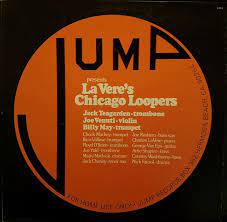
In 1944 he formed the LaVere’s Chicago Loopers featuring Billy May, Artie Shapiro, Floyd O’Brien, Joe Venuti, Matty Matlock, Nick Fatool, and George Van Eps. He would go on to perform for Walt Disney, Gordon Jenkins, George Burns, Bobby Darin, Bob Crosby and Wingy Manone.
As rock music became more popular his work became more sporadic and in 1964 LaVere accepted a position as assistant conductor at the Melodyland Theater. He performed piano and accordion on cruise ships, arranged and performed with Russ Morgan in Las Vegas, Nevada and continued to work with Gordon Jenkins, performing on Harry Nilsson’s album of jazz standards. From the 1960s onward he ran his own piano repair shop in the San Diego, California area, in addition to performing solo residencies at resorts in California, Oregon, and Colorado.
Pianist, vocalist, bandleader, and composer Charlie LaVere transitioned on April 28, 1983 in Ramona, California.
More Posts: bandleader,composer,history,instrumental,jazz,music,piano,vocal
Daily Dose Of Jazz…
Dee Bell was born in Fort Wayne, Indiana on July 16, 1950 and grew up in a musical family and began playing music at home. She played clarinet in the Plainfield High School band and performed in an a cappella trio from age ten through her last year of high school. She went on to enroll and graduate from Indiana University in 1972, lived on the edge of the Hoosier National Forest in a two-room cabin with a wood stove for heat, and was co-founder and head chef of the Earth Kitchen vegetarian restaurant in Bloomington, Indiana.
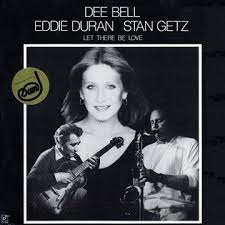
The late 1970s saw Bell moving to California and working at a restaurant in Sausalito. While singing Happy Birthday to a customer, she was heard by jazz guitarist Eddie Duran who invited her to sing with his band. They made a demo tape which became her first album, Let There Be Love on the Concord Jazz label, that included saxophonist Stan Getz. Their sophomore album for Concord Jazz brought in trumpeter Tom Harrell.
Bell recorded a third album, Sagacious Grace in 1990 with Houston Person and John Stowell, but was never released due to technical problems until 2011 when audio engineers fixed the problem. It reached No. 31 on the JazzWeek radio chart.
Bell left the music business and became a grade school music teacher in Mill Valley. After the death of her musical director, Al Plank, she met Marcos Silva backstage at a tribute to Merrilee Trost. This became a collaboration, merging her swing style with his Brazilian rhythms, resulting in the recording of three CDs by them.
With permission and copyrights Bell has written lyrics to Billy Strayhorn’s Isfahan, Jimmy Rowles The Peacocks, Don Sebesky’s You Can’t Go Home Again, and Ivan Lins’ Acaso (By Chance), Depois dos Temporais (After the Storm), and Choros das Aguas (Crying of the Waters).
Vocalist Dee Bell, who has released six albums and has been nominated for several awards by Down Beat, Billboard and BAM, continues to perform.
More Posts: bandleader,history,instrumental,jazz,lyricist,music,vocal
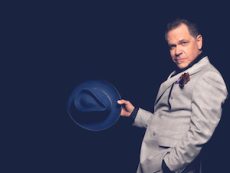
SUPERBLUE: KURT ELLING AND CHARLIE HUNTER
GRAMMY® Award-winner Kurt Elling is without question today’s preeminent male jazz vocalist, renowned worldwide for his unparalleled virtuosity and flair for trailblazing artistic exploration. From his stunning reinvention of timeless standards to his own captivating original songcraft, the Chicago-based musician has fused his dazzling talents across a panoply of musical approaches, emblazoning each with signature imagination, insight, and emotional intelligence.
Where many male jazz vocalists at this stage in a much vaunted career have tended to stick to the tried and true, Elling seems to be growing more ambitious and experimental with the passing of time, a tendency evidenced by his stunning new LP, SuperBlue: The Iridescent Spree. The followup to 2021’s remarkable SuperBlue, the album once again sees Elling joining forces with producer/guitarist Charlie Hunter and multi-instrumentalist duo drummer Corey Fonville and bassist-keyboardist DJ Harrison for a kaleidoscopic collection of new songs, surprising covers, and dynamic reinventions.
Showtimes ~ 8:00pm | 10:00pm
More Posts: adventure,club,genius,guitar,jazz,music,preserving,travel,vocal