

Three Wishes
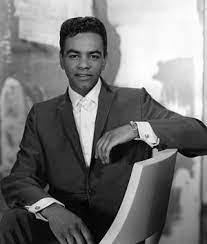
What Johnny Mathis responded to the question posed by Baroness Pannonica was one word answers as to his three wishes:
-
-
“Love.”
-
“Kindness.”
- “Tactfulness.
-
*Excerpt from Three Wishes: An Intimate Look at Jazz Greats ~ Compiled and Photographed by Pannonica de Koenigswarter

More Posts: baroness,history,instrumental,jazz,music,pannonica,three,vocal,wishes
Daily Dose Of Jazz…
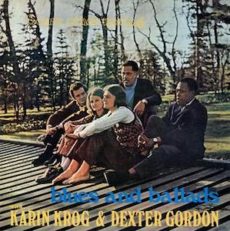
Karin Krog was born May 15, 1937 in Oslo, Norway and started singing jazz as a teenager, attracting attention while performing in jam sessions in her hometown. By 1955, she was hired by the pianist Kjell Karlsen to sing in his sextet.
1962 saw Karin forming her first band and becoming a student of the Norwegian-American singer Anne Brown, studying with her until 1969. Throughout the Sixties she performed with the rhythm and blues band Public Enemies, releasing the hit singles Sunny and Watermelon Man.
She has worked with Vigleik Storaas, Jacob Young, Terje Rypdal, Arild Andersen, Jan Garbarek, Dexter Gordon, Kenny Drew, Don Ellis, Steve Kuhn, Archie Shepp, Paul Bley, John Surman, Niels-Henning Ørsted Pedersen, Red Mitchell, and Bengt Hallberg. During 1994, she became the first Norwegian musician to have an album released by Verve Records. The album Jubilee was a compilation of songs from her thirty-year career.
She has released thirty-seven albums as a leader with her latest live album Infinite Paths in 2016, as well as three as a guest. Vocalist Karin Krog, who has been bestowed with fifteen awards, including being knighted in 2005 into the Royal Norwegian Order of St. Olavz, continues to compose and perform.

More Posts: bandleader,history,instrumental,jazz,music,vocal
The Quarantined Jazz Voyager
A simple statement: You know what to do to remain safe and healthy. The fat lady hasn’t begun to warm up because it’s not over.
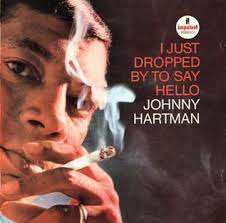
This week I am featuring an album by an understated vocalist who recorded some two dozen albums. I’ve selected from the library. I Just Dropped By To Say Hello is a studio album by jazz vocalist Johnny Hartman, released on Impulse! Records. It was his second and next-to-last album on the label, after his highly successful collaboration with John Coltrane which produced John Coltrane and Johnny Hartman, recorded a few months earlier.
Tracks 1 & 6 were recorded on October 9, 1963 and the balance of the songs were recorded on October 17, 1963 at Van Gelder Studios in Englewood Cliffs, New Jersey. It was produced by Bob Thiele, The album was mastered at Longwear Plating and released in 1964. Tracks 1~6 were on the A side of the album and 7~11, the B side of the original album.
Track List | 33:09- Charade (from Charade) (Henry Mancini, Johnny Mercer) ~ 2:38
- In the Wee Small Hours of the Morning (Bob Hilliard, David Mann) ~ 2:49
- A Sleepin’ Bee (Harold Arlen, Truman Capote) ~ 2:15
- Don’t You Know I Care (Or Don’t You Care To Know) (Mack David, Duke Ellington) ~ 4:14
- Kiss & Run (Rene Denoncin, William Engvick, Jack Ledru) ~ 3:35
- If I’m Lucky (Eddie DeLange, Josef Myrow) ~ 2:52
- I Just Dropped by to Say Hello (Sid Feller, Rick Ward) ~ 4:10
- Stairway to the Stars (Matty Malneck, Mitchell Parish, Frank Signorelli) ~ 3:09
- Our Time (Stanley Glick, Johnny Hartman) ~ 3:00
- Don’t Call It Love (Ronnell Bright) ~ 2:07
- How Sweet It Is to Be in Love (George Cardini, Danny DiMinno) ~ 2:20
- Johnny Hartman ~ vocals
- Illinois Jacquet ~ tenor saxophone
- Kenny Burrell ~ guitar (tracks 2-5, 7-11)
- Jim Hall ~ guitar (tracks 1, 6)
- Hank Jones ~ piano
- Milt Hinton ~ double bass
- Elvin Jones ~ drums

More Posts: adventure,album,club,genius,jazz,museum,music,preserving,restaurant,travel,vocal
Daily Dose Of Jazz…
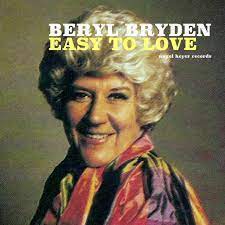
Beryl Audley Bryden was born May 11, 1920 in Norwich, Norfolk, England and was an only child Her enthusiasm for jazz music started during her teenage years, becoming a member of the National Rhythm Club when she was 17 and became secretary of the local branch in 1941. An ardent jazz fan she established a Nat Gonella fan club in her teens, before taking up the washboard and singing, influenced by Bessie Smith.
Moving to Cambridge in 1942 at 22, post WWII she returned to London with the hope of starting a career in music/ She worked with Mick Mulligan and George Melly at London jazz venues and became a supporter of visiting American jazz acts when the Musicians Union ban was lifted. Beryl befriended, amongst others, Buck Clayton, Louis Armstrong and Bud Freeman, with whom she recorded.
By 1949 she formed her own group called Beryl’s Back-Room Boys and later worked with Mike Daniels. In 1955 she joined the Chris Barber band on washboard, and played on Rock Island Line with Lonnie Donegan on vocals. This track helped trigger the ‘skiffle’ craze of the late 1950s.
Graduating to the Monty Sunshine jazz band she covered Bessie Smith’s Young Woman’s Blues, Gimme a Pigfoot (And a Bottle of Beer, and Coney Island Washboard Blues, which demonstrated her washboard technique.
She remained active at the end of the British trad jazz boom, and became particularly popular in Northern Europe, playing with the Ted Easton Jazz Band and The Piccadilly Six. She was active well into the Nineties playing with the Metropolitan Jazz Band, Digby Fairweather, Nat Gonella and her own Blue Boys.
Vocalist Beryl Bryden, whose final recording was with Nat Gonella shortly before her death, transitioned from lymphoma, aged 78, at St Mary’s Hospital, Paddington, England on July 14, 1998
More Posts: bandleader,history,instrumental,jazz,music,vocal,washboard
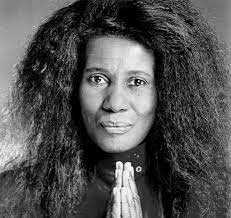
Three Wishes
When the ladies took a moment for themselves, Nica inquired of Alice Coltrane what her three wishes would be if they were able to be given and she told her:
-
-
“I’d like to see my little daughter graduate from the University in Paris.”
-
“I would dig an artist’s colony. Like one block of buildings, or area, where artists and musicians could get together, and teach, and study. Artists could display their art. Writers ~ we’d allow them in, too, but it’d be mostly artists and musicians. We’d have a library, concerts, and sessions, and rooms for tapings. Artists could come in and record. You know, you’ve got it!”
-
*Excerpt from Three Wishes: An Intimate Look at Jazz Greats ~ Compiled and Photographed by Pannonica de Koenigswarter
More Posts: baroness,harp,history,instrumental,jazz,music,organ,pannonica,piano,three,vocal,wishes