


Daily Dose Of Jazz…
John Paul Pizzarelli Jr. was born April 6, 1960, in Paterson, New Jersey and started playing guitar when he was six He attended Don Bosco Preparatory High School, an all-boys Catholic school. In his teens, he performed with Benny Goodman, Les Paul, Zoot Sims, Slam Stewart, and Clark Terry.
He played trumpet through his college years, attending the University of Tampa and William Paterson University, but his most important teacher was his father through the Eighties. During that period he established himself as a jazz guitarist and a vocalist and released his debut solo album, I’m Hip (Please Don’t Tell My Father) in 1983.
During the 1990s, Pizzarelli played in a trio with Ray Kennedy and his younger brother Martin. In 1993, the trio opened for Frank Sinatra in Las Vegas, Nevada and four years later, he was starring on Broadway in Dream, a show devoted to the music of Johnny Mercer.
Naming Nat King Cole as the inspiration for his career, he has honored him with the albums Dear Mr. Cole and P.S. Mr. Cole. He has also recorded tribute albums to Frank Sinatra, Duke Ellington, Antônio Carlos Jobim, Richard Rodgers, and Paul McCartney. Along with his father accompanying Annie Ross, they recorded her album To Lady with Love, a tribute to Billie Holiday that Ross recorded when she was eighty-four.
He has hosted a national radio show, Radio Deluxe with John Pizzarelli, and has worked with George Shearing, Rosemary Clooney, Johnny Frigo, Buddy DeFranco, the Clayton-Hamilton Jazz Orchestra, the Boston Pops Orchestra, and the Cincinnati Pops Orchestra.
As a co-producer of the James Taylor album American Standard, he received a Grammy nomination for Best Traditional Pop Vocal Album in 2020. Guitarist and vocalist John Pizzarelli continues to explore and expand his musical vocabulary.
More Posts: bandleader,guitar,history,instrumental,jazz,music,vocal
Daily Dose Of Jazz…
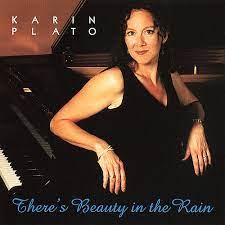
Karin Plato was born on March 31, 1960 in Alsask, Saskatchewan, Canada. As a small child she studied piano and later attended the University of Saskatchewan in Saskatoon, where she received a Bachelor Of Music Degree in Piano and Voice.
Moving to Vancouver, Canada in 1985 she studied vocal jazz and arranging at Capilano College, and has made the city her base ever since. In the late 90s, she studied with Sheila Jordan and Jay Clayton at the Banff Centre For The Arts. In 2000, her album There’s Beauty In The Rain was nominated for a Juno Award.
She has performed at numerous festivals and in 2000, she became a member of DIVAS For Life, which came about when the Vancouver-based magazine, Lifestyles, profiled six female vocalists: Plato, Laura Crema, Dee Daniels, Kate Hammett-Vaughan, Stevie Vallance and Tammy Weis. Established to help raise money for people living with cancer and other life-threatening illnesses. Their debut concert was a huge success and the singers appeared collectively and individually at a series of SOR engagements,
Vocalist Karin Plato continues to use her contralto to deliver elegant performances of standards and original material.

More Posts: bandleader,history,instrumental,jazz,music,vocal
Daily Dose Of Jazz…
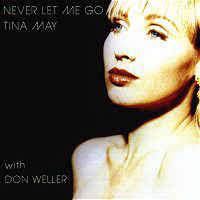
Tina May was born March 30, 1961 in Gloucester, England. She lived in Frampton-on-Severn when she was young and attended Stroud High School.
She has recorded twenty-five albums as a leader and three as a guest artist, of which18 albums are on the 33 Records label. She has worked with Tony Coe, Nikki Iles, Stan Sulzmann, Ray Bryant, Enrico Pieranunzi and Patrick Villanueva.
In 1989 she married jazz drummer and bandleader Clark Tracey and recorded several albums with him in the 1990s. Vocalist Tina May continues to perform, record and explore the azz idiom.
More Posts: bandleader,history,instrumental,jazz,music,vocal

Daily Dose Of Jazz…
Stacey Kent was born March 27, 1965 in South Orange, New Jersey. After graduating from Sarah Lawrence College, she crossed the pond to study music at the Guildhall School of Music and Drama in London, England where she met and married saxophonist Jim Tomlinson.
In the 1990s, she began her professional career singing at Café Bohème in London’s Soho. After two or three years, she began opening for established acts at Ronnie Scott’s Jazz Club in London. By 1995, she appeared in the film Richard III singing Come Live with Me and Be My Love. Her debut album, Close Your Eyes, was released in 1997.
In 2020, Kent released a series of singles and EPs, including “Christmas in the Rockies”, “Three Little Birds”, “Lovely Day”, “Landslide”, “I Wish I Could Go Travelling Again”, “Bonita” and “Craigie Burn” as a duet with her longtime pianist Art Hirahara. Several of these singles become part of an album released on Sept 17, 2021, called “Songs From Other Places.”
She has received several awards and honors including receiving the Chevalier dans l’Ordre des Arts et des Lettres (Order of Arts and Letters) in 2009. Grammy-nominated vocalist Stacey Kent has recorded nearly two dozen albums and continues to explore the realm of her music.
More Posts: bandleader,history,instrumental,jazz,music,vocal
The Quarantined Jazz Voyager
It is amazing but not surprising how people want to get back to the same old routine they were in before the pandemic instead of inventing themselves anew. As I move around my city I see more and more people not wearing masks in enclosed spaces. I am not surprised by the robotic sense of normalcy by society.
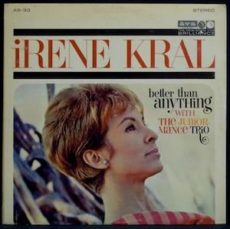
This week I have selected an album by the underrated and often unappreciated vocalist Irene Kral. The younger sister of pianist Roy Kral, I discovered her towards the end of her career in 1977 when I heard her album Where Is Love. I was enamored by her voice and the quiet understatement of her singing. Unfortunately I never had the opportunity to hear her live as she transitioned the followin year in August.
The album I present today is her third studio session, Better Than Anything, recorded on June 17 & 18, 1963 at the World Pacific Studios in Los Angeles, California. It was produced by Joe Burnett, engineered by Richard Bock and released the same year on Äva Records and distributed by MGM. Making up the quartet with Irene is the Junior Mance Trio.
The cover design was by Richter & Mracky Design Associates, the photography by Fred Seligo and the liner notes were written by Tommy Wolf.
Track List | 29:24
- Better Than Anything (David “Buck” Wheat, Bill Loughborough) ~ 2:21
- The Touch Of Your Lips (Ray Noble) ~ 2:22
- The Meaning of the Blues (Bobby Troup, Leah Worth) ~ 3:11
- Rock Me To Sleep (Benny Carter, Paul Vandervoort II) ~ 2:20
- No More (Tutti Camarata, Bob Russell) ~ 3:10
- Passing By (Laurent Hess, Charles Trenet, Jack Lawrence) ~ 1:54
- It’s a Wonderful World (Jan Savitt, Harold Adamson, Johnny Watson) ~ 2:34
- This Is Always (Mack Gordon, Harry Warren) ~ 3:23
- Just Friends (John Klenner, Sam M. Lewis) ~ 2:40
- Guess I’ll Hang My Tears Out to Dry (Jule Styne, Sammy Cahn) ~ 3:35
- Nobody Else But Me (Jerome Kern, Oscar Hammerstein II) ~ 1:54
- Irene Kral ~ vocals
- Junior Mance ~ piano
- Bob Cranshaw ~ bass
- Mickey Roker ~ drums
More Posts: adventure,album,bass,club,drums,genius,jazz,museum,music,piano,preserving,restaurant,travel,vocal