

Daily Dose Of Jazz…
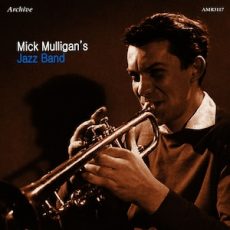
Peter Sidney Mulligan who was known by Mick, was born on January 24, 1928 in Harrow, Middlesex, England. He began playing trumpet while a student at Merchant Taylors’ School, Northwood and entered into the family wine company, but became an alcoholic and eventually was pushed out of the business by his relatives.
Forming his Magnolia Jazz Band in 1948, he met George Melly soon afterwards and they became close associates who performed together for many years. Mulligan’s orchestra included Roy Crimmins, Ian Christie, and Archie Semple that rivalled Humphrey Lyttelton’s band in popularity on the British trad jazz circuit.
While he booked excellent side men, Mick was not a top-flight musician and his own playing was often hampered by intoxication; their recording legacy is spotty because their releases were irregular and generally for small labels. He and Melly’s antics were drunken and scandalous outings, making them regular tabloid figures in the 1950s.
Breaking up his band in 1953 he reformed it a year and a half later, continuing with the new group into 1962 and was part of the biggest trad jazz event to be staged in Britain at Alexandra Palace. By the early 1960s, rock and roll had whittled the enthusiasm for trad jazz to nearly nothing and Mulligan disbanded the Magnolia Jazz Band. He went on to manage Melly, who was launching a solo career. He played occasionally into the 1970s, but mostly retired to run a grocery store. Later in life he became interested in horse racing, and owned or part-owned several race horses, including the prize-winning horse, Forever My Lord.
Trumpeter and bandleader Mick Mulligan, who was best known for his presence on the trad jazz scene, suffered a stroke at age 78 and died in Chichester, West Sussex, England on December 20, 2006.

More Posts: bandleader,history,instrumental,jazz,music,trumpet

The Jazz Voyager
New York is beckoning the Jazz Voyager to leave the cold of the Midwest to experience the familiar cold of the Big Apple for two new events. The first is a visit to a fresh old fashioned haunt that’s tucked away in Lefferts Garden called Bar Bayeux. Though it may be familiar, I’m desirous of warmer southern temperatures but the jazz and new adventures never stop.
The second event has me in the company of international recording pianist, organist, and accordionist Gary Versace who is one of the busiest and most versatile musicians on the international jazz scene. Leading this quartet date, he has been featured in bands of John Scofield, Maria Schneider, John Abercrombie, Anat Cohen, Al Foster, Regina Carter, Kurt Elling, Madeleine Peyroux, Matt Wilson, Ingrid Jensen and many others.
Bar Bayeux is located at 1066 Nostrand Avenue, Brooklyn, NY 11225. For more information visit https://www.barbayeux.com. No cover, one drink minimum but tips for musicians are encouraged.

More Posts: accordion,adventure,club,genius,jazz,music,organ,piano,preserving,travel

Daily Dose Of Jazz…
Teddy Napoleon was born January 23, 1914 in New York City, New York. His first professional engagement was with Lee Castle in 1933, then played with Tommy Tompkins for several years before working as a freelance musician in New York.
In the 1940s he played in several big bands, including Johnny Messner and Bob Chester, before signing up with Gene Krupa in 1944. He worked with Krupa intermittently for the next fourteen years including on many of his big band releases in the 1940s, and in his trio settings with Charlie Ventura.
He also spent time working with Flip Phillips, Bill Harris, and Eddie Shu. Teddy moved to Florida in 1959 and led his own trio there, though he never recorded as a leader, however he did record a duo album with his younger brother Marty, also a pianist.
Swing jazz pianist Teddy Napoleon, who was the nephew of trumpeter Phil Napoleon, eventually returned north and died on July 5, 1964 in Elmhurst, New York.
More Posts: history,instrumental,jazz,music,piano

Daily Dose Of Jazz…
Alan Lee da Silva was born on January 22, 1939, in Bermuda, British Empire to an Azorean/Portuguese mother, Irene da Silva, and a black Bermudian father known only as Ruby. Emigrating to the United States at the age of five with his mother, he was raised in Harlem, New York City. Here he first began studying the trumpet, and moved on to study the upright bass. He eventually acquired U.S. citizenship by the age of 18 or 19 and in his twentieshe adopted the stage name of Alan Silva.
As one of the most inventive bass players in jazz, Silva has performed with avant-garde jazz musicians Cecil Taylor, Sun Ra, Albert Ayler, Sunny Murray, and Archie Shepp. He performed in 1964’s October Revolution in Jazz as a pioneer in the free jazz movement, and for the 1967 live album Albert Ayler in Greenwich Village.
Since the early 1970s, Alan has lived mainly in Paris, France where he formed the Celestrial Communication Orchestra, dedicated to the performance of free jazz with various instrumental combinations. In the 1980s, Silva opened a music school, Institute for Art, Culture and Perception (I.A.C.P.) in Central Paris, together with François Cotinaud and Denis Colin.
In the 1990s he picked up the electronic keyboard, the electric violin and electric sarangi on his recordings. Since around 2000, he has continmued to perform more frequently as a bassist and bandleader, notably at New York City’s annual Vision Festivals.
More Posts: bass,history,instrumental,jazz,keyboards,music,sarangi,violin

Jazz Poems
CHARLES PARKER 1920~1955
Listen
This here
Is what
Charlie
Did
To the Blues.
Listen
That there
Is what
Charlie
Did
To the Blues.
This here,
bid-dle-dee-dee
bid-dle-dee-dee
bopshop
have you any cool?
bahdada
one horn full.
Charlie
Filled the Blues
With
Curly-cues.
That’s what
Charlie
Did
To the Blues.
Play
That again
Drop
A nickel in,
Charlie’s
Dead
Charlie’s
Gone,
But
John Birks
Carried on.
Drop
A nickel in,
Give
The platter
A spin,
Let’s listen
To what
Charlie
Did
To the Blues.
WARING CUNEY
from Jazz Poems ~ Selected and Edited by Kevin Young

More Posts: book,classic,collectible,history,jazz,library,poet