

On The Bookshelf
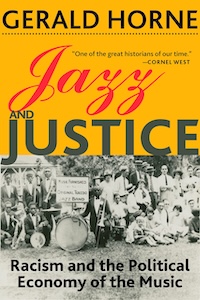
Jazz and Justice explores the rich, complex origins of jazz, the historical American art form born in the late 19th century, most likely in the brothels of Storyville in New Orleans, Louisiana from the cultural traditions of the newly emancipated African Americans. Rooted in the blues, a genre that gave voice to the pain, endurance, and aspirations of the oppressed Black communities under Jim Crow. Jazz emerged from the discarded instruments of post–Civil War military bands and quickly evolved into a profound cultural force.
In this revelatory work, historian and professor Gerald Horne examines the social, economic, and political dynamics that shaped jazz into a singular Black American contribution to global arts and culture. He chronicles the struggles musicians faced in a deeply segregated and exploitative society, contending with organized crime, white supremacist groups like the Ku Klux Klan, and the pervasive racism of American society and the entertainment industry.
Horne gives overdue recognition to the groundbreaking contributions of women artists, such as pianist Mary Lou Williams and trombonist Melba Liston, while also highlighting the influence of musicians with Native American heritage. Jazz and Justice is both an incisive historical investigation and a tribute to the resilience of an art form that gave voice to generations.
Jazz & Justice: 2019 | Gerald Horne
Monthly Review Press
Daily Dose Of Jazz…
Jimmy Henderson was born on May 20, 1921 in Wichita Falls, Texas and began studying piano at age six, picking up the trombone a few years later. By the time he was thirteen he had joined a musicians’ union and was first chair at the Wichita Falls Symphony Orchestra.
Winning several trombone competitions by age fourteen, Jimmy started his own orchestra while still in his teens, in addition to studying at the Cincinnati Conservatory of Music. Henderson toured with the big bands of Hal McIntyre, Jimmy Dorsey, and Tommy Dorsey.
In 1954, he moved to Los Angeles, California where he steadily worked as a session musician for some 20 years. Among his credits in the studios was the soundtrack for Bonanza. From 1957 to 1960, he was also a member of Lawrence Welk’s orchestra in which he appeared weekly on the Maestro’s television show.
He led his own orchestra for fifteen years, and was the musical director for the Emmy Awards, Television Academy Honors, and Directors Guild of America Awards In the 1970s, he led the Glenn Miller Orchestra ghost band before retiring in 1980.
Trombonist and bandleader Jimmy Henderson died at the age of 77 on June 10, 1998 in New York City, New York.
More Posts: bandleader,history,instrumental,jazz,music,trombone
Daily Dose Of Jazz…
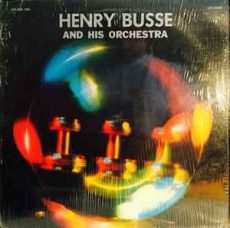
Henry Busse Sr. was born on May 19, 1894 in Magdeburg, Germany to a generational German Band family. He studied violin and then trumpet after a broken finger was set incorrectly. In 1912 at age 18 he ran away from the family farm outside of Magdeburg, where he had been forced to play trumpet in his uncle’s band.
Initially jumping ship in New York City and landing in the German ghettos there, unable to speak English, he found a job on a boat heading to California. He acquired some English on his trip in 1916 that found him in Hollywood working as an extra in Keystone Cop films and playing trumpet in a movie theater pit band.
In 1917, he played the trumpet with the Frisco Jass Band before forming his own band, Busse’s Buzzards which was the nucleus of the Paul Whiteman orchestra of the mid-1920s, and featuring Henry they made four sides in total. Being the subject of discrimination because of his German accent caused concern among those living in post-World War I America.
At one point, eight out of the top ten sheet music sales spots belonged to the band. During his peak with them, Busse was earning $350 weekly, while fellow band member Bing Crosby was earning just $150. Busse co-composed several of the band’s early hit songs, including Hot Lips with Gussie Mueller and Wang Wang Blues. The latter sold over one million copies, and was awarded a gold disc in 1920.
Throughout the 1920s he was concertmaster for the Whiteman Band, played alongside the Dorsey brothers, Ray Bolger, and formed the Shuffle Rhythm Band, which went on to enjoy great success in the 1930s and ’40s. A later group, The Henry Busse Orchestra. This group was more of a dance band than a jazz band and had a successful career.
Hitting his peak in 1930-45 playing dance music before the war, and swing during the war. He and his band appeared in two MGM color movies in 1935 called Starlit Days at the Lido, filmed at the Ambassador Hotel, along with Clark Gable and the studio’s stable of stars and in the movie Lady Let’s Dance.
Trumpeter Henry Busse and his Orchestra continued to record and perform up until his death on April 23,1955. at an undertaker’s convention at the Peabody Hotel in Memphis, Tennessee. He was playing with the Shuffle Rhythm Band.
More Posts: history,instrumental,jazz,music,trumpet
Requisites
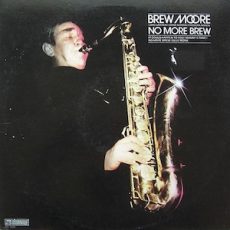
No More Brew ~ Brew Moore | By Eddie Carter
This morning’s album offered for your consideration is a live performance by Brew Moore. No More Brew (StoryvilleSLP-4019) was his final album, released eight years after his passing. Brew was born in Indianola, Mississippi and began playing the trombone at age twelve, later graduating to the clarinet and eventually the tenor saxophone. His professional journey took him from a Texas territorial band before attending college, to New Orleans, Memphis, and New York, to further his craft. He’s joined on stage by Lars Sjösten on piano, Sture Nordin on bass, and Fredrik Noren on drums. My copy is the 1981 U.S. Stereo release.
The set begins with Jimmy Van Heusen and Johnny Burke’s It Could Happen To You. Lars opens with a swinging introduction, setting up the quartet’s theme. Brew launches into a sizzling solo. Lars comes in energetically next. Sture illustrates he’s an effective soloist in a polished reading. Brew and Frednik exchange a brief dialogue, leading to the theme’s return and closure. Moore addresses the audience, then Sjösten’s introduction leads into the ensemble’s lively melody of Manny’s Tune by John Marabuto. Moore takes off first quickly. Sjösten responds with an impressive reading. Moore and Noren wrap things up with a concise conversation ahead of the closing chorus and abrupt finish.
Brew’s contribution to the set, No More Brew begins Side Two with the foursome’s joyful introduction and melody. Moore opens with energetically captivating phrases, then Lars’s vigorous reading flows through the rhythm section like ephemeral shadows. Brew and Fredrik fuel the finale with a concise comment preceding the theme’s return and a short announcement by Moore that concludes with Blue Monk by Thelonious Monk. The quartet begins with a soulful, blues-inspired melody that sets the stage for Moore to accelerate into an extended, captivating solo. Sjösten mines a rich vein of sentimentality next until the tempo slows again for the melody’s reprise and exit.
Rune Öfwerman produced the album, although it’s unknown who recorded it. However, the album’s sound quality is excellent, with a soundstage placing the listener in the club audience as the musicians are performing. Brew Moore, known for his irresistibly appealing tone that could either stir excitement or touch the heart, recorded twelve albums as a band leader and contributed to seven more as a sideman. Tragically, he passed away on August 19, 1973, at age forty-nine after a fatal fall down a flight of stairs. If you’re a fan of swing and bop and also enjoy the tenor sax, I highly recommend exploring No More Brew by Brew Moore on your next record store visit. This exceptional album showcases a talented young musician whose promising career was sadly cut short!
~ Blue Monk – Source: JazzStandards.com
~ It Could Happen To You – Source: Wikipedia.org
© 2025 by Edward Thomas Carter

More Posts: choice,classic,collectible,collector,history,instrumental,jazz,music,saxophone
Daily Dose Of Jazz…
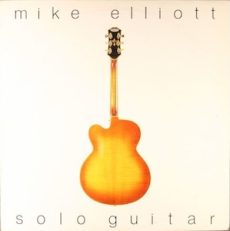
Mike Elliott was born on May 18, 1940 in Chicago, Illinois to a studio musician father and a blues singer mother. Raised in Colorado he learned guitar at a young age and was playing professionally by the time he was sixteen. It was in Colorado where he studied guitar with Johnny Smith.
He formed his first jazz group and in 1964 was on the road. He moved to Minneapolis, Minnesota two years later, and in the Seventies he helped found the jazz fusion group Natural Life, which included saxophonist Bob Rockwell, bassist Billy Peterson, pianist Bobby Peterson, and drummers Bill Berg and Eric Kamau Gravatt.
The 1980s saw him moving to Nashville, Tennessee and becoming manager of Gibson Professional Musical Services and holding clinics with Les Paul, Howard Roberts, and Elliot Easton. Mike did session work, engineering, producing, arranging, and songwriting. In the middle of the decade he teamed up with songwriter musician Jim Pasquale to form Magic Tracks Recording Studio.
Remaining in Nashville until 1998 he worked with Johnny Cash, Mickey Newbury, Chubby Checker, Emmylou Harris, Trisha Yearwood, Joe Diffie, Earl Klugh, Vic Damone, Steve Earle, Crystal Gayle, and Tennessee Ernie Ford.
Gruitarist Mike Elliott died on September 14, 2005. A Mike Elliott Scholarship Award for excellence in guitar was established in his honor.
More Posts: bandleader,guitar,history,instrumental,jazz,music