

On The Bookshelf
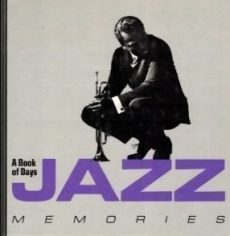
JAZZ MEMORIES: A Book of Days | Michael Elhers
This book has been designed by Stephen Kruse in the date book format, with blank spaces to record appointments, notes, ideas, etc. or just to enjoy the facts about each artist featured on selected birthdays, festival openings, and other events on both sides of the pond in jazz history. The names are recognizable to adicionados, enthusiasts and for any first year student of jazz who has delved into the history of the genre.
The introduction gives hor and praise to not only the musicians but to everyone connected to the making of this project. This includes radio stations, critics, columnists, poets and writers. All text and notes have been written by Michael Ehlers.
The photographs of the musicians that fill this book are memories taken by Jerry Stoll, unless otherwise noted. His sensitive portraits capture not just the images of the musicians but also the spirit of their music.
The book is dedicated to Tommy Flanagan, a pianist’s pianist, and to the memory of John Henry Hammond (1910~1987), a jazz saint.

Daily Dose Of Jazz…
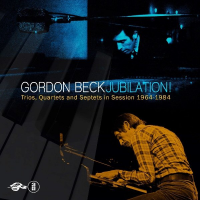
Gordon James Beck was born on September 16, 1935 in Brixton, London, England where he attended Pinner County Grammar School. He studied piano in his youth, but decided to pursue a career as an engineering technical draughtsman and moved to Canada in 1957 for this reason.
Largely self-taught, he returned to music after returning home from Canada in 1958, where he had been exposed to the works of George Shearing and Dave Brubeck. He became a professional musician in 1960 and played with saxophonist Don Byas in Monte Carlo. Beck joined the Tubby Hayes group in 1962, then led his own bands from 1965, including Gyroscope, from 1968, a trio with bassist Jeff Clyne and drummer Tony Oxley.
1967 saw the Gordon Beck Quartet record the album Experiments with Pops released on Major Minor MMLP 21 in 1968. That same year they recorded with Joy Marshall and released as When Sunny Gets Blue decades later.
Beck first played with vocalist Helen Merrill in 1969 and continued the relationship into the 1990s when she toured Europe. From 1969 to 1972 he toured with saxophonist Phil Woods’s European Rhythm Machine.
In the Sixties and Seventies he was a house pianist at Ronnie Scott’s Jazz Club. Beck played experimental funk with George Gruntz from1973-75), and free jazz with improv drummer John Stevens and was a member of Nucleus between 1973 and 1974.
From middle age, Beck played predominantly in mainland Europe, recorded albums with Allan Holdsworth, Henri Texier, Didier Lockwood and others. He often played solo from the 1980s and started teaching music at the same poin and toured Japan with Holdsworth in 1985.
Pianist Gordon Beck stopped performing around 2005 because of poor health and died in Ely, Cambridgeshire, England on November 6, 2011.

More Posts: bandleader,history,instrumental,jazz,music,piano
Daily Dose Of Jazz…
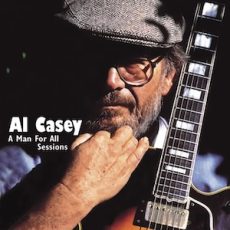
Albert Aloysius Casey was born September 15, 1915 in Louisville, Kentucky. He was a child prodigy who first played violin, then switched to ukulele. He began playing guitar in 1930 and attended DeWitt Clinton High School in New York City where he studied guitar. He met Fats Waller in 1933 and the following year, at eighteen, he became a member of Waller’s band.
Making several recordings with the band, he is known for having played the solo in Buck Jumpin’. After Waller’s death in 1943, he led his own trio and for two consecutive years in the 1940s, he was voted best guitarist in Esquire magazine.
From 1957, he was a member of a rhythm and blues band led by King Curtis. Four years later he dropped out of music, though he returned in the 1970s to record with Helen Humes and Jay McShann. Another absence followed until 1981, when he returned to music to play with the Harlem Blues and Jazz Band.
During his career, Casey worked with Louis Armstrong, Chu Berry, Coleman Hawkins, Lionel Hampton, Billie Holiday, Billy Kyle, Frankie Newton, Clarence Profit, Art Tatum, and Teddy Wilson.
Guitarist Albert Casey died of colon cancer on September 11, 2005, four days shy of his 80th birthday.
More Posts: bandleader,guitar,history,instrumental,jazz,music
Requisites
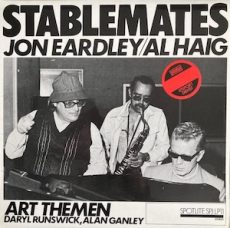
Stablemates ~ Jon Eardley and Al Haig | By Eddie Carter
You really know your godchildren truly care and love you when they surprise you for your birthday with an album by two artists whose music you’re aware of, yet whose records have never found a place in your library. This morning’s spotlight shines on flugelhorn and trumpet player Jon Eardley, who was passing through London on a brief 1977 tour and pianist Al Haig, who was in town to visit friends. The two musicians seized the moment to head into the studio to record their only album together, Stablemates (Spotlite Records SPJ LP11). It was released two years later, and rounding out the ensemble are Art Themen on tenor sax, Daryl Runswick on bass, and Alan Ganley on drums. My copy of this album is the 1979 U.K. stereo release.
The first side opener, Tangerine by Johnny Mercer and Victor Schertzinger, begins with Al’s upbeat piano intro to Jon’s lively melody. Art kicks off the opening solo briskly, then Al flows smoothly into the following reading. Jon entersnext with a strong, assertive tone. Art and Jon share a final conversation leading back to the theme’s reprise and close. Speak Low by Ogden Nash and Kurt Weill raises the temperature with the quintet’s swinging melody. Themen opens the solos with an inspired improvisation that sets the tone. Eardley follows with plenty of bounce and effervescence on the second statement. Themen is off to the races next with impeccable precision, then Runswick and Ganley engage in a spirited exchange until the theme’s restatement fades out.
‘Round Midnight by Bernie Hanighen, Thelonious Monk and Cootie Williams is a quartet showcase that opens with Al and Daryl’s pensive introduction ahead of Jon’s tender melody. Al begins the opening solo with dreamlike softness, then the pace moves upward slightly for Jon’s elegant interpretation before the ensemble’s gentle ending. The second side gets underway with the pianist’s soothing introduction to Embraceable You by George and Ira Gershwin. Eardley states the gentle melody with Themen. In the first solo, Haig offers a tender, thoughtful statement with a soft touch of elegant beauty. Eardley truly shines in the closing reading with notes so deeply heartfelt that it’s bound to move you to tears, leading to Themen’s closing chorus and a gentle climax.
Don’t Blame Me by Dorothy Fields and Jimmy McHugh receives a gorgeous treatment by the quintet, beginning with Jon’s slow-paced theme that radiates inviting warmth, and Art’s perfectly placed inserts. Al leads off, skillfully blending composure and gentleness, before Art continues this lovely standard with a solo that truly touches the spirit. Jon delivers an exquisitely soft, poignant horn passage preceding the theme’s return. The beat moves upward on final time for Eardley’s theme to Love Walked In by George and Ira Gershwin. Themen opens the solos with an energetic drive, then Haig contributes a robust interpretation. Eardley matches the intensity with swift execution, and Ganley and Runswick meet on common ground in the closer, leading to the theme’s reprise and climax.
Tony Williams produced the album, and Steve Waldman served as the recording engineer. It delivers an exceptional soundstage, as though the ensemble is performing live in your listening room. The mix is impressively balanced, offering remarkable clarity and fidelity from your speakers. Stablemates is one of six albums Jon Eardley led as a leader, and he contributed as a sideman on ten additional records. Al Haig, meanwhile, led twenty-five albums and played as a sideman on eight more. If you haven’t yet experienced the artistry of Jon Eardley or Al Haig, I highly encourage you to seek out Stablemates on your next search for great jazz records. This outstanding album invites fresh appreciation with each play and remains as relevant today as it was over forty years ago!
~ Don’t Blame Me, Embraceable You, Love Walked In, ‘Round Midnight, Speak Low, Tangerine – Source: JazzStandards.com
© 2025 by Edward Thomas Carter
More Posts: choice,classic,collectible,collector,history,instrumental,jazz,music,piano,trumpet

Daily Dose Of Jazz…
Eddie Moore was born in Houston, Texas on September 14, 1940 and began his musical journey at Texas Southern University where he earned a Bachelors in Arts and immersed himself in the Houston music scene. He relocated to Kansas City, studied under Bobby Watson at the University of Missouri-Kansas City and received a M.A in Jazz Studies.
He formed a jazz fusion group Eddie Moore & The Outer Circle in 2012, with diversity and inclusiveness defining him as an artist. His debut album, The Freedom of Expression, was released in 2013. With a performing and visual arts curator he created an experimental platform in partnership with Charlotte Street that pairs time-based artists, producers and musicians.
Eddie has received awards and a 2017 residency at the Kemper Museum of Contemporary Art. He has composed music that has been featured commercially for Sprint, Netflix’s Queer Eye, Morgan Cooper’s short film Room Tone, and Peacock’s Bel-Air.
He has shared the stage and recorded with Tia Fuller, Pam Watson, Logan Richardson, Maurice Brown, Boys II Men, Brian Blade and the Fellowship, John Baptiste, Erykah Badu, Mos Def, Bilal, Ledisi, Chantae Cann, Krystal Warren, Andre Hayward, Tivon Pennicott, and Various Blonde.
As an educator his passion for teaching sent him on a course as a jazz lecturer at the University of Kansas, created a pilot Incubator, Tribe Studios, which programs master classes, music business meet-ups, and provides creative/maker space for musicians and visual artists.
Pianist and bandleader Eddie Moore is an integral member of the music community in Kansas City, as well as an advocate for change and resources for professional artists.
More Posts: bandleader,educator,history,instrumental,jazz,music,piano