

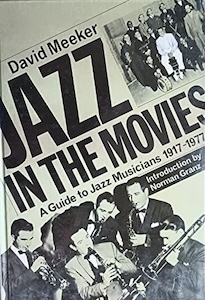
On The Bookshelf
Jazz In The Movies: A Guide to Jazz Musicians 1917~1977 by David Meeker is the result of ten years research into the arena of jazz and the film industry. Norman Granz, who penned the introduction, writes of David as one of the small, dedicated, diligent, extremely hard-working, enthusiastic group of people that the world luckily possesses.
The idea for the book came to Meeker some twenty years before its writing after waiting for a prolonged and disappointing time of news reels, travelogues and the like to watch a film titled The Three Little Bops and to finally hear the sweet sounds of Shorty Rogers. Then he thought why has there been no jazz filmography produced. So, he set about the daunting task of compiling 2,500 movies and this is the outcome.
The book lists each film title alphabetically, together with its nationality, year of production, director, running time, a short critique and details of all jazz artists, band personnel and musical items where known.

Daily Dose Of Jazz…
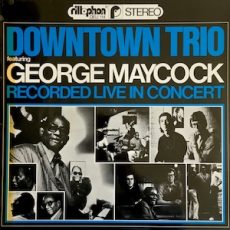
George Maycock was born on September 9, 1917 in Colón, Panama. He played in Panama with his band Chimbombo Swingjazz since 1940. With the dance and show music of Cuban Jaime Camino, he and his band came to Spain in 1949.
Together with the trumpeter Boogie Sergeant and drummer Big Fletchit, who played at Camino and stayed in Europe, they became the Chic Combo with the Jamaican bassist Noel George Gillespie. They operated from Basel, Switzerland then from Cologne, Germany to go on tour. On occasion saxophonist Jack Poll played with the quartet, before Wilton Gaynair joined in 1956, creating the George Maycock Quintet.
This band played modern jazz and continued to perform regionally and was rated the best black combo in this country by the 1980 Rheinische Post 1980. Later, Maycock moved to Düsseldorf, Germany where he was in the center of the local jazz scene. In the 1960s he had increasingly begun playing in dance bands. During the Seventies he toured with Fletchit and Ali Haurand in the trio and played with Jörn Behrens and Ralph Kleine-Tebbe in the Düsseldorf area.
Pianist George Maycock, who was one of the first Black musicians to perform authentic jazz in Central Europe after the Second World War, not on concert tours, but through intimate performances in jazz clubs, died on August 20, 1979 in New York City, New York.
More Posts: bandleader,history,instrumental,jazz,music,piano
Daily Dose Of Jazz…
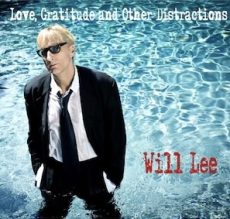
Will Lee was born September 8, 1952 in San Antonio, Texas. Greatly influenced to pursue music because of his parents, his father played piano, trumpet and the upright bass professionally and his mother sang with big bands. He took up drums after seeing the Beatles on The Ed Sullivan Show, and by the time he was 12 had formed his first band in Miami, Florida.
Due to the great numbers of drummers in Miami, Lee studied French horn for a year before shifting to bass and studying at the University of Miami. He became part of a succession of bands including top 40 bands with names like Chances R, The Loving Kind, Green Cloud and Goldrush.
A move to New York City saw Will selected by trumpeter Randy Brecker to join the jazz-rock group Dreams. He played on the album Imagine My Surprise as a bassist and vocalist. After Dreams disbanded, his career as a session musician flourished, and he toured with many artists. In 1982,he became one of the original members of The World’s Most Dangerous Band, the house band on NBC‘s Late Night with David Letterman.
Bassist Will Lee, who has played in both the jazz, rock and r&b genres, continues his career as a seesion and touring musician and recording artist.
More Posts: bandleader,bass,history,instrumental,jazz,music
Requisites
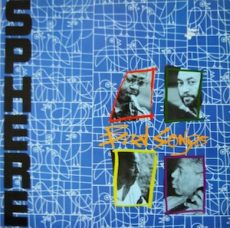
Bird Songs ~ Sphere | By Eddie Carter
Sphere initially came together to celebrate the music of Thelonious Monk; however, the quartet soon expanded its repertoire to include original albums as well. I first heard “I Didn’t Know What Time It Was” on WNOP, Cincinnati’s then-jazz station, and I immediately purchased the album right after work. Listening to it again a few nights ago inspired me to share my thoughts this morning. Bird Songs (Verve Digital 837 032-1), the quartet’s sixth release, is an excellent showcase of the underrated artistry of tenor saxophonist Charlie Rouse. Also on board are Kenny Barron on piano, Buster Williams on bass, and Ben Riley on drums, as the quartet celebrates the legacy of Charlie Parker. My copy of this album is the 1988 U.S. digital stereo release.
Side One opens with the quartet’s introduction and theme to Red Cross. Kenny sparkles with inventive runs and unexpected turns in the opening statement. Charlie follows, paying homage to Bird’s rhythmic playfulness, driven by Buster and Riley’s groundwork into the group’s rousing closing chorus. I Didn’t Know What Time It Was by Richard Rodgers and Lorenz Hart is a beloved jazz standard that was a staple in Parker’s repertoire. Williams and the rhythm section set the scene elegantly. Rouse enters next with a smoky, reflective melody, before taking flight in the first solo. The trio’s brief, tasteful interlude clears the way for Barron’s swinging interpretation. After a second trio interlude nudges the tempo forward, Rouse returns for the reprise, and the song gently fades out with the trio’s subtle touch.
The ensemble moves into Dewey Square next, with the rhythm section’s introduction paving the way for Charlie todeliver the melody. Buster begins the solos with a delightfully spirited walk, then Charlie steps into the second statement with a passionately frisky tone that’s crisp, well-structured and executed vivaciously. Kenny tackles the closing reading with youthful zest that’s right on the beat. Ben adds a concise comment during the theme’s reprise and exit. Moose The Mooche shifts the energy upward to begin Side Two with the quartet’s brisk introduction and theme. Rouse fires off the first solo with an infectiously cheerful solo. Barron leaves a memorable mark in the second reading, then Riley takes the spotlight next with youthful vigor. Barron places a few inserts during the theme’s restatement.
Barbados showcases Parker’s take on the calypso rhythm, infused with a bebop twist. The quartet’s melody is joyous, setting the stage for Charlie’s opening solo, which captures the tune’s Caribbean sunlight. Buster walks with a buoyant swagger next, then Kenny weaves a zesty spell with uplifting confidence. Ben evokes the gentle ebb and flow of island waves, carrying the quartet to the closing chorus. The ensemble’s brisk, buoyant introduction to Ah-Leu-Cha leads to an exuberant melody. Rouse draws on his robust tone and melodic inventiveness in the first solo. Barron opens the following reading with playful fragments derived from the central theme. Williams steps forward last, threading a stream of flawlessly constructed musical thoughts until the quartet reconvenes for the melody’s return and climax.
The album’s closer, Quasimodo, slows the pace one final time, for the group’s medium theme. First up is Kenny, who unfolds his solo gradually, with lines marked by crisp articulation and a deft touch. The baton then passes to Charlie, who enters with a relaxed warmth and expressiveness. He listens and responds to the rhythm section, ahead of the theme’s restatement and finale. Joanne Klein and Sphere produced the album, with Richard Seidel serving as executive producer. Rudy Van Gelder was behind the recording dials, and the album was recorded directly to two-track digital using the Sony 3402 DASH Reel-to-Reel Recorder. The album’s sound quality possesses a superb soundstage that emerges from your speakers as if the musicians are positioned directly in front of your sweet spot.
Bird Songs was the final recording Charlie Rouse made with the quartet, as he sadly passed away from lung cancer eight months later, on November 30, 1988, at the age of 64. The ensemble delivers a tight and cohesive performance throughout, and this is truly one of those thoughtfully crafted sessions that invites listeners to return again and again. For anyone who treasures bebop, I enthusiastically suggest adding Bird Songs by Sphere to your library during your next visit to the record store. The album serves as a stirring homage to Charlie Parker, with four remarkable musicians breathing new life into his legacy, creating an experience rich in pure joy, surprise, and profound artistry!
~ I Didn’t Know What Time It Was – Source: JazzStandards.com
~ Postscript Excerpt: DASH – The Digital Audio Stationary Head standard is a reel-to-reel digital audio tape format introduced by Sony in early 1982 for high-quality multitrack studio recording and mastering, as an alternative to analog recording methods. Source: Wikipedia.org
© 2025 by Edward Thomas Carter

More Posts: bass,choice,classic,collectible,collector,drums,history,instrumental,jazz,music,piano,saxophone
Daily Dose Of Jazz…
Harry Percy South was born on September 7, 1929 in Fulham, London, England. He came to prominence in the 1950s, playing with Joe Harriott, Dizzy Reece, Tony Crombie, and Tubby Hayes. In 1954, he was in the Tony Crombie Orchestra with Dizzy Reece, Les Condon, Joe Temperley, Sammy Walker, Lennie Dawes, and Ashley Kozak.
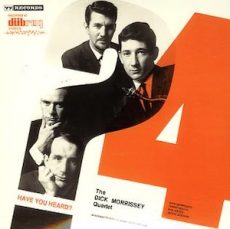
Returning from a Calcutta, India tour with the Ashley Kozak Quartet, he spent four years with the Dick Morrissey Quartet, where he both wrote and arranged material for their subsequent four albums. He formed the Harry South Big Band in 1966 with Latin, ballads and straight-forward swingers.
By the mid-1960s, he began working with British rhythm & blues singer and organist Georgie Fame, recording the album Sound Venture. He composed and arranged for Humphrey Lyttelton, Buddy Rich, Sarah Vaughan, and Jimmy Witherspoon and was musical director and arranger for Annie Ross.
He branched out into session work, writing themes for television and music libraries. He is credited with the arrangements used for Emerson, Lake & Palmer’s Works Vol. 1 (1977). In 1981, he again arranged for Annie Ross and Georgie Fame in a collaboration on what was to be Hoagy Carmichael’s last recording, In Hoagland.
Pianist, composer and arranger Harry South, who was honored with an album released by the National Youth Jazz Orchestra, died on March 12, 1990 in Lambeth, London at the age of 60.
More Posts: arranger,composer,history,instrumental,jazz,music,piano