

Hollywood On 52nd Street
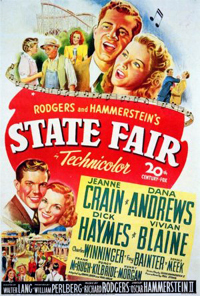
It Might As Well Be Spring has been a classic jazz favorite for many years but it didn’t start out that way. It was a song taken from the 1945 film State Fair with music by Richard Rodgers and lyrics by Oscar Hammerstein II. It won the Academy Award for Best Original Song and was part of the only original film score.
Jeanne Crain, who played Margy Frake, sang the song in the film, but was dubbed by Louanne Hogan. Dick Haymes, who portrayed the original Wayne Frake, made the first hit recording of the song, followed by Frank Sinatra, Sammy Kaye, Paul Weston, Margaret Whiting, Shirley Bassey, Ella Fitzgerald, Sarah Vaughan, Blossom Dearie, Nina Simone, Brad Mehldau and Jane Monheit.
The Story: Love, romance and competition take center stage as the Frake family sets off for the state fair. Margy is melancholy and looks forward to the break in routine. Father Abel is excited about entering his prize pig Blue By for the ribbon and bets his neighbor. Mother is entering the cooking competition with her pickles and mincemeat recipes. Brothe Wayne is left forlorn by his girlfriend’s inability to go with him.
At the fair all the romances take a different turn of occurrences and lucky beaus end up with new ladies, Blue Boy wins in all his categories thanks to his lady love Esmeralda, and it’s a happily ever after story ending.
Sponsored By

www.whatissuitetabu.com
Daily Dose Of Jazz…
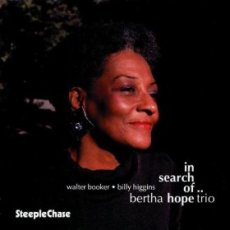
Bertha Hope was born Bertha Rosemond on November 8, 1936 and raised in Los Angeles, California. At age three she began studying classical piano and at a young age she was playing and learning from other young musicians in her neighborhood such as Richie Powell and Elmo Hope. Hope attended Manual Arts High School, performed in numerous nightclubs around town and went on to study piano at the Los Angeles Community College, finally receiving a B.A. in early childhood education from Antioch College.
In 1957 she married Elmo and relocated to the Bronx, New York, working at the telephone company during the day and performing at night. After her husband’s passing ten years later, Bertha continued to present his music and remained an active force in improvised music within the New York jazz scene. Her second husband, Walter Booker Jr., worked with her to keep the music of Elmo Hope alive through their tribute ensemble called “ELMOllenium” and The Elmo Hope Project.
The composer and arranger has recorded for Steeplechase, Minor and Reservoir record labels, has toured extensively through Japan, plays with the group, Jazzberry Jam in addition to leading The Bertha Hope Trio with Walter and Jimmy Cobb and has taught an advanced jazz ensemble at the Lucy Moses School in NYC, and an introduction to jazz program at Washington Irving High, sponsored by Bette Midler.

Inspire A Young Mind
More Posts: piano
Daily Dose Of Jazz…
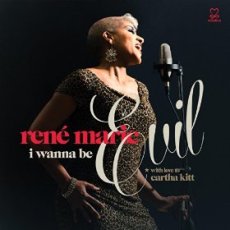
René Marie was born René Marie Stevens on November 7, 1955 in Warrenton, Virginia. With the encouragement of her children, the jazz vocalist and songwriter started her professional musical career in 1997 at the age of 42.
Performing at Washington D.C.’s Blues Alley in 1999, René signed with the MaxJazz label out of St. Louis and released four albums to critical acclaim and her sophomore project “Vertigo” received a coronet ranking by the “Penguin Guide to Jazz”, a distinction given to less than 85 other recordings in jazz history.
Her work often combines contrasting songs such as “Dixie” and the anti-lynching “Strange Fruit” on Vertigo or Ravel’s Bolero with Leonard Cohen’s Suzanne” on Live at Jazz Standard.
Attracting controversy and national attention in 2008, René substituted the lyrics of “The Star-Spangled Banner” with “Lift Every Voice and Sing” when invited to sing the national anthem at a civic event in Denver. This arrangement of the national anthem forms part of the titular suite of Marie’s 2011 CD, “The Voice of My Beautiful Country” on the Motema Music label.
René Marie specializes in writing her own music, and she comments on the fact that this is not the norm in jazz in one of her songs, “This for Joe,” after a club manager who got mad at her for singing originals. Her 8th release, Black Lace Freudian Slip, maintains the tradition.
She followed that project by steering away from tradition with a rare tribute album to Eartha Kitt, her latest titled “I Want To Be Evil”. Vocalist Rene Marie continues to record, perform and tour worldwide.
Give A Gift Of Jazz – Share
More Posts: vocal
Daily Dose Of Jazz…
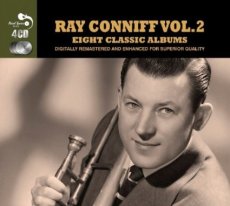
Joseph Raymond Conniff was born on November 6, 1916 in Attleboro, Massachusetts, learned to play trombone from his father and learned music arranging from a course book.
Post World War II he joined the Artie Shaw big band writing many of his arrangements. Hired by Mitch Miller, head of A&R at Columbia Records, Ray became the house arranger. During this period he worked with Rosemary Clooney, Johnny Mathis, Frankie Laine, Marty Robbins and Johnny Ray among others. In 1955 Ray wrote a top 10 arrangement for Don Cherry’s “Band of Gold” that sold more than a million copies.
From 1957 to 1969 Conniff arranged and recorded as a leader and sideman for Columbia and their subsidiary label Epic, became a bandleader and had 28 albums in the American Top 40, created the Ray Conniff Singers, toured Europe, was the first American popular artist to record in Russia and stepping out of his element he produced a couple of light jazz albums sans vocals.
Conniff’s most famous album was his 1966 release of “Somewhere My Love” written to the tune Lara’s Theme from the 1965 film Dr. Zhivago. It featured the 12 female and 13 male Ray Conniff Singers. The album went platinum, hit the top of the American and European charts and grabbed a Grammy Award.
The next three decades were equally lucrative for Ray recording mainly out of Los Angeles and finding fame touring Latin and South America. He recorded an average of two instrumental and one vocal album a year and sold over 70 million albums worldwide. He continued to record and perform until his death on October 12, 2002 in Escondido, California.
Jazz Is Global – Share
More Posts: trombone
Daily Dose Of Jazz…
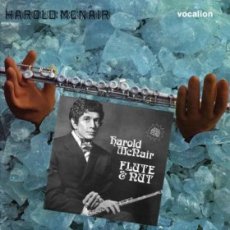
Harold McNair was born on November 5, 1931 in Kingston, Jamaica and started his instrumental training at the Alpha Boys School. Recording and playing mostly Caribbean music styles in the Bahamas, the first decade of his career he was known as “Little G”. During this time he sang and played both alto and tenor saxophones.
McNair played a calypso singer in the 1958 film Island Women and by 1960 he was in Miami recording his first album as a leader “Bahama Bash”, with a mixture of jazz and calypso numbers. It was around this time that he began playing the flute, which would eventually become his signature instrument. Though he took a few lessons in New York, he was largely self-taught.
Departing for Europe later in 1960 Harold toured with Quincy Jones, worked on film and TV scores in Paris, then settled in London gaining a formidable reputation and leading a regular gig at Ronnie Scott’s nightclub
Drawing the admiration of bassist Charles Mingus, in London to shoot the 1961 motion picture All Night Long, McNair became a member of the rehearsal quartet and appeared on the soundtrack on the now famous Mingus composition “Peggy’s Blue Skylight”.
A brief return to The Bahamas produced his first all jazz album “Up in the Air with Harold McNair”, then back to permanent London residence to release his first UK album of hard swinging standards as a leader, “Affectionate Fink” on Island Records with Ornette Coleman.
He signed with RCA and released his most famous composition “The Hipster” in 1968 that has become a playlist fixture. He continued to perform and record into 1971 working and recording with the likes of Philly Joe Jones, Eddie “Lockjaw” Davis, Blossom Dearie, Ginger Baker’s Air Force big band and John Cameron as both leader and sideman.
Harold McNair, flautist, alto and tenor saxophonist whose unique phrasing on the flute in particular also led to great demand for his services among non-jazz musicians, passed away of lung cancer in Maida Vale, North London on March 7, 1971 at age 39.
Put A Dose In Your Pocket