


Daily Dose Of Jazz…
Basia was born Barbara Stanisława Trzetrzelewska on September 30, 1954 in Jaworzno, Poland. Growing up in a musical household she enjoyed singing from an early age and had an extensive collection of vinyl records. Her mother played piano and gave her first music lessons.
She began singing professionally in various Polish bands in the late Sixties in a local band Astry. During her first year at Jagiellonian University, the manager of the popular Polish all-female band Alibabki asked her to join the group. She accepted, dropped out and toured with them in 1972 around Poland and abroad until 1974. She performed in Polish rock band Perfect.
Relocating to London, England with her partner in 1981 recorded demo tracks for various artists. It was there she met Danny White and his collaborator Mark Reilly. The trio performed as Bronze, but later changed the name to Matt Bianco and released their debut album Whose Side Are You On? that became a hit across Europe. This catapulted her rise to fame.
She signed on with Epic Records and enjoyed a successful international career between 1987 and 1995, particularly in the US where her first two albums Time and Tide and London Warsaw New York both sold more than a million copies. She released several successful albums throughout the 1990s and into the new century.
She took a lengthy hiatus due to personal tragedies, then made a comeback to regular recording and performing in the late 2000s. Vocalist Basia, currently releases her music through independent labels.
 </p
</p
More Posts: bandleader,history,instrumental,jazz,music,vocal
Requisites
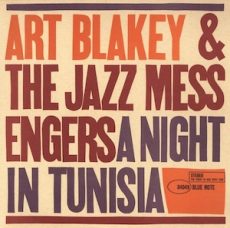
A Night In Tunisia ~ Art Blakey and The Jazz Messengers | By Eddie Carter
This morning’s record from the library is an exceptional jazz album where the musicians complement each other behind the iconic drummer Art Blakey. A Night In Tunisia (Blue Note BLP 4049/BST 84049) is a 1961 release that is not just one of the best LPs in The Jazz Messengers discography but a historical treasure that is better experienced than described. In the spotlight with Art on this date are Lee Morgan on trumpet, Wayne Shorter on tenor sax, Bobby Timmons on piano, and Jymie Merritt on bass. The 1978 King Record Company Japanese Stereo reissue is my copy (Blue Note BST 84049 – GXK 8041).
A Night In Tunisia by Dizzy Gillespie and Frank Paparelli starts swinging with Art’s lively introduction to the quintet’s brisk melody. Wayne launches into a hard-driving interpretation, showcasing his technical prowess and emotional depth. Lee continues cooking with energetic exuberance, his trumpet work adding a vibrant layer to the tune. Jymie demonstrates his skillful command of the bass, walking with authority in a short solo. Art fuels the finale with intense emotion ahead of the theme’s vigorous restatement.
The ensemble eases to a medium melody for Sincerely Diana by Wayne Shorter, stepping aside for the saxophonist’s bluesy opening statement. Morgan carries himself well in the following reading, his trumpet work adding a soulful touch. Then, Timmons delivers a delightfully relaxed performance, his piano playing adding a smooth, jazzy feel. Blakey provides a memorable exclamation point ahead of the closing chorus, his drumming adding a dynamic energy to the piece.
So Tired by Bobby Timmons starts Side Two at a medium tempo, with a boogaloo flavor for the ensemble’s theme. Wayne gives the opening solo an unmistakable melodic charm. Lee next illustrates a splendid study in soulful improvisation; then Bobby hits an ideal groove, leading to the theme’s restatement and graceful fadeout. Yama is the first of two originals by Lee Morgan, and the quintet’s melody is a model of uncomplicated beauty. Timmons is up first and shows his soloist capabilities to fine advantage here in a gentle performance. Morgan responds with a tender, tasteful presentation next. Shorter culminates the solos with an affectionately intimate reading over the trio’s lush foundation into the song’s soothing ending.
Art’s drums kick off the album closer, Kozo’s Waltz by Lee Morgan. The complete ensemble joins in for the medium-fast theme. Wayne gets things underway with a passionate opening statement. Lee responds with an exciting interpretation; Timmons follows with a few intriguing choruses. Art puts his stamp on the closing solo with a sizzling beat before the return to the theme. Alfred Lion produced the initial session, and Rudy Van Gelder was the recording engineer, both of whom were instrumental in capturing the quintet’s energy and chemistry. This King Record Company reissue has a spectacular soundstage that transports the musicians to the sweet spot in your listening room with stunning fidelity. If you’re a hard bop fan, I happily recommend A Night In Tunisia for a place in your jazz library. It’s a gem by Art Blakey and The Jazz Messengers that no jazz enthusiast should miss on their next shopping trip!
~ A Night In Tunisia – Source: JazzStandards.com
© 2024 By Edward Thomas Carter
More Posts: choice,classic,collectible,collector,drums,history,instrumental,jazz,music
Daily Dose Of Jazz…
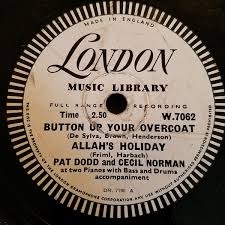
Cecil Norman was born on September 29, 1897 in Oldham, Lancashire, United Kingdom. Considered a child prodigy, by the age of 11 he was playing concertos, at 15 he appeared at London’s Aeolian Hall. He was the son of music hall artists, billed as Olga and Otto, with his mother playing trumpet, trombone, concertina and piano.
Cecil stayed in London during World War II, with many engagements to entertain the troops, accompanying Vera Lynn as well as Inga Anderson, who sang with the George Melachrino Orchestra. After serving in World War I, he switched from classical to popular music, partly due to developing neuritis in the right hand, which forced him to give up the piano for a couple of years. Thereafter Cecil specialised in dance music, it being less likely to aggravate his condition.
He played in so many popular bands it’s hard to list them all, however in 1924 along with his alto saxophonist brother Leslie began their own band at the Savoy Hotel for tea dances and the Bekeley Hotel in the evenings. They soon moved to the Empress Rooms where they played seven days a week plus tea dances. At times, either he or his brother were in charge and arranging for the Savoy Plaza Band and Savoy Dance Band. In 1927, the Norman Brothers Band moved to Carlton Hotel. In 1928, Cecil went to America and had Rudy Vallee introduce him around, including to Bert Lown, whom he joined in New York.
Moving back to London in 1929, Cecil played and recorded with Fred Elizalde Band in 1930 before moving to Jerry Hoey’s band and Melville Gideon’s band in 1931. He went on to join several other bands in London and Australia, including the BBC Dance Orchestra. He stayed in London during World War II, with many engagements to entertain the troops, accompanying Vera Lynn as well as Inga Anderson, who sang with the George Melachrino Orchestra.
After the war, Norman formed the Rhythm Players that became the cornerstone of the BBC’s Music While You Work program in the 1950’s. Over the course of his career he composed several instrumental numbers. He retired in 1962 when he was 65 after suffering an accident. He returned one last time for a 15-minute spot in 1970, ending his more than sixty years in music.
Dance pianist & composer Cecil Norman, who used the pseudonym Norman Sissel for some Norman Sissel And His Rhythm Twisters recordings, died February 8, 1988 aged 91 in East Sussex, England.
</p
More Posts: bandleader,history,instrumental,jazz,music,piano
Daily Dose Of Jazz…
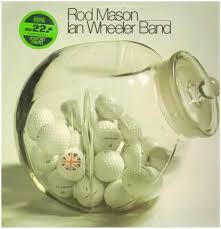
Rod Mason was born September 28, 1940 in Plymouth, England and as a young man played with the local Tamar Valley Jazz Band, in which his father, Frank “Pop” Mason, had played drums. At Kelly College, in Tavistock, England he played the bugle with the cadet corps, then the valve trombone. He played this in his father’s band until the trumpet player left, whereupon he replaced him using a brass-band style cornet.
He went on to play briefly with the Cy Laurie band from 1959 to 1960 and two years later went with Monty Sunshine who left the Chris Barber band to form his own group. Sunshine hired Mason on the recommendation of Kenny Ball. In the mid-1960s after leaving Sunshine, Rod worked in the family business and played occasionally, until a winning appearance on Hughie Green’s Opportunity Knocks TV talent show which led to a flood of offers.
A facial paralysis forced him to use other mouthpieces, which allowed him to extend the range of his instrument. In 1965, he established his own band. From 1970 he played in the Acker Bilk Paramount Jazz Band, before he founded a band together with Ian Wheeler in 1973. He recorded numerous recordings for the Reef label. The 1980s saw Mason playing in the Dutch Swing College Band. In 1985, he founded the Hot Five band and released a number of albums for Timeless Records and regularly toured Europe.
Trumpeter, cornetist, vocalist Rod Mason who recorded thirty-two albums as a leader, played his last gig in Kaarst, Germany in December 2016 and died three weeks later on January 8, 2017 after developing peritonitis and pneumonia.
</p
More Posts: bandleader,cornet,history,instrumental,jazz,music,trumpet,vocals

Daily Dose Of Jazz…
Guido Basso was born on September 27, 1937 in Montreal, Quebec, Canada. He grew up in the Little Italy neighbourhood of Montreal, in an Italian-Canadian family. He began playing the trumpet at the age of nine and studied at the Conservatoire de musique du Québec à Montréal.
His professional music career started in his teens, under the name Stubby Basso. During his early twenties he performed regularly at the El Morocco in Montreal, and played in bands led by Maury Kaye. Singer Vic Damone discovered Basso playing at El Morocco, then included him on a tour from 1957 to 1958.
He had a professional career as a composer, conductor, arranger, trumpeter, flugelhornist, and harmonica player. In 1958, Guido joined singer Pearl Bailey and her husband, drummer Louis Bellson, touring North America with them and their orchestra. Returning to Canada Guido settled in Toronto, Canada in 1961, during that time he studied at The Royal Conservatory of Music.
In 1963, he became music director for CBLT’s Nightcap, a tv station job he held for four years, then on to music director for the Canadian Broadcasting Corporation. He organized and led big band concerts featuring Dizzy Gillespie, Quincy Jones, Woody Herman, Benny Goodman, Count Basie and Duke Ellington. Basso was a charter member of Rob McConnell’s Boss Brass, playing with the band for over twenty years and also played in big bands led by Ron Collier, and Phil Nimmons.
Trumpeter, flugelhornist, arranger, composer, and conductor Guido Basso, who won two Juno awards, was a member of the Order of Canada, died in Toronto, Canada on February 13, 2023, at age 85.
More Posts: bandleader,history,instrumental,jazz,music