

Daily Dose Of Jazz…
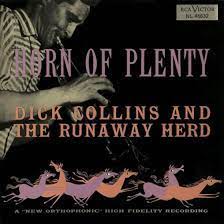
Dick Collins was born Richard Harrison Collins on July 19, 1924 in Seattle, Washington into a musical family where several of his parents and grandparents were professional musicians. He attended Mills College in 1946–47, where he studied music formally under Darius Milhaud, and moved with Milhaud to Paris, France for the next academic year. As a student at Mills, he first met Dave Brubeck, and while in Paris he played with Hubert Fol and Kenny Clarke.
Returning to the States he landed in San Francisco, California where he began playing with Brubeck in his Bay Area-based octet, then completed his bachelor’s degree in music at San Francisco State College. In the 1950s he performed and recorded with Charlie Barnet, Charlie Mariano, Nat Pierce, Paul Desmond, Cal Tjader, and Woody Herman. By 1957 Dick was working with Les Brown, an association that continued for nearly a decade that included worldwide tours.
In 1965, Collins took a position as a music librarian, which he held through 1967, and took a second position from 1971 to 1986, mostly receding from active performance. In later years, he still occasionally performed live or recorded, including with Nat Pierce, Mary Ann McCall, and Woody Herman.
Trumpeter Dick Collins transitioned on April 19, 2016 in Hesperia, California, at the age of 91.

More Posts: bandleader,history,instrumental,jazz,music,trumpet
Daily Dose Of Jazz…
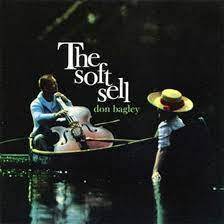
Donald Neff Bagley was born on July 18, 1927 in Salt Lake City, Utah and received formal training on the double bass. He went on to study in Los Angeles, California and played in 1945 with Shorty Sherock and Wingy Manone, and in 1948 with Dick Pierce.
During the early Fifties from 1950 to 1953, and sporadically thereafter, Bagley played with Stan Kenton. HIs time with Kenton, A Study for Bass by Bill Russo and Bags by Bill Holman were written to feature Bagley’s playing. By 1954 he was fronting his own ensembles. His session work between 1950 and 1952, Don worked extensively with Nat King Cole, Maynard Ferguson, and Dexter Gordon. He played in Europe with Zoot Sims, Lars Gullin, Frank Rosolino, and Åke Persson. He would go on to work with Les Brown, Jimmie Rowles, Shelly Manne, Pete Fountain and Phil Woods. In 1957 and 1958, he recorded three albums under his own name.
The Sixties saw him playing with Ben Webster and Julie London. Into the 1970s and 1980s he worked with Burt Bacharach while composing and arranging for film and television, including the scores to Mama’s Dirty Girls, The Manhandlers, The Swinging Barmaids, The Student Body, Young Lady Chatterley and Sacred Ground.
Double bassist, composer and arranger Don Bagley transitioned of natural causes on July 26, 2012 at the age of 85.
More Posts: arranger,bandleader,bass,composer,history,instrumental,jazz,music
Requisites
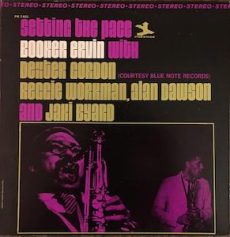
Setting The Pace ~ Booker Ervin | By Eddie Carter
I love a good blowing session, especially one featuring a tenor sax. I became a fan of Booker Ervin after hearing That’s It! (1961), Exultation! (1963), and Back From The Gig (1976). This morning’s album submitted for your approval is a 1967 release by the saxophonist, Setting The Pace (Prestige PR 7455/PRST 7455). Booker was born in Denison, Texas, and began playing the trombone as a youngster. He taught himself the tenor sax while serving in the Air Force and stationed in Okinawa. He later attended Berklee College of Music after completing his service and began playing with trombonist Ernie Fields. Ervin moved to New York a few years later and worked with Charles Mingus. Sharing the spotlight with him on this date is Dexter Gordon on tenor sax, Jaki Byard on piano, Reggie Workman on bass, and Alan Dawson on drums. My copy used in this report is the 1973 US Stereo reissue (Prestige PRT-7455).
The quintet dives straight into the first of two tunes by Dexter Gordon. Setting The Pace occupies the entire first side and both horns begin with an ear-opening introduction evolving into the ensemble’s lively melody. Dexter is up first with a lengthy performance of high-spirited delight. Booker keeps his foot on the pedal with long phrases soaring ambitiously to the stratosphere. Reggie makes a brief bass comment, then Jaki gets into something interesting on the next reading. Dex and Book return to share a brisk conversation. Alan concludes the solos with a short workout into the song’s climax. Side Two takes off with the rhythm section’s introduction and quintet’s theme to Dexter’s Deck. Booker starts things off vigorously in his opening statement. Dexter takes charge next on an enthusiastic nine-and-a-half-minute reading. Reggie responds with an inspired bit of bass walking preceding the song’s conclusion.
Setting The Pace was produced by Don Schlitten and Willy Schmidt was the man behind the dials. This reissue is a gorgeous recording possessing a very impressive soundstage. The instruments emerge from your speakers with crystal-clear clarity. Booker recorded a total of nine albums for Prestige, and seven more for Bethlehem, Blue Note, Candid, Pacific Jazz, and Savoy. He also made quite a few recordings as a sideman working with some of the best jazz musicians. He passed away at age thirty-nine from kidney failure on August 31, 1970. If you’re a fan of either Booker Ervin or Dexter Gordon and are in the mood for some adventurous Hard-Bop, I invite you to check out Setting The Pace on your next vinyl shopping spree. It’s forty-two-and-a-half minutes of splendid jazz that’s sure to have the listener hungering for more!
~ Back From The Gig (The Blue Note Reissue Series BN-LA488-H2), Exultation! (Prestige PRLP 7293/PRST 7293), That’s It! (Candid CJM-8014/CJS-9014) – Source: Discogs.com ~ Booker Ervin – Source: Wikipedia.org © 2022 by Edward Thomas Carter

More Posts: choice,classic,collectible,collector,history,instrumental,jazz,music,saxophone
Daily Dose Of Jazz…
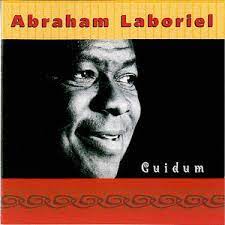
Abraham Laboriel López was born on July 17, 1947 in Mexico City, Mexco into a talented family with a rock singer brother and a sister who is a singer, film and television actress. A classically trained guitarist, he switched to bass guitar while studying at the Berklee College of Music, graduating in 1972.
It was during this time that he learned the importance of versatility as a musician. Henry Mancini encouraged Laboriel to move to Los Angeles, California, to pursue a recording career, which he did in 1976. Though he struggled to find work for two years, he found his first gig on a road tour with Olivia Newton-John. After a consequent European tour with Al Jarreau, he settled into a full-time studio career in Los Angeles.
He would go on to work and record with Al Jarreau, Billy Cobham, Freddie Hubbard, George Benson, Herbie Hancock, Lalo Schifrin, Gary Birton, Stan Getz, Larry Carlton, Lee Ritenour, Quincy Jones, Randy Crawford, Dave Grusin, and Umberto Tozzi as well as Stevie Wonder, Michael Jackson, Barbra Striesand, Madonna, Andre Crouch, Herb Alpert Minnie Riperton, Barry Manilow, and many others.
Abraham was a founding member of the bands Friendship and Koinonia. With the latter he recorded four albums. In addition he recorded several solo albums on which he recruited a cast of musicians that included Alex Acuña, Al Jarreau, Jim Keltner, Phillip Bailey, Ron Kenoly, his son Abe Laboriel Jr. on drums, and others.
In 2005, he was awarded an Honorary Doctorate of Music by the Berklee College of Music. Electric bassist Abraham Laboriel has played on over 4000 recording sessions, is ranked No. 42 on Bass Player magazine’s list of The 100 Greatest Bass Players of All Time, and continues to record and perform as a member of the band Open Hands with Justo Almario, Greg Mathieson, and Bill Maxwell.
More Posts: bandleader,bass,history,instrumental,jazz,music

Daily Dose Of Jazz…
Bobby Previte was born July 16, 1951 in Niagara Falls, New York. He started playing early but went on to earn a degree in economics from the University at Buffalo, New York where he also studied percussion.
Moving to New York City in 1979 he began professional relationships with John Zorn, Wayne Horvitz, and Elliott Sharp. While Previte is a talented drummer he has also received critical acclaim for his exceptional abilities as a composer and orchestrator. His compositions are often tightly arranged, although they leave room for significant amounts of improvisation. Additionally, Previte often uses unusual instrumentation and also draws on many non-jazz musics for his compositions.
As a performer much of his work is also improvisational. He has recorded three dozen albums as a leader or co-leader and as a sideman played on 85 recording sessions across numerous genres of music. Drummer, composer and orchestrator Bobby Previte, who has delved into the jazz, avant~garde and rock genres as a leader, continues to expand his career.
More Posts: bandleader,composer,drums,history,instrumental,jazz,music,orchestrator