

Daily Dose Of Jazz…
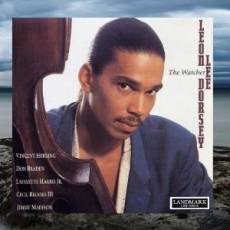
Leon Lee Dorsey was born on March 12, 1958 in Pittsburgh, Pennsylvania. The post bop genre bassist began as a child and matriculated through Oberlin College receiving two Bachelor of Music Degrees and the University of Wisconsin and the Manhattan School of Music receiving Maters degrees from both.
Dorsey’s chops for composing and arranging are witnessed on his 1995 debut album on the Landmark label titled The Watcher with Don Braden, Vincent Herring, Lafayette Harris Jr., Cecil Brooks III and Jimmy Madison followed by his 1999 release of Song of Songs that maintains a supreme sense of melody throughout the session.
He has performed and recorded with Lionel Hampton, Art Blakey, John Lewis, Cassandra Wilson, Freddie Hubbard, Dizzy Gillespie, Wynton Marsalis, Kenny Clarke, Jon Hendricks, Gloria Lynn, Harry “Sweets” Edison, has played with symphonies, orchestras and big bands of Duke Ellington, Benny Carter and Charlie Persip, with opera diva Marilyn Horne and with Frank Sinatra at Carnegie Hall.
Bassist Leon Dorsey completed his doctorate in Classical Double Bass under Ron Carter and is currently Assistant Professor of Jazz Performance at the University of Pittsburgh.
More Posts: bass
Daily Dose Of Jazz…
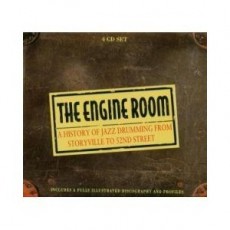
Chauncey Morehouse was born on March 11, 1902 in Niagara Falls, New York and was raised in Chambersburg, Pennsylvania where he learned and played drums from an early age. He also played piano and banjo and while in high school led a group called the Versatile Five. He landed a job with Paul Specht’s orchestra in 1922, touring with him through Europe in 1923.
Through the Roaring Twenties Chauncey played with The Georgians, Jean Goldkette, Adrian Rollini and Don Voorhees. He recorded with Frankie Trumbauer, Bix Beiderbecke, Red Nichols, The Dorsey Brothers, Joe Venuti and many others.
By 1929 Morehouse was active for the next decade chiefly as a studio musician, working in radio and television in and around New York City. In 1938, he put together his own percussion ensemble which played percussion tuned chromatically.
Morehouse invented a set of drums called the N’Goma drums, which were made by the Leedy Drum Company who endorsed Morehouse during his career. His career in the studios continued into the 1970s when he retired from studio work and began playing jazz again, mostly at festivals.
In his later years Morehouse made appearances at Carnegie Hall for the Tribute to Bix concert for the Newport Jazz Festival, and at one of the early Bix Beiderbecke Memorial Jazz Festivals in Davenport, Iowa. Chauncey Morehouse passed away on October 31, 1980 in Medford, New Jersey, aged 78.
More Posts: drums
Daily Dose Of Jazz…
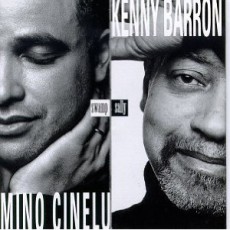
Mino Cinelu was born on March 10, 1957 in Saint-Cloud, Haute-de-Seine and was introduced to music as a child playing percussion in concert halls in the suburbs of Paris. He became interested in jazz, rock, salsa eventually expanded into fado, flamenco, African, Japanese and other varieties.
His first instrument was the bongo drums, which led him to decide to try and live from his music. He often played the bongos in the streets experimenting with improvisation. By the end of the 1970s he became more and more interested in the French jazz-fusion scene working with Jef Gilson, Chute Libre and Moravagine
In 1979 Mino moved to New York, met George Benson, Wayne Shorter, Kenny Barron and Cassandra Wilson, added new instruments to his repertoire, and was soon joining Miles Davis on tour. This recognition led Joe Zawinul asking him to be a part of Weather Report during which time he began composing with the help of Wayne Shorter and Zawinul.
Cinelu also played with Michel Portal prior to beginning his solo career in the 1990s with his self-titled debut album Mino Cinelu was released in 2000, followed by Quest Journey in 2002 and La Californie in 2006. He continues to compose, record and perform.
More Posts: percussion
Daily Dose Of Jazz…
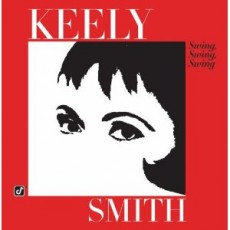
Keely Smith was born Dorothy Jacqueline Keely on March 9, 1932 in Norfolk, Virginia and showed a natural aptitude for singing at a young age. By 14, she was singing with a naval air station band. At 15, she got her first paying job with the Earl Bennett band.
Smith made her professional debut with Louis Prima in 1949 who later became her husband, playing the ” straight guy” in the duo and making the Mercer/Arlen tune “That Old Black Magic” a standard that won them a Grammy for Best Performance by a Vocal Group.
Keely appeared with Prima in the 1959 film, Hey Boy! Hey Girl! singing Fever, appeared in and sang on the Thunder Road soundtrack, and her first big solo hit was with “I Wish You Love”. Signing with Reprise in 1961 she began working with Nelson Riddle, though those recordings have never been released. Through the 60s she had minor hits but it wasn’t until 1985 that she made a comeback with “I’m In Love Again” and her 2001 album “KeelySings Sinatra” was nominated for a Grammy.
Smith released Vegas ’58 – Today, a compilation album of her best known songs, all recorded live by her own admission, she has never had a singing lesson and cannot read music. In recent years she has been booked at New York’s Café Carlyle, performed “That Old Black Magic” with Kid Rock at the 50th Grammy Awards and continued to work a light-touring schedule until her passing away on December 16, 2017 of heart failure in Palm Springs, California.
More Posts: vocal
Requisites
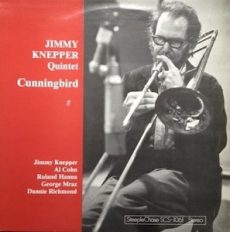
Cunningbird ~ Jimmy Knepper Quintet | By Eddie Carter
A few years back, during our anniversary trip to Honolulu, Hawaii, my wife and I took a walk along Bethel Street in Chinatown and found our way into Skull-Face Books and Vinyl. There, I came across an album by the Jimmy Knepper Quintet, which I listened to a few nights ago, inspiring me to feature it in this morning’s discussion. Cunningbird (SteepleChase Records SCS-1061) is a 1977 Danish release, the trombonist’s fourth as a bandleader. He’s best known for working with Charles Mingus, Gil Evans, the Mingus Dynasty, and the Thad Jones-Mel Lewis Orchestra. Here, he’s joined by Al Cohn on tenor saxophone, Roland Hanna on piano, George Mraz on bass, and Dannie Richmond on drums. The copy I own is the 1980 U.S. stereo reissue that shares the original catalog number.
Side One opens with Figment Fragment, the first of six originals by Jimmy Knepper. The opening ensemble is a spirited romp by the group with Knepper and Cohn at the forefront. Jimmy is up first and gives an energetic solo, then Al jumps in with a lively bounce. Roland follows with a delightful reading, and George walks with assurance next. Knepper and Cohn share a short workout ahead of the closing chorus. Languid is a lovely ballad that begins with a touchingly tender ensemble melody. Knepper’s opening solo is executed with warmth and intimacy. Hanna delivers a short statement, delicately leading to the group’s elegant reprise and ending.
Just Tonight is a fast bopper that gets busy right from the start of the ensemble’s speedy theme. Jimmy kicks things off with a fiery opening statement. Cohn takes over, pouring energy into every note. Roland builds the third reading with a compelling intensity next. George steps in last and walks briskly before the quintet wraps up with a vigorous restatement of the theme. Cunningbird, the title selection, opens the second side solemnly, then picks up the pace for Knepper to state the theme. Knepper cruises comfortably into the lead solo. Mraz follows and solos effectively. Cohn swings lightly next, and Hanna takes aim last, making a concise comment into the reprise and close.
Noche Triste is a haunting ballad with a Latin groove underpinning the ensemble’s graciously inviting melody. Jimmy leads the way with a thoughtfully tender solo. Al fills the next interpretation with a soft, elegant beauty. Roland etches a reading of lyrical grace next, and George gets the last words to deliver a wonderfully soothing statement preceding the group’s gentle reprise and fadeout. Spotlight Girl ends the album on an upbeat note with the quintet’s theme. Knepper gets to the point right away in the first solo. Mraz responds vigorously in the following reading. Hanna finds new avenues to explore in the third statement, and Knepper and Cohn have a brief conversation that leads back to the lively reprise and climax.
Nils Winther produced Cunningbird, and Elvin Campbell managed the recording console. The album’s sound quality is excellent with no harshness from top to bottom. The record is silent until the music starts, and the soundstage of each instrument is splendid. If you’re a hard bop fan and are in the mood for a great ensemble album, I invite you to consider Cunningbird by the Jimmy Knepper Quintet on your next record-shopping trip. It’s a terrific album by one of the unsung heroes of the slide trombone, who’s deserving of greater recognition and serves as a perfect introduction to his discography as a leader and sideman!
© 2026 by Edward Thomas Carter

More Posts: choice,classic,collectible,collector,history,instrumental,jazz,music,trombone