

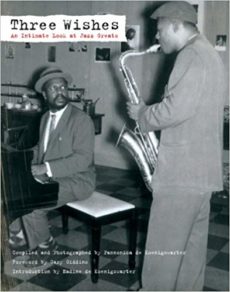
Three Wishes
Upon request by Pannonica as to his three wishes Danny Quebec~West responded by telling her:
-
-
“That the United States government… I wish that the capitalistic system be like the socialistic system in subsidizing the starving musicians, for art’s sake.”
-
“My second wish ~ speaking of a field not concerning music ~ I wish that the stigma on jazz musicians concerning drugs… that the world have socialization of medicine, and therefore that we canget all we want.”
- “I hope when they do decide to let me be heardagain after such a long layoff, I hope that I can reach from their toes to their heads, and explode every minute cell in their brain ~ meaning the public, being that I feel that I have been treated very unjustly music~wise..”
-
*Excerpt from Three Wishes: An Intimate Look at Jazz Greats ~ Compiled and Photographed by Pannonica de Koenigswarter

More Posts: baroness,history,instrumental,jazz,music,pannonica,saxophone,three,wishes
Daily Dose Of Jazz…
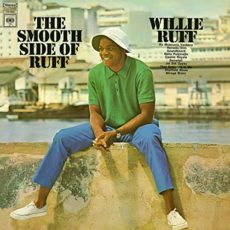
Willie Ruff was born on September 1, 1931 in Sheffield, Alabama and learned to play both the French horn and the double bass. He attended the Yale School of Music graduating with a Bachelor and Master of Music degrees by 1954.
He met pianist Dwike Mitchell in 1947 when they were teenage servicemen stationed at the former Lockbourne Air Force Base in Ohio. They began a professional relationship when Mitchell recruited him to play bass with his unit band for an Air Force radio program. They later played in Lionel Hampton’s band but left in 1955 to form their own group, then together as the Mitchell-Ruff Duo that lasted over fifty years. They also played as the second act to artists such as Louis Armstrong, Count Basie, Duke Ellington, and Dizzy Gillespie.
From 1955 to 2011, the duo regularly performed and lectured in the United States, Asia, Africa, and Europe. In 1950 the Mitchell-Ruff Duo was the first jazz band to play in the Soviet Union and in China in 1981. Ruff was chosen by John Hammond to be the bass player for the recording sessions of Songs of Leonard Cohen, was one of the founders of the W. C. Handy Music Festival in Florence, Alabama in 1982.
As an educator, Willie was a faculty member at the Yale School of Music, teaching music history, ethnomusicology, and arranging. He is founding Director of the Duke Ellington Fellowship Program at Yale, held a visiting appointment at Duke University, where he oversaw the jazz program and directed the Duke Jazz Ensemble, and also has been on faculty at UCLA and Dartmouth.
French hornist, double bassist, music scholar, and educator Willie Ruff, was awarded the Sanford Medal, the Connecticut Governor’s Arts Award, and was an inductee of the Alabama Jazz Hall of Fame, primarily a Yale professor from 1971 to 2017, and continues to reside in Alabama.

More Posts: bass,educator,french horn,history,instrumental,jazz,music

Daily Dose Of Jazz…
Roy Willox was born August 31, 1929 in Welwyn, Hertfordshire, England into a musical family in 1929. At 16 he initially played with Johnny Claes for a short time in 1945 and then worked in other well-known bands before joining the Ted Heath Orchestra for a five-year stint from 1950 to 1955. During this time he also worked in a band with Keith Christie.
A collaboration with Jack Parnell and other bands led to extensive freelance in television, radio and theater. In the field of jazz, he was part of Harry South’s band in the 1960s and 1970s. This period of performing saw him occasionally returning to the Heath band throughout the 1990s and 2000s, playing the Ted Heath Bands farewell concert at London’s Royal Festival Hall in 2000.
In his later years Roy worked with Kenny Baker, the Robert Farnon Orchestra, and Laurie Johnson’s London Big Band. 2009 with the all-star formation The Allan Ganley Jazz Legacy. He was involved in 156 jazz recording sessions between 1951 and 2016 with Cleo Laine, Larry Page, George Chisholm, Beryl Bryden, Johnny Keating, Tubby Hayes, Kenny Clare, Dudley Moore, Louie Bellson, The London Jazz Chamber Group, Michel Legrand, Phil Woods, and the Len Phillips Big Band.
As a session musician, he is also in pictures of Bert Kaempfert, Tiny Tim ~ Live! At the Royal Albert Hall, and Harry Nilsson ~ A Little Touch of Schmilsson in the Night. Alto saxophonist Roy Willox, who also plays clarinet and flute, passed away on November 25, 2019.
More Posts: clarinet,flute,history,instrumental,jazz,music,saxophone
Requisites
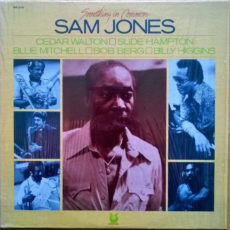
Something In Common ~ Sam Jones | By Eddie Carter
Up next from the library is a 1978 album by bassist Sam Jones titled Something In Common (Muse Records MR5149). If you’re unfamiliar with him, he’s recorded as a leader for East Wind, Interplay, Riverside, SteepleChase, and Xanadu. For five years, he was an essential member of the quintet and sextet of Cannonball Adderley. He’s also appeared on some of the most important jazz LP’s ever recorded and worked with Nat Adderley, Gene Ammons, Donald Byrd, Al Cohn, Arnett Cobb, Lou Donaldson, Kenny Dorham, Red Garland, Dizzy Gillespie, Johnny Hodges, Clifford Jordan, Duke Jordan, Yusef Lateef, Thelonious Monk, Sonny Stitt, and Bobby Timmons among others. For this date, Jones assembled an excellent quintet, Blue Mitchell on trumpet; Slide Hampton on trombone; Bob Berg on tenor sax; Cedar Walton on piano and Billy Higgins on drums. My copy used in this report is the original US Stereo release.
The briskly paced Slide Hampton tune, Every Man Is A King kicks off Side One with Sam presenting a gentle solo introduction that evolves into a swinging affair on the melody. The solo order is Hampton, Mitchell, Berg, Walton, Higgins, and the front line’s strength is in evidence on three exhilarating readings. Cedar kicks it up a notch when his turn comes, followed by Billy who makes a brief closing comment. For All We Know is a jazz and pop standard that was written in 1934 by Fred Coots and Sam Lewis. The ensemble begins with a very pretty melody reminiscent of the cool jazz sound Miles Davis, Gil Evans, and Gerry Mulligan achieved on the LP, Birth of The Cool. Sam shapes the opening statement thoughtfully into an elegant interpretation. The beat moves upward for a brief reading by Blue into the ensemble’s soothing coda.
Mitchell’s Blue Silver ends the first side with the group taking the main theme at a speedy velocity. Blue takes flight first with a joyously, happy lead solo. Bob, Slide, and Cedar follow with three brief energetic interpretations, then Higgins takes the final bow exchanging short riffs with all four soloists preceding the out-chorus. Something In Common is the first of two tunes from Cedar’s pen and starts Side Two swinging from the melody with the sextet showing off their chemistry. Walton opens with an aggressive solo, then Berg shines on a marvelous statement that’sa knockout. Mitchell responds to the saxophonist with exuberant energy next. Hampton follows, making an authoritative entrance into the fourth presentation with passionate emotion. Higgins delivers the final performance with aggressive incisiveness, providing the perfect counterpoint to each artist.
Bolivia, one of Cedar’s most famous compositions made its debut on the 1975 album, Eastern Rebellion with Jones, Higgins, and George Coleman joining the pianist. Blue is featured during the robust melody and end theme but does not solo here. Slide jumps out the box first with enthusiastic authority, then Cedar gives a fiery display on a jubilant statement. Bob makes a bold statement of robust wailing on the next reading. Sam completes the solos with luminous intensity ahead of the ensemble’s reprise and fadeout. Jones’ Seven Minds is the longest track on the album, affording solo opportunities for everyone except Mitchell and Higgins. Sam opens auspiciously with an extended solo vamp, developing into the sextet’s expedient theme. Walton opens with a fiercely, exciting first statement. Hampton demonstrates the tools of a master craftsman with a cooking reading next. Berg follows, producing incandescent heat, then Jones culminates the set with a delightful improvisation.
This release was recorded by one of the best engineers in the business, Chuck Irwin whose list of credits includes many albums across several genres. The LP also has a fine tonal balance of treble, midrange, and bass with superb sound quality as though we’re in the studio with the musicians, eavesdropping. If you’re a fan of Hard-Bop, or Post-Bop, or are looking for an album showcasing superb bass, I offer for your consideration and also recommend Something In Common by Sam Jones. It’s a great set of excellent jazz that should become an essential addition to any library!
~ Birth of The Cool (Capitol Records T-762); Eastern Rebellion (Timeless SJP 101) – Source: Discogs.com
~ For All We Know – Source: Wikipedia.org © 2020 by Edward Thomas CarterAs you listen to this version of the album, be mindful that three songs, Shoulders, One for Amos, and You Are the Sunshine of My Life, have been added to the compact disc release of this album that are not included on the original release. For what reason I am not aware.

More Posts: choice,classic,collectible,collector,history,instrumental,jazz,music
Daily Dose Of Jazz…
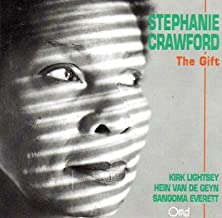
Stephanie Crawford was born on August 30, 1942 in Detroit, Michigan and divided her childhood between living with her mother in Detroit’s Black Bottom, called that due to its dark soil, and with an aunt in Chattanooga, Tennessee. She grew up surrounded by jazz, blues, R&B, and gospel music, from which she draws from.
Although singing was her first love from childhood she did not sing in public until she was 36, after working on a Chrysler assembly line and as a short-order cook, and earning a bachelor’s degree in painting from Wayne State University.
Her first live performance in front of an audience was accidental while taking in a rather bad pianist/vocalist in a local dive. Whe she would forget the words, Stephanie would call out the lyrics. Fed up, the woman challenged her to come up and sing and the rest is history. The invite to come back was given and she found her home.
A move to New York City, while working on her master’s in fine arts, Crawford became so immersed in the Manhattan jazz scene that she dropped out of school in order to devote more time to sitting in at jam sessions. She found herself seeking out and studying with Frank Foster and Barry Harris.
Her next stop was Paris, France where she won the prestigious Django d’Or award for Best International Jazz Vocalist in 1993. Singing did not pay the bills, so to support herself Stephanie taught jazz singing at two music schools. Returning to New York City she found work with a Portuguese wine importer.
Vocalist Stephanie Crawford, is clear that talent and fame are not synonymous, and though she continues to sing, helping to keep the fading local jazz scene alive, and continues with her passion for art. Just prior to the pandemic she performed in New York City at the Laurie Beechman Theater.
More Posts: bandleader,history,instrumental,jazz,music,vocal