

Daily Dose Of Jazz…
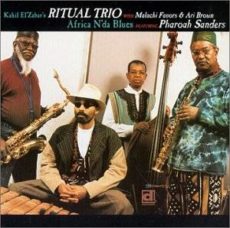
Kahil El’Zabar was born on November 11, 1953 in Chicago, Illinois and attended Lake Forest College before joining the AACM, Association for the Advancement of Creative Musicians in the early 1970s. He would go on to become its chairman in 1975.
During the 1970s, he formed the musical groups Ritual Trio and the Ethnic Heritage Ensemble, both of which have remained active. Kahil has collaborated include Dizzy Gillespie, Stevie Wonder, Nina Simone, Cannonball Adderley, and Paul Simon.
The multi-instrumentalist, Kahil El’Zabar, who is mainly a percussionist and composer, regularly records for Delmark Records. As a leader and co-leader he has released eight albums, fourteen with the Ensemble, 14 with the Trio, two with the group Tri-Factor and has recorded four as a sideman with David Murray and Wadada Leo Smith. He continues to perform, compose and record.

More Posts: percussion
Daily Dose Of Jazz…
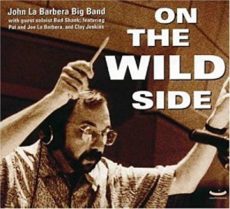
John LaBarbera was born November 10, 1945 in Mount Morris, New York and studied trumpet in his youth. During the late Sixties he worked with Buddy Rich but has performed and recorded with many big bands.
His career accomplishments to date include recording and/or performing with Woody Herman, Count Basie, Dizzy Gillespie, Sammy Davis, Jr., Mel Tormé, Chaka Khan, Harry James, Bill Watrous, the Glenn Miller Orchestra, Al Cohn, Bill Perkins, and Phil Woods.
A two-time recipient of the National Endowment For the Arts award for Jazz Composition, John is also an educator teaching jazz and music industry courses at the University of Louisville.
Leading his own big band, trumpeter and arranger John LaBarbera has released two CDs, On the Wild Side and Fantazm, the former of which was nominated for a Grammy award in 2004. He continues to educate, perform and arrange.

More Posts: trumpet
The Jazz Voyager
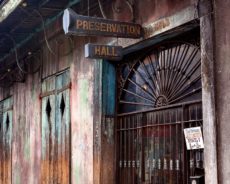
Heading to Louisiana and the Big Easy once again, yes, to the birthplace of jazz, to 726 St. Peter Street in the heart of the French Quarter to Preservation Hall and there is no other place that can transport the audience through time to the very origins of jazz.
Opened originally in the 1950s as Associated Artists, a small art gallery, by proprietor Larry Borenstein who found that it curtailed his ability to attend the few remaining local jazz concerts. So he began inviting the living legends of New Orleans jazz to have “rehearsal sessions” in the gallery. Then in 1961 Preservation Hall was established to preserve, perpetuate, and protect traditional New Orleans Jazz, becoming a cornerstone of New Orleans music and culture.
So this Jazz Voyager is going to soak up some traditional jazz with trumpeter Leroy Jones on Saturday and the Shake ‘Em Up Jazz Band: Present a Tribute to the Ladies of Preservation Hall on Sunday, eat a few beignets and enjoy the Crescent City nightlife. Showtimes are 6:00, 8:00, 9:00, and 10:00pm nightly, seating is reserved, tickets are $40-$50 for Mr. Jones, and $15-$45 for the Shake ‘Em Up Jazz Band and can be purchased at http://preservationhall.tunestub.com/eventList.cfm. More information can be gotten by calling (504) 522-2841. #preserving genius #wannabewhereyouare
More Posts: adventure,art gallery,club,genius,jazz,music,preserving,restaurant,travel,voyager
Daily Dose Of Jazz…
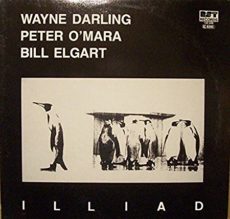
Bill Elgart or Billy Elgart was born on November 9, 1942 in Chelsea, Massachusetts. A student of Alan Dawson, he studied at the Berklee College of Music. By the 1960s he was playing with Carla Bley, Paul Bley, Marion Brown, Sam Rivers, Lowell Davidson, Mark Levinson, Roswell Rudd, John Tchicai, Jack Walrath and Glenn Ferris. In 1968 he made his recording debut on Mr. Joy, with Paul Bley and Gary Peacock.
Moving to Europe in 1976, Bill settled first in Salzburg, Austria and later in Ulm, Germany. He played with Karl Berger, Dave Holland, Ed Schuller and Wayne Darling over the course of the 1980s and 1990s. He was a member of the group Zollsound 4 with Carlo Mombelli, Lee Konitz, and Thomas Zoller. He played in the Sundial Trio with Peter O’Mara from 1982 to 1990, and in 1991 he worked with Caoma alongside Ed Schuller, Sigi Finkel and Tomasz Stanko. He and Stanko also played with Vlatko Kucan in the 1990s.
Elgart worked on the Annemarie Roelofs Projekt, alongside Berger, Frank Möbus, Vitold Rek, and Ingrid Sertso. He has performed as a sideman on recordings by Leszek Zadlo, Manfred Bründl, Kenny Wheeler, Carlo Mombelli, Charlie Mariano, Arrigo Cappelletti, Franco D’Andrea, Wolfgang Lackerschmid, Claudio Fasoli, Sigi Finkel and Paolino Dalla Porta. He has also worked with Tim Berne, Barre Phillips, Eddie Gómez, Conny Bauer, Sheila Jordan, David Friedman and Matthias Schubert. Drummer Bill Elgart continues to perform and record.
More Posts: drums
Daily Dose Of Jazz…
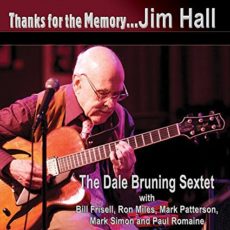
Dale Bruning was born on November 8, 1934 in Carbondale, Pennsylvania and as a small child played piano. When he was in high school he moved to the guitar and went on to become adept at playing tuba, double bass, vibraphone and drums. He was influenced by a wide range of jazz and classical musicians and composers. It was on guitar, however, that he went on the road with various small groups before playing for four years in US Navy bands.
In 1961, he led the house band on The Del Shields Show on NBC in Philadelphia, Pennsylvania that attracted him considerable attention. He performed during the Fifties and following decades were Dennis Sandole, his mentor and principal tutor, Jim Hall, Red Norvo, Dave McKenna, Dizzy Gillespie, Erroll Garner, Marian McPartland, Michael Moore, Gus Johnson, Bill Frisell, and Chet Baker.
He also recorded with bassist Ted Alexander, Nicky DeMatteo and Tony Luis in the late 1950s to early Sixties, and with Rich Chiaraluce in the early 70s. Moving to Denver, Colorado for domestic reasons, he has remained a resident and became an educator in 1960. His playing is inventive in conception and fluid in execution albeit regional in recognition. Though he won many awards, it was not until the late NIneties that Bruning’s reputation began to spread both nationally and internationally.
His book published in 1997, The Dale Bruning Jazz Guitar Instruction Book Series, Vol. I: Phrasing and Articulation, along with new albums received critical acclaim. His profile rose with a series of theme concerts, conceived in collaboration with writer-producer Jude Hibler, that celebrated the music of Duke Ellington, Hoagy Carmichael, Harold Arlen, Harry Warren, Johnny Mandel, Michel Legrand, Cole Porter and Kurt Weill, among others.
Guitarist Dale Bruning continues to educate, has also composed several songs, is an accomplished arranger and continues to perform.

More Posts: guitar