

Requisites
Double Take ~ Freddie Hubbard and Woody Shaw | By Eddie Carter
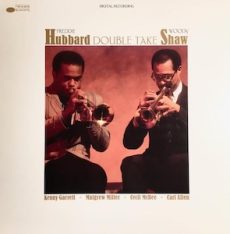
Freddie Hubbard and Woody Shaw were two of my mom’s favorite trumpet players, and one of her favorite albums inspired this morning’s discussion. Double Take (Blue Note BT-85121) is the first of two collaborations by Hubbard and Shaw, the other being The Eternal Triangle, recorded two years later. The sextet features Freddie Hubbard on flugelhorn (track: A3, B2) and trumpet (tracks: A1, A2, A4, B1, B3), Woody Shaw on trumpet, Kenny Garrett on alto saxophone (tracks: A1 to A4, B1, B3) and flute (track: B2), Mulgrew Miller on piano, Cecil McBee on bass, and Carl Allen on drums. I own the 1985 U.S. stereo release.
The set opens with Clifford Brown’s Sandu, and the sextet’s mellow melody is led by the front line. Woody is smooth as velvet on the first solo, followed by Kenny’s warm, mellow notes in a short statement. Freddie is up next and swings comfortably to the rhythm section’s support. Mulgrew takes a final short solo before the group reconvenes for the theme’s return. The trio’s introduction opens the tune for the ensemble’s leisurely melody of Boperation by Fats Navarro and Howard McGhee. Freddie takes the lead this time and gets down to business. Kenny swings through the second solo with rich, melodic lines. Woody follows with renewed vitality in the third reading. Mulgrew and Cecil share the last spot with two concise comments ahead of the sextet’s climax.
Lament for Booker by Freddie Hubbard is his tender ballad dedicated to Booker Little. Mulgrew’s delicately gentle introduction gets things started, with Freddie’s flugelhorn leading the group’s melody. As the song’s only soloist, he gives an elegantly graceful performance as the rhythm section provides a lush foundation, leading to the haunting finale. Hub-Tones, one of Freddie Hubbard’s signature compositions, picks up the pace significantly for the sextet’s brisk theme. Woody launches into an exhilarating opening statement. Kenny meets the challenge with a lively second statement. Freddie is at his sharpest in the third lively interpretation, then Mulgrew continues motoring along in the fourth reading. Carl gets a chance to shine briefly before the sextet’s theme restatement fades out softly.
Side Two takes off with the ensemble’s swinging rendition of Desert Moonlight by Lee Morgan. Woody leads the brisk melody and makes an energetic opening statement. Kenny, who isn’t featured in the theme, gets cooking in the second solo. Freddie takes over to give a short, sparkling interpretation, followed by Mulgrew, who gets one quick chorus before the theme is restated. Just a Ballad for Woody is a very pretty ballad written by Woody Shaw and his wife, Theresa Trainello. Woody leads the group again on the tender theme, with Freddie in a supporting role on flugelhorn and Kenny switching to flute on this tune. Woody has the first spot and gives a hauntingly dreamy performance. Kenny concludes the solos with a beautifully tender statement before the theme’s restatement and soft ending.
The sextet turns the temperature up one final time with Kenny Dorham’s Lotus Blossom. This is a showcase for both trumpeters, with Kenny stepping aside for Woody to lead the melody. Freddie is firing on all cylinders for the first solo; then Woody follows with a scintillating statement that will awaken the listener’s senses. The two trumpeters have a vigorous conversation before Carl makes a concise comment, leading to the spirited reprise and climax. Michael Cuscuna produced Double Take, and Rudy Van Gelder was behind the dials of the recording console. It’s a digital recording, but the sound quality is superb, with a stunning soundstage emerging from your speakers as if the musicians are playing in front of the sweet spot in your listening room.
To me, Double Take is more than an exemplary album showcasing two of jazz’s renowned trumpeters; it embodies a heartfelt love letter to trumpet players everywhere. The musicianship is exceptional, and every track was thoughtfully composed by a trumpeter, adding to its special charm. If you’re a fan of either Freddie Hubbard or Woody Shaw, I cordially encourage you to check out Double Take on your next record-shopping trip. It’s a terrific collaboration and an excellent display of both musician’s artistry that should become a welcome addition to your library!
Album Note. Freddie Hubbard is heard in the center of “Lament for Booker,” and Woody Shaw is heard in the center of “Just a Ballad for Woody.” Hubbard plays lead and is heard on the right channel on “Sandu” and “Boperation.” Shaw plays lead on “Just a Ballad for Woody” and is heard on the right channel on the remaining selections.
~ The Eternal Triangle (Blue Note B1-48017) – Source: Discogs.com © 2026 by Edward Thomas Carter

More Posts: choice,classic,collectible,collector,history,instrumental,jazz,music,trumpet
Daily Dose Of Jazz…
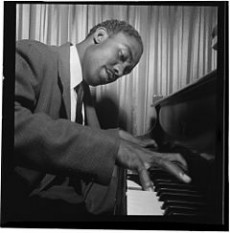
John Malachi was born on September 6, 1919 in Red Springs, North Carolina and was the pianist for the epochal Billy Eckstine Bebop Orchestra in 1944-45 and again in 1947. He worked with Illinois Jacquet in 1948, Louis Jordan in 1951, and a series of singers including Pearl Bailey, Dinah Washington, Sarah Vaughan, Al Hibbler, and Joe Williams.
Malachi is credited with creating the nickname “Sassy” for Sarah Vaughan, working with her both in the Eckstine Orchestra and later during her solo career. He was also fond of categorizing jazz pianists into “acrobats” and “poets,” classifying himself among the latter.
John opted out of the traveling life of the touring jazz musician in the 1960s, living roughly the last decade and a half of his life in Washington, D.C. freelancing, playing with touring bands and artists when they stopped through, and leading music workshops at clubs like Jimmy MacPhail’s Gold Room and Bill Harris’s Pig’s Foot.
Always the educator, Malachi’s generosity towards younger musicians was legendary. One of the musicians he helped influence recalls that younger players referred to his workshops as “The University of John Malachi”. On February 11, 1987 jazz pianist John Malachi passed away in Washington, D.C.
More Posts: piano
Daily Dose Of Jazz…
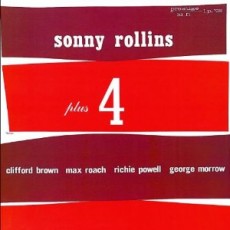
Richie Powell was born on September 5, 1931 in New York City, the older brother of bebop-icon Bud Powell. He studied piano at City College of New York and played in the bands of Paul Williams, Johnny Hodges and for two years was a member of the group led by Clifford Brown and Max Roach
Pianist McCoy Tyner, who grew up next door to Richie and brother Bud in Philadelphia, purportedly got some of his inspiration to develop his pentatonic chord voicings because he heard the Richie voice left-hand chords in fourths.
In 1956, after an informal gig at a Philadelphia store called Music City, Powell and Brown were being driven overnight by Powell’s wife Nancy to an engagement in Chicago. During the dark rainy night Nancy lost control of the vehicle on the Pennsylvania Turnpike, heading for Cleveland, and in the early hours of June 26, 1956 all three occupants were killed.
Although sometimes considered less gifted than his brother, he was a respected musician and was beginning to achieve recognition at the time of his death. He left behind a small discography, playing on albums with Dinah Washington, and Sonny Rollins but mainly with Max Roach and Clifford Brown.
More Posts: piano
Daily Dose Of Jazz…
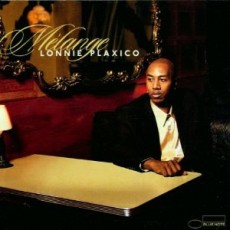
Lonnie Plaxico was born on September 4, 1960 in Chicago, Illinois and started playing the bass at age twelve. He turned professional at 14 playing both double bass and bass guitar. His first recording was with his family’s band, and by the time he was twenty he had moved to New York City, where he had stints playing with Chet Baker, Dexter Gordon, Sonny Stitt, Junior Cook, and Hank Jones..
In 1978 he won the Louis Armstrong Jazz Award but first came to public attention through his work with the Wynton Marsalis group in 1982. Lonnie’s first regular attachment was with Art Blakey‘s Jazz Messengers from 1983–1986, with whom he recorded twelve albums. At the end of his work relationship with Blakey he joined Jack DeJohnette’s Special Edition, and stayed with them until 1993. During his tenure with Blakey, in the mid-1980s he joined the M-Base collective and played on the debut-releases of Steve Coleman, Cassandra Wilson, and Greg Osby
Plaxico held the musical director and featured bassist position for Cassandra Wilson for fifteen years and has performed and recorded with a wide range of artists, including Dizzy Gillespie, David Murray, Alice Coltrane, Stanley Turrentine, Andrew Hill, Joe Sample, Abbey Lincoln, Bill Cosby, Lonnie Liston Smith, Ravi Coltrane, Scott Tixier, Barbara Dennerlein, Helen Sung and Nina Vidal, among others.
Double bassist Lonnie Plaxico has thirteen albums to his credit as a leader and continues to perform and record.
More Posts: bass
Daily Dose Of Jazz…
Onaje Allan Gumbs was born Allan Bentley Gumbs on September 3, 1949 in Harlem, New York but grew up in St. Albans, Queens. Starting to play piano at age 7, Henry Manciniwas one of his earliest and greatest influences, hearing Peter Gunn and Mr. Lucky themes on television. He later studied at the Music and Art High School in Manhattan and was mentored by Erskine Tate Alum Leroy Kirkland.
During this time, he was playing in a Latin band, a big band, playing piano duets and listening to records made by Motown and Blue Note, developing an interest in R&B in conjunction with the straight-ahead jazz of Horace Silver, Dizzy Gillespie, Lalo Schifrin, Gil Evans, Miles Davis, McCoy Tyner and John Coltrane. He went on to study classical piano, composition, arranging and graduated with a degree in Education at the State University of New York at Fredonia in upstate New York.
In 1971, Leroy Kirkland introduced Onaje to guitarist Kenny Burrell and a subsequent gig led him to play with Larry Ridley and The Thad Jones/ Mel Lewis Orchestra. He would join jazz ensemble Natural Essence that included Thelonious Monk Jr. In 1972he went to work with Norman Connors as an arranger on the Dark of Light album and contributed keyboards on the albums Love From the Sun, Saturday Night Special, You Are My Starship, Invitation and Mr. C.
Toward the late 1970s, Onaje spent two years working in Woody Shaw‘s band as pianist, arranger, and occasional composer, in which the group won the Down Beat Reader’s Poll for Best Jazz Group and for Best Jazz Album in 1978 for Rosewood. His first solo piano project was simply titled Onaje and was followed by venturing into R&B and subsequently ending up on the smooth jazz charts and rotations for nearly 20 years with his composition “Quiet Passion”.
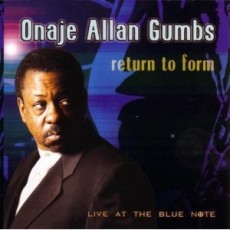
In 2003, Onaje return to straight-ahead with his release of the live album Return to Form, and garnering critical acclaim the next year with a project on his own label, Ejano, titled Remember Their Innocence. These were followed with Grady Tate‘s Sack Full of Dreams before his stroke in 2010 but by year end had recorded and release Just Like Yesterday in Japan, with all signs of a stroke vanished. His sideman work has included stints with Buster Williams, Cecil McBee, and Betty Carter and most recently with Avery Sharpe on the 2012 album Sojourner Truth: Ain’t I A Woman.
He has received the Min-on-Art Award, has his song Dare To Dream chosen by Panasonic as the theme for their 10th anniversary celebration of Kid Witness News, composed, arranged and performed the original score for the Showtime film, Override and was nominated for an NAACP Image Award.
Suffering a stroke in 2010 he was able to return to music two weeks later. In 2015 he was hospitalized again for two weeks but made a full recovery and returned to composing and performance. Pianist, composer, arranger and bandleader Onaje Allen Gumbs passed away at 70 on April 6, 2020.
More Posts: piano