

Daily Dose Of Jazz…
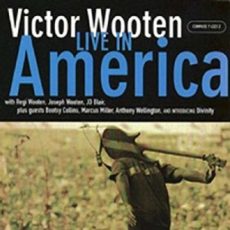
Victor Lemonte Wooten was born on September 11, 1964 in Mountain Home, Idaho and was the youngest of the five Wooten Brothers; Regi, Roy, Rudy and Joseph, all of whom are musicians. Regi began to teach him to play bass when he was two, and by the age of six was performing with his brothers in their family band, The Wooten Brothers Band. As a United States Air Force family, they moved around a lot when he was very young, but the family finally settled in the Warwick Lawns neighborhood of Newport News, Virginia in 1972.
While in high school, he and his brothers played in the country music venue at Busch Gardens theme park in Williamsburg, Virginia, Graduating from Denbigh High School in 1982, by 1987 Victor was traveling to Nashville, Tennessee to visit friends that he made at the theme park, one of whom was a studio engineer who introduced him to Béla Fleck, with whom he still collaborates musically.
As an educator Wooten has created a music program called Bass/Nature camp that has since expanded into the Victor Wooten Center for Music and Nature and now includes all instruments. All of his camps are held at his location called Wooten Woods which is a 147 acre retreat center located in Only, Tennessee, outside of Nashville. He also co-leads the Victor Wooten/Berklee Summer Bass Workshop at Berklee College of Music in Boston, MA. He collaborates with Berklee Bass Dept. chair, Steve Bailey and the two bassists have been teaching together since the early 1990s.
He has been featured on the cover of Making Music Magazine, has won the “Bass Player of the Year” award from Bass Player magazine three times, is the first to win the award more than once, and was named #10 in the “Top 10 Bassists of All Time” by Rolling Stone. As a leader he has recorded ten albums, another seven with various groups and with Béla Fleck , fourteen. He has authored a novel titled “The Music Lesson: A Spiritual Search for Growth Through Music” and has a sequel in the making. Bassist, composer, author, producer, educator, and five-time Grammy Award winner Victor Wooten, who has recorded an album titled SMV with Stanley Clarke and Marcus Miller, continues to compose, perform and record.
More Posts: bass
Daily Dose Of Jazz…
Prince Lasha (pronounced “La-shay“) was born William B. Lawsha on September 10, 1929 in Fort Worth, Texas. He came of age studying and performing alongside fellow I.M. Terrell High School students John Carter, Ornette Coleman, King Curtis, Charles Moffett and Dewey Redman.
Lasha moved to California during the 1950s. In the 1960s, Prince Lasha was active in the burgeoning free jazz movement, of which his Fort Worth cohort Ornette Coleman was a pioneer. Lasha worked closely with saxophonist Sonny Simmons , with whom he recorded two albums, The Cry and Firebirds no the Contemporary label, the latter receiving five stars and an AMG Albumpick at Allmusic. Later, he played with Harold Land.
Living to Europe for twenty years beginning in 1965, Lasha worked as a sideman appearing on recordings with Eric Dolphy, Elvin Jones/Jimmy Garrison Sextet featuring McCoy Tyner, and with Michael White. He also played with Steve Lacy , Paul Bley , Attila Zoller , Gary Peacock , and Barry Altschul. In the 1970s, Lasha and Simmons made additional recordings under the name Firebirds. In 2005, Lasha recorded the album The Mystery of Prince Lasha with the Odean Pope Trio.
From 1965, Lasha lived in Europe for two years, where In the 1970s, he recorded with the sextet of
Saxophonist, flautist and clarinetist Prince Lasha died on December 12, 2008, in Oakland, California. He left a small legacy of six recordings as a leader marking his place in jazz history.
Daily Dose Of Jazz…
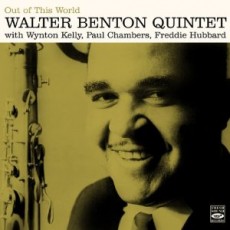
Walter Benton was born September 9, 1930 in Los Angeles, California and first began playing saxophone as in high school. After three years of service in the Army in the early 1950s, he played in 1954 with Kenny Clarke, Max Roach and Clifford Brown.
From 1954 to 1957 he played Afro-Latin jazz with Pérez Prado, touring Asia with the band. Returning to the States, he went on to work with Quincy Jones in 1957 and Victor Feldman in 1958-59. He led his own group from 1959, recording under his own name in 1960 with Freddie Hubbard , Wynton Kelly , Paul Chambers , and Albert “Tootie” Heath.
That same year he worked again with Max Roach and Julian Priester. In 1961 he recorded with Abbey Lincoln, Roach once more, Eric Dolphy and Slide Hampton. By the late 1960s he was working with Gerald Wilson and John Anderson.
As so often happens with great players, in the late 60’s Benton became discouraged with the state of jazz and the overall music business, disappeared from the scene, sank into poverty never re-discovered. He stopped playing and lived the rest of his days in cheap rooming houses and collected a pittance of social assistance.
On August 14, 2000, West Coast tenor saxophonist Walter Benton, who played cool and bluesy, ventured into free and wild before returning to his roots with his beautiful dark and somewhat diffused sound coupled with his own ideas and phrasing, passed away in total obscurity in Los Angeles at the age of 69.
More Posts: saxophone
Daily Dose Of Jazz…
Specs Wright was born Charles Wright on September 8, 1927 in Philadelphia, Pennsylvania. He played drums in an Army band until his discharge in 1947. Following this he played in a group with Jimmy Heath and Howard McGhee. By 1949 he had joined Dizzy Gillespie‘s band alongside John Coltrane, remaining until it disbanded in mid-1950.
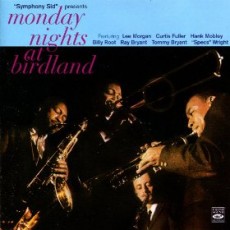
Wright would rejoin Dizzy late in the decade as a member of his sextet with Coltrane, Jimmy Heath, Percy Heath, and Milt Jackson. He would go on to play with Earl Bostic, Kenny Drew, Cannonball Adderley, Art Blakey, and Carmen McRae as well as a member of the Hank Mobley sextet with Billy Root, Curtis Fuller, Ray Bryant, Tommy Bryant, and Lee Morgan.
Not one to be idle, though never a leader, he was a sought after sideman playing with Sonny Rollins, Betty Carter, Red Garland, Coleman Hawkins, and Lambert, Hendricks and Ross in the early Sixties. Drummer Specs Wright passed away on February 6, 1963. He was 36 years old.
More Posts: drums
Daily Dose Of Jazz…
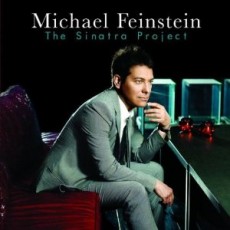
Michael Jay Feinstein was born September 7, 1956 in Columbus, Ohio. At the age of five, he studied piano for a couple of months until his teacher became angered that he wasn’t reading the sheet music she gave him, since he was more comfortable playing by ear. As his mother saw no problem with her son’s method, she took him out of lessons and allowed him to enjoy music his own way.
After graduating from high school, Feinstein worked in local piano bars for two years, moving to Los Angeles when he was 20. He catalogued Ira Gershwin’s extensive collection of phonograph records, unpublished sheet music and rare recordings. This led to the development of a close relationship with Gershwin’s neighbor, Rosemary Clooney.
By the mid-1980s, Feinstein was a nationally known cabaret singer-pianist who dedicating himself to the Great American Songbook and recorded his debut titled Pure Gershwin in 1986. This led to more Americana with Irving Berlin, a live album from the Algonquin, “Over There” featuring music of the WWI era and “Pure Imagination” – a children’s album in 1992.
He has starred on Broadway, recorded several “composer” albums, and a series of “romance” albums and a Sinatra project. Feinstein then embarked on a Great American Songbook music project with Burton Lane, Jule Styne, Jerry Herman, Hugh Martin, Jimmy Webb, Jay Livingston, and Ray Evans.
Michael was appointed by the Library of Congress to the National Recording Preservation Board to safeguard America’s musical heritage; he is the artistic director of The Center for the Performing Arts, which is home to the Michael Feinstein Initiative, and is the owner of a nightclub in Manhattan, “Feinstein’s” in the Regency Hotel.
More Posts: vocal