

Daily Dose Of Jazz…
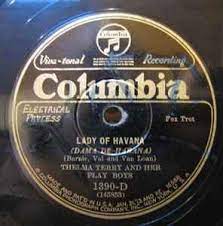
Thelma Terry was born Thelma Esther Combes on September 30, 1901 in Bangor, Michigan in 1901. After her parents divorced she moved with her mother and two sisters to Chicago, Illinois where she chose to study string bass. Her early years were spent on the road performing in Chautauqua assemblies. When she graduated from Austin Union High School, she earned first chair in the Chicago Women’s Symphony Orchestra. As this did not provide her with a living, she turned to jazz.
She found her way into Chicago nightlife, playing in and around the city with her all-women band, Thelma Combes and her Volcanic Orchestra, or her jazz string quartet, and was hired by Al Capone as the house band in his Colosimo’s Restaurant.
Withan article in Variety bringing national attention to her, the Music Corporation of America took notice of Combes and renamed her “Thelma Terry” and gave her an all-male band, Thelma Terry and Her Playboys, with a young Gene Krupa on drums.
MCA billed Terry as “The Beautiful Blonde Siren of Syncopation”, “The Jazz Princess”, and “The Female Paul Whiteman”. Bud Freeman was so enthusiastic about the band that he paid another musician to fill his seat in the Spike Hamilton Band so he could join the Playboys. The band toured nationally on the Eastern Seaboard and as far west as Kansas City. In 1929 she disbanded the Playboys, quit MCA to marry Willie Haar and settled in Savannah, Georgia.
After a failed comeback, and a divorce in 1936 she sold her string bass, turned her back on the music profession, and took a job as a knitting instructor. She spent her last years with family in her native Michigan.
Bandleader and bassist Thelma Tery, who was the first American woman to lead a notable jazz orchestra as an instrumentalist, transitioned on May 30, 1966 from esophageal cancer at the age of 64.

More Posts: bandleader,bass,history,instrumental,jazz,music

Daily Dose Of Jazz…
Tiny Bradshaw was born Myron Carlton Bradshaw on September 23, 1907 in Youngstown, Ohio. Graduating from high school he went on to matriculate through Wilberforce University with a degree in psychology, then turned to music for a living.
In Ohio, he sang and played drums with Horace Henderson’s campus oriented Collegians. Relocating to New York City in 1932 he drummed for Marion Hardy’s Alabamians, the Charleston Bearcats, and the Mills Blue Rhythm Band, and sang for Luis Russell. Two years later Bradshaw formed his own swing orchestra, which recorded eight sides in two separate sessions for Decca Records that year in New York City. The band would go on to record in 1944 for Manor Records with the music leaning more towards rhythm and blues than jazz or swing. In 1947 he recorded for Savoy Records.
The band recorded extensively for the rhythm and blues market with King Records between late 1949 and early 1955. His influence as a composer is evidenced in the rock world with his 1951 song The Train Kept A-Rollin’ that has been recorded by Johnny Burnette & The Rock and Roll Trio, The Yardbirds with Jeff Beck, Aerosmith, Motörhead and performed by Jimmy Page as the first song played, at the very first rehearsal of the band that would become Led Zeppelin.
Returning to R&B with Soft and Heavy Juice, he brought along with him on both of these 1953 hits, Red Prysock on tenor saxophone. Tiny’s later career was hampered by severe health problems, including two strokes, the first in 1954, that left him partially paralyzed. However he made a return to touring in 1958.
As a bandleader, he was an invaluable mentor to important musicians and arrangers including Sil Austin, Happy Caldwell, Shad Collins, Wild Bill Davis, Talib Dawud, Gil Fuller, Gigi Gryce, Big Nick Nicholas, Russell Procope, Red Prysock, Curley Russell, Calvin “Eagle Eye” Shields, Sonny Stitt, Noble “Thin Man” Watts, and Shadow Wilson.
Weakened by the successive strokes as well as the rigors of his profession, bandleader, singer, composer, pianist, and drummer Tiny Bradshaw, who was important to the development of rock and roll, transitioned from a final stroke on November 26, 1958 in Cincinnati, Ohio at 51 years of age.
More Posts: bandleader,composer,drums,history,instrumental,jazz,music,piano,vocal
Daily Dose Of Jazz…
Stanley Frank Dance was born in Braintree, Essex, England on September 15, 1910. As a youth, he claimed he was “fortunate” to have been sent to boarding-school at Framlingham College, where he first encountered American recordings of bands fronted by Jelly Roll Morton and Benny Moten, among others. While working in the family business he continued to pursue his interest in music and soon learned of Louis Armstrong, Fats Waller and Duke Ellington through the music newspaper Melody Maker.
Focusing on the music of black bands he started writing opinion pieces about the jazz scene for Hugues Panassié’s French-language magazine Jazz Hot in 1935, modeling his articles on those written by John Hammond. A 1937 three week visit to New York City’s jazz scene had Stanley at the Savoy Ballroom and similar venues in the evenings, listening in on recording sessions during the day and an introduction to Canadian writer Helen Oakley.
Joining the RAF he was assigned to the Royal Observer Corps in East Anglia, and for a period of nine years his opportunity to listen to Black American bands was curtailed. He missed the start of Bebop, which developed during the war and a recording-musicians’ strike in the US, but he found Oakley when the American OSS assigned her to London late in the war.
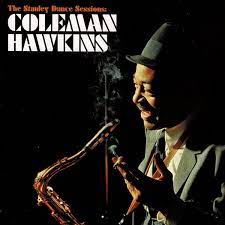
Dance and Oakley married in 1947, resided in England until 1959 then moved to Connecticut. He wrote a monthly jazz column for Jazz Journal, he coined the term mainstream to describe those in between revivalist Dixieland and modern bebop. In 1958, Decca’s Felsted Records commissioned him to produce a series of New York recordings of Coleman Hawkins, Cozy Cole/Earl Hines, Billy Strayhorn/Johnny Hodges, Buddy Tate, and several others, which were released under the collective title Mainstream Jazz.
Leaving England for Connecticut with a commission from EMI’s English Columbia label to make proprietary jazz recordings, Stanley used his and Helen’s contacts with the Ellington players to produce seven albums that were quite successful in Europe. He also assembled two albums for RCA as well as writing liner notes and shared a 1963 Grammy with Leonard Feather for his liner notes to The Ellington Era, Vol. 1.
He went on to publish five books on jazz, write articles for several magazines, helped Duke Ellington write his autobiography and is credited with helping to revive the careers of several musicians including Helen Humes and Earl Hines. By 1979 the Dances moved to Southern California where he consulted with Ken Burns during the development of his documentary television series Jazz, served as book editor for Jazz Times and donated their journals, photographs, and recordings to the Yale Music Library’s Special Collections.
Over his career, his priority was advocating for the music of black ensembles performing sophisticated arrangements, based on Swing-era dance music. Jazz writer, business manager, record producer, and historian Stanley Dance who was personally close to Duke Ellington which put him in a position to author official biographies, transitioned from pneumonia at 88 on February 23, 1999 in Vista, California.
More Posts: historian,history,instrumental,jazz,music,producer,writer
Daily Dose Of Jazz…
Jan Savitt was born Jacob Savetnick on September 4, 1907 in Shumsk, Russian Empire and reared in Philadelphia, Pennsylvania. He showed musical ability at an early age and began winning conservatory scholarships in the study of the violin. He was offered the position of concertmaster in Leopold Stokowski’s Philadelphia Symphony Orchestra, but turned it down, preferring to continue his studies at Curtis Institute. About a year later, believing himself ready, he joined Stokowski and the association continued for seven years, during which time he gained further laurels as a concert soloist and leader of a string quartet.
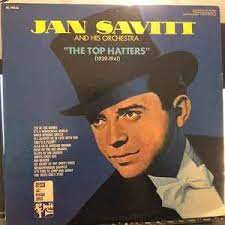
By 1938, Jan Savitt & His Top Hatters broadcasted as the KYW staff orchestra at KYW/NBC in Philadelphia coast-to-coast. The group also played at the Earl Theatre and performed with The Andrews Sisters and The Three Stooges.
Getting his start in popular music some time later as music director of KYW, he evolved the unique “shuffle rhythm” which remained his trademark. Numerous sustaining programs created such a demand for the “shuffle rhythm” that Jan left KYW to form his own dance crew.
His band was notable for including George “Bon Bon” Tunnell, one of the first Black singers to perform with a white band. Tunnell’s recording with Savitt included Vol Vistu Gaily Star co-composed by Slim Gaillard and Rose of the Rio Grande. Helen Englert Blaum, known at the time as Helen Warren, also sang with Savitt during the war years. His orchestra had a bit role in the 1946 film High School Hero.
Shortly before arriving in Sacramento, California with his orchestra in 1948 he was stricken with a cerebral hemorrhage and taken to Sacramento County Hospital. Bandleader, arranger, and violinist Jan Savitt, known as The Stokowski of Swing, transitioned on October 4, 1948 with his wife at his bedside.
More Posts: arranger,bandleader,history,instrumental,jazz,music,violin
Daily Dose Of Jazz…
William Stevens Bryant was born August 30, 1908 in Chicago, Illinois and while growing up took trumpet lessons to little success. His first job in entertainment was dancing in the Whitman Sisters Show in 1926. He worked in various vaudeville productions for the next several years, and in 1934 he appeared in the show Chocolate Revue with Bessie Smith.
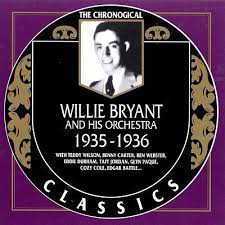
In 1934, he put together his first big band, which at times included Teddy Wilson, Cozy Cole, Johnny Russell, Benny Carter, Ben Webster, Eddie Durham, Ram Ramirez, and Taft Jordan. They recorded six times between 1935 and 1938 with Bryant sings on 18 of the 26 sides recorded.
Once his ensemble disbanded, Bryant worked as an actor and disc jockey. He recorded R&B in 1945 and led another big band between 1946 and 1948. During September and October 1949, he hosted Uptown Jubilee, a short-lived all-Black variety show on CBS-TV, airing on Tuesday nights. In the 1950s he was the emcee at the Apollo Theater in Harlem, New York.
Bandleader, vocalist, and disc jockey Willie Bryant, known as the Mayor of Harlem, transitioned from a heart attack in Los Angeles, California on February 9, 1964.

More Posts: bandleader,disc jockey,history,instrumental,jazz,music,vocal