

Daily Dose Of Jazz…
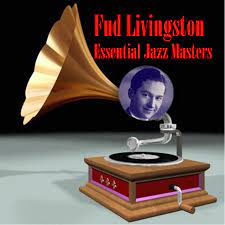
Joseph Anthony Livingston, better known by his peers as Fud, was born April 10, 1906 in Charleston, South Carolina and started out on accordion and piano before settling on saxophone. At seventeen he was playing with Tal Henry in Greensboro, North Carolina in 1923, then worked with Ben Pollack, the California Ramblers, Jean Goldkette, Nat Shilkret, Don Voorhees, and Jan Garber. He recorded freelance with musicians such as Joe Venuti, Red Nichols, and Miff Mole.
He did some arrangement work for Frankie Trumbauer and Bix Beiderbecke, including the nursery rhyme Humpty Dumpty. Livingston played on the 1928 Brunswick recording of “Room 1411” as a member of Bennie Goodman and His Boys, which also featured Glenn Miller, Jimmy McPartland, Bud Freeman, and Ben Pollack.
A stint in London,England in 1929 had him working with Fred Elizalde, then returned to New York City to play with Paul Whiteman. His time with Whiteman lasted from 1930 to 1933, and was mainly as an arranger, though he played occasionally. By the mid 1930s he worked with Benny Goodman, Jimmy Dorsey, Bob Zurke, and Pinky Tomlin as the country entered into the Forties. Essentially stopping his writing and arranging at this point, Fud would occasionally perform in small-time venues in New York in the 1950s.
His compositions included Feelin’ No Pain, Imagination, Humpty Dumpty, Harlem Twist, Sax Appeal, are well known but the jazz standard, I’m Thru With Love, written with Matty Malneck and Gus Kahn, has been recorded by over sixty musicians and vocalists, but a short list is Bing Crosby, Dizzy Gillespie, Arthur Prysock, Coleman Hawkins, Lorez Alexandria, John Pizzarelli, Joe Williams Marilyn Monroe, Maxine Sullivan and Steve Tyrell.
It has been sung in the films Everyone Says I Love You, Some Like It Hot, The Affairs Of Dobie Gillis and Spider~Man 3. Even Alfalfa from The Little Rascals had added it to his repertoire.
Clarinetist, saxophonist, arranger, and composer Fud Livingston, who never recorded as a leader, transitioned on March 25, 1957 in New York City.
More Posts: arranger,clarinet,composer,history,instrumental,jazz,music,saxophone
Daily Dose Of Jazz…
William Taylor Sr. was born Washington, D.C. on April 3, 1906 and began his musical education first on the tuba but later picked up the bass alongside it. After moving to New York City in 1924, at 18 he initially played with Elmer Snowden, then Willie Gant and Arthur Gibbs, followed by two stints with Charlie Johnson closing out the Twenties and reuniting in the early Thirties. He would go on to perform with Duke Ellington, McKinney’s Cotton Pickers, Fats Waller, and Fletcher Henderson.
He recorded with Jelly Roll Morton on three sessions in 1930. From 1935 to 1940, he again played with Ellington, and it is for this association that he is best remembered, often playing at times with bassists Hayes Alvis or Jimmie Blanton. During that time he recorded with Cootie Williams and Johnny Hodges.
The Forties saw him playing with Coleman Hawkins, Red Allen, Joe Sullivan, Raymond Scott, Cootie Williams, Barney Bigard, Benny Morton, and Cozy Cole. Later in the decade he freelanced in New York before moving back to D.C. in 1949.
Bassist Billy Taylor Sr., who led his own ensemble for Keynote Records in 1944, transitioned on September 2, 1986 in Fairfax, Virginia.
More Posts: bandleader,bass,history,instrumental,jazz,music

Daily Dose Of Jazz…
Pete Johnson was born Kermit H. Johnson on March 25, 1904 in Kansas City, Missouri. Raised by his mother after the father deserted the family, financially distressed, he was placed in an orphanage at three. Homesick, he ran away and returned home. By the age of 12, finding work to ease the financial burden at home, he dropped out of school in the fifth grade as a result of his efforts.
Beginning his musical career in 1922 as a drummer in Kansas City, Missouri. He began piano about the same time he was learning the drums. His early piano practices took place in a church, where he was working as a water boy for a construction company. From 1926 to 1938, he worked as a pianist, often working with Big Joe Turner. with record producer John Hammond that led to an engagement at the Famous Door in New York City, and an in the From Spirituals to Swing concert at Carnegie Hall. Working locally, touring and recording with Turner, Meade Lux Lewis, and Albert Ammons kept him busy during this period. He appeared in the film short Boogie-Woogie Dream in 1941.
The song Roll ‘Em Pete, composed with and featuring Turner on vocals and Johnson on piano, was one of the first rock and roll records. They went on to record Johnson and Turner Blues and Rocket 88 Boogie.
By 1946 Pete recorded a concept album, Pete Johnson’s Housewarmin’, with J. C. Higginbotham, J. C. Heard, Albert Nicholas, Hot Lips Page, Clyde Bernhardt. Budd Johnson, and a young singer, Etta Jones. It was later re-released as Pete’s Blues.
The Fifties saw Johnson moving to Buffalo, New York, where he suffered health and financial difficulties including being partially paralyzed by a stroke. He held a series of jobs over the next few years supplementing them with occasional gigs. He continued to record, and toured Europe in 1958 with the Jazz at the Philharmonic ensemble, despite the fact that wasn’t in thebest of health. Returning to the States, he accompanied Big Joe Turner, Chuck Berry and Big Maybelle at the Newport Jazz Festival.
Diagnosed with a heart condition, diabetes and plagued with several strokes, Pete lost the mobility in both hands. Four years ater he began losing his eyesight. Royalties were dribbling in from Blue Note and Victor until he was finally accepted into ASCAP, which ensured that some of the royalties would be received on a regular basis.
His final live appearance was the Spirituals to Swing concert at Carnegie Hall in January 1967, his eighth and final appearance at this event. Pianist Pete Johnson, who played jazz and boogie~woogie, transitioned two months later in Meyer Hospital in Buffalo, on March 23, 1967, at the age of 62, two days before his 63rd birthday.

More Posts: bandleader,history,instrumental,jazz,music,piano
Daily Dose Of Jazz…
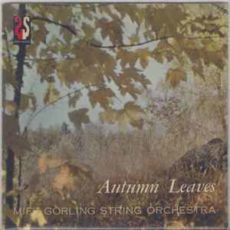
Miff Görling was born Uno Görling on March 21, 1909 in Stockholm, Sweden. He took his nickname from trombonist Miff Mole and got his start late in the 1920s with the Frank Vernon Orchestra, where he played until 1932.
He then worked with Arne Hülphers, Gösta Jonsson, Seymour Österwall, and Gösta Säfbom before organizing his own ensemble in 1938 and led bands well into the 1950s. He also did arrangement and composition work for other jazz groups as well as for popular Swedish musicians.
Bandleader, trombonist, arranger, and composer Miff Görling transitioned on February 24, 1988 in Stockholm.
More Posts: arranger,bandleader,composer,history,instrumental,jazz,music,trombone
Daily Dose Of Jazz…
George Robert Orendorff was born on March 18, 1906 in Atlanta, Georgia but when he was nine years old his family moved to Chicago, Illinois. His early musical years were spent learning the guitar before picking up cornet and spending his high school days with fellow students Eddie South, Wallace Bishop and Lionel Hampton. He began his career at 17, playing in Chicago dance bands, one of them led by Detroit Shannon.
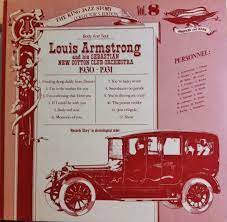
Following a 1925 tour with the Helen Dewey Show, the revue dumped him in Los Angeles, California where he played with Paul Howard from 1925 to 1930. He then played with Les Hite for most of the 1930s and recorded with Louis Armstrong from 1930 to 1931. In the 1940s he accompanied Ceele Burke, and after his WWII army service, he became a post officer and an official in the American Federation of Musicians. George also recorded on the West Coast Jazz and Rhythm and Blues scene and continued to play with Les Hite.
Later in his career he worked with Maxwell Davis, Ike Lloyd, and T-Bone Walker among others. Trumpeter George Orendorff transitioned on June 28, 1984 in Los Angeles.