

Daily Dose Of Jazz…
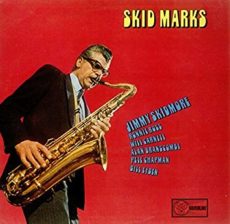
James Richard Skidmore was born on February 8, 1916 in Manor Park, London, England. After teaching himself to play tenor saxophone when he was 20, he played with Harry Parry and George Shearing, becoming especially active in the years immediately following World War II. He attracted attention as a member of the Vic Lewis Jazzmen and in the Fifties played and recorded with Kenny Baker and Humphrey Lyttelton, forming part of the latter’s non-traditionalist saxophone line-up alongside Tony Coe and Joe Temperley.
During the 60s and 70s he continued to perform in clubs but the frequency of his playing diminished. A combination of changing musical times and his own casual approach to his music adversely affected the success his talent deserved. In the mid-80s he still played in the London area and apparently took the jazz world a little more seriously than he had in the past. He celebrated his 80th birthday by appearing alongside his tenor saxophonist son Alan, who had gained the lion’s share of public attention from the mid-60s on..
Tenor saxophonist Jimmy Skidmore passed away on August 22, 1998 in Welwyn Garden City, Hertfordshire, England.
Sponsored By


#preserving genius
More Posts: saxophone
Daily Dose Of Jazz…
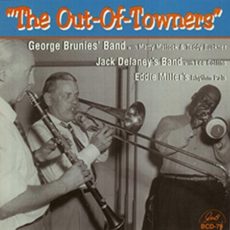
George Clarence Brunies, a.k.a. Georg Brunis was born into a musical family on February 6, 1902 in New Orleans, Louisiana.. His father led a family band with his brothers Henry, Merritt, Richard, and Albert who all became noted professional musicians. By the age of 8 he was already playing alto saxophone professionally in Papa Jack Laine’s band, but a few years later he switched to trombone.
Though Brunies never learned to read music, he played with many jazz, dance, and parade bands in New Orleans, quickly picking up tunes and inventing a part for his instrument. He first went to Chicago, Illinois in 1919 with a band led by Ragbaby Stevens, then worked the riverboats up and down the Mississippi River.
By 1921 he returned to Chicago and joined a band of his New Orleans friends playing at the Friar’s Inn, and this band eventually became famous as the New Orleans Rhythm Kings. His trombone style was influential to the young Chicago players, and his records were much copied. In this era Brunies was never bested as he could play anything any other trombonist could play as well or better. He would often end battles of the bands or cutting contests by outplaying other trombonists while operating the slide with his foot.
In 1924 after the Rhythm Kings broke up in Chicago, George joined the Ted Lewis band, which he played with through 1934. He spent some time with Louis Prima’s band, then landed a steady gig at the New York City jazz club Nick’s through 1938. In 1939 he joined Muggsy Spanier, with whom he made some of his most famous recordings. The following year he returned to Nick’s, where he remained through 1946 and then worked with Eddie Condon.
In 1949 Brunies returned to Chicago and landed at the 1111 Club leading his own band. Often showing off his unusual technical abilities and bizarre sense of humor at the same time, for example, he would lie on the floor and invite the largest person in the audience to sit on his chest while he played trombone. Believing that this name change would increase his good luck, on the advice of a numerologist, he changed his name to Georg Brunis in the late 1940s. While in residence every now and then other well-known jazz musicians would sit in and play until the wee hours.
Trombonist George Brunies, known as the King of the Tailgate Trombone, passed away in Chicago on November 19, 1974.
Sponsored By

Voices From The Community
#preserving genius
More Posts: trombone
Daily Dose Of Jazz…
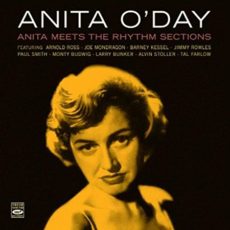
Joe Mondragon was born on February 2, 1920 in Antonito, Colorado. An autodidact on bass, he began working professionally in Los Angeles, California before serving in the Army during World War II. After his discharge he joined Woody Herman’s First Herd in 1946.
Over the next two decades, Mondragon became one of the more popular studio bassists for jazz recording on the West Coast, appearing on albums by June Christy, Buddy Rich, Buddy DeFranco, Marty Paich, Claude Williamson, Bob Cooper, Harry Sweets Edison, Gerry Mulligan, Art Pepper, and recording the Duke Ellington Songbook with Ella Fitzgerald in 1956. He also played on soundtracks for films such as The Wild One and Pete Kelly’s Blues.
Though Joe never recorded as a leader, he did however, record 45 albums as a sideman with Georgie Auld, Chet Baker, Louis Bellson, Buddy Bregman, Hoagy Carmichael, Herb Ellis, Jimmy Giuffre, Woody Herman, Harry James, Stan Kenton, Barney Kessel, Henry Mancini, Shelly Manne, Carmen McRae, Jack Montrose, Gerry Mulligan, Oliver Nelson, Art Pepper, Shorty Rogers, Pete Rugolo, Lalo Schifrin, Bud Shank and others.
Bassist Joe Mondragon passed away in July 1987 in Ohkay Owingeh, New Mexico.
Sponsored By

#preserving genius
More Posts: bass
Daily Dose Of Jazz…
Sam Allen was born on January 30, 1909 in Ohio and accompanied silent films in movie palaces from the age of ten, and in the next few years seemed to have absorbed plenty of slapstick hi-jinx and derring-do from the Hollywood sagas he accompanied. In 1928 he moved to New York City, where he joined Herbert Cowans’s band at the Rockland Palace. Within a year he moved back to Ohio, where he played with Alex Jackson in 1930. Soon afterward he joined James P. Johnson‘s orchestra as the second pianist, as one piano could not play all the chords in the scores. This engagement he followed with an extended run in Teddy Hill’s band, which occupied him for most of the 1930s and included tours of Europe.
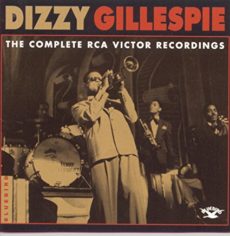
Early in the 1940s Sam worked one of his most musically satisfying collaborations as piano man in the sometimes rowdy combo of violinist Stuff Smith. He then became the pianist for the madcap jive jazz duo of Slim Gaillard and Slam Stewart, the gig for which he was best known, his years in the movie houses came in handy. His talent was further challenged with the bebop hyper-drive of trumpeter Dizzy Gillespie during the same decade.
By the end of the Forties decade Allen moved to Washington and worked locally as a solo pianist for a time, giving up being a touring sideman. Finally he relocated and settled into the Oakland, California, where he often accompanied vocalist Billie Heywood, among others.
Pianist Sam Allen passed away in September 1963.
Sponsored By
Voices From The Community
#preserving genius
More Posts: piano
Daily Dose Of Jazz…
Milt Raskin was born on January 27, 1916 in Boston, Massachusetts and played saxophone as a child before switching to piano at age 11. In the 1930s he attended the New England Conservatory of Music and worked on local Boston-area radio.
Moving to New York City, Milt played with Wingy Manone in 1937 at the Famous Door and with Gene Krupa in 1938-39. He then played with Teddy Powell and Alvino Rey before rejoining Krupa again for a short time. Following this stint, he joined the Tommy Dorsey Orchestra for two years in 1942, replacing Joe Bushkin.
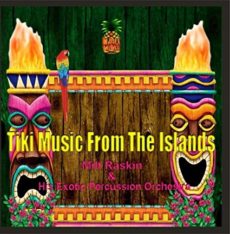
He relocated to Los Angeles, California in 1944, where he occasionally worked in jazz, recording with Artie Shaw, Billie Holiday and Georgie Auld, but concentrated on work as a studio musician and musical director. Much of his studio work from the 1940s on was uncredited, and he never led his own jazz recording session. He did, however, formed and led his Exotic Percussion Orchestra and released a few albums in the 1950s and Sixties.
Swing pianist, composer and arranger Milt Raskin passed away on October 16, 1977 in Manhattan, New York.
Sponsored By

www.whatissuitetabu.com
#preserving genius
More Posts: piano