

Daily Dose Of Jazz…
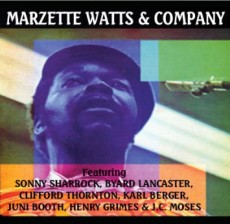
Marzette Watts was born March 9, 1938 in Montgomery, Alabama. Early in his life he played piano but did not play regularly in his teens. While studying at Alabama State College he became a founding member of SNCC, however, this association led to his being forced to leave the state at the behest of the governor.
He moved to New York, where he lived in a loft building on Cooper Square where Leroi Jones aka Amiri Barak lived and with whom he participated in the Organization of Young Men.. Watts returned to college in New York, completing his studies in 1962; and then moved to Paris to study painting at the Sorbonne and began playing saxophone for extra money.
Returning to New York in 1963, Marzette studied under Don Cherry, played in his loft and around the city with Juini Booth, Henry Grimes, J.C. Moses, and others. He also continued painting, producing work strongly influenced by Willem de Kooning. His loft attracted many established and up-and-coming musicians who would hang out there and play at parties, including Ornette Coleman, Cecil Taylor, Don Cherry, Archie Shepp and Pharoah Sanders.
By 1965 he devoted himself to music more fully, moved to Denmark for further study. Moving back and forth between Europe and New York City, while in New York he recorded an album for ESP-Disk and another for Savoy Records, and aught briefly at Wesleyan University.
He wrote film scores and did production work for his own films, eventually abandoning music to work in film and record production. Late in his life he moved to Santa Cruz, California but free jazz tenor and soprano saxophonist, bass clarinetist and sound engineer Marzette Watts passed away in Nashville, Tennessee of heart failure on March 2, 1998.

Dose A Day-Blues Away
Daily Dose Of Jazz…
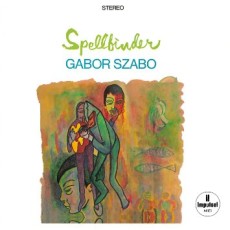
Gábor Szabó was born Szabó Gábor István on March 8, 1936 in Budapest, Hungary and began playing guitar at the age of 14, inspired by jazz music heard on Voice of America. He escaped Hungary in 1956, the year of the attempted revolt against Soviet dominated Communist rule, and moved to the United States. Once there he attended the Berklee School of Music.
In 1958, he was invited to perform at the Newport Jazz Festival. He then went on to perform with the quintet of Southern California drummer Chico Hamilton from 1961 to 1965, playing what has been described as chamber jazz, with “a moderate avant-gardism. In 1962 and 1963, Hamilton’s bands cut two albums consisting entirely of saxophonist Charles Lloyd compositions. The title track of Man From Two Worlds featured Szabó’s guitar on top of a propulsive beat, parrying with Lloyd’s tenor sax.
Throughout the Sixties and Seventies he cut a span of albums as a leader for Impulse! Record label, co-founded the short-lived Skye Records with Cal Tjader and Gary McFarland, recorded an album with Lena Horne, and performed and recorded with The California Dreamers, Ron Carter, Paul Desmond and Bobby Womack. His playing also influenced guitarist Carlos Santana witnessed by Szabó’s mid-1960s jazz/gypsy guitar work in his Gypsy Queen and Santana’s Black Magic Woman.
He would go on to be label mates with George Benson at CTI, became affiliated with the Church of Scientology and signed in November 1978 with their Vanguard Artists International that brought its own set of troubles to his career, eventually ended uo with cross-suits aimed at both parties. He recorded twenty-four albums as a leader, and also worked with Steve Allen, Coke Escovedo and Santana, infusing jazz, pop-rock and his native Hungarian music.
Despite his influence on jazz music and the caliber of players with whom he performed, Gábor Szabó, who felt he was never fully accepted as a jazz artist in the United States, passed away on February 26, 1982 in his hometown, Budapest.
Take A Dose On The Road
More Posts: guitar
Daily Dose Of Jazz…
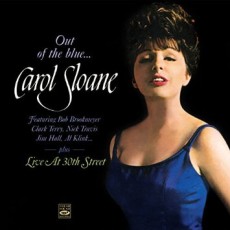
Carol Sloane was born on March 5, 1937 in Providence, Rhode Island. She has been singing professionally since she the age of 14. Between September 1967 and May 1968, she occasionally wrote album reviews for Down Beat and for a time in the 1970s she worked as a legal secretary in Raleigh, North Carolina
One of her early efforts was working with the Les and Larry Elgart orchestra. Later she filled in for Annie Ross of Lambert, Hendricks & Ross. But by 1961, with success at the Newport Jazz Festival Carol landed a multi-album contract with Columbia Records.
In the 70s her career stalled for a time, but Sloane was able to resume live performance and recording by the 1980s. She later signed with Concord Records and found some successes touring Japan.
She has worked with Tim Horner, George Duvivier, Art Davis, Barry Galbraith Clark Terry, Nick Travis, Bob Brookmeyer, Richie Pratt, Art Farmer, Clifford Jordan, Kenny Burrell, Kenny Barron, Rufus Reid, Grady Tate and Ken Peplowski, just to names a few. Vocalist Carol Sloane continues to perform, record and tour.
Uplift Someone’s World
More Posts: vocal
Daily Dose Of Jazz…
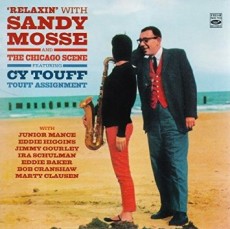
Cy Touff was born Cyril James Touff on March 4, 1927 in Chicago, Illinois. He started on piano at age 6 and went on to play xylophone and saxophone before settling on trumpet.
Serving in the Army from 1944 to 1946, while in the military Touff played trombone. After the war he switched to bass trumpet and worked with Woody Herman and Sandy Mosse among others. He joined Herman’s band in 1953 and in 1954-55 played with a reduced version of the band that also included Richie Kamuca.
Touff and Mosse co-led an octet called Pieces of Eight from the late 1950s into the next decade. He also recorded as a leader for Pacific Jazz, Argo and Mercury record labels. Though he spent most of his life in Chicago, he was also well associated with West Coast jazz.
One of the few jazz musicians known as a bass trumpeter, Cy Touff passed away in Evanston, Illinois on January 24, 2003.
Jazz Is Global – Share
More Posts: trumpet
Daily Dose Of Jazz…
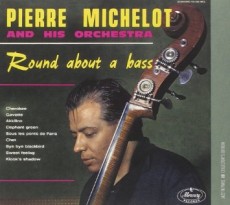
Pierre Michelot was born on March 3, 1928 in Saint-Denis, Seine-Saint-Denis, Paris, France. He studied piano from 1936 until 1938 when he switched to bass at the age of sixteen.
Throughout his career he performed and recorded with Rex Stewart, Coleman Hawkins, Django Reinhardt, Stephane Grappelli, Don Byas, Thelonious Monk, Lester Young, Dexter Gordon, Stan Getz, Bud Powell, Kenny Clarke, Zoot Sims, Dizzy Gillespie, Chet Baker and numerous others.
Michelot was a member of the Jacques Loussier Trio, known for the Play Bach album series. In 1957 he recorded the landmark album Afternoon In Paris with John Lewis and Sacha Distel Septet. As a leader he recorded Round About A Bass with an orchestra on the Uni Jazz France label.
Together with Miles Davis, he was responsible for the critically acclaimed soundtrack of Louis Malle’s film Ascenseur pour l’echafaud and also appeared as an unnamed bass player in the movie Round Midnight.
In later life, bebop and hard bop double bassist Pierre Michelot suffered from Alzheimer’s disease and passed away on July 3, 2005.
Give A Gift Of Jazz – Share
More Posts: bass