

Daily Dose Of Jazz…
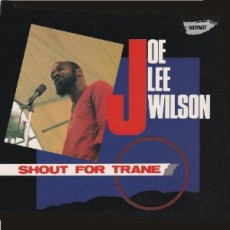
Joe Lee Wilson was born to farming parents on December 22, 1935 in Bristow, Oklahoma of African American and Creek Native American heritage. Attending a 1951 performance by Billie Holiday began his interest in a music-industry career. He studied in Los Angeles before touring the West Coast, where he sat in with Sarah Vaughan before heading down to Mexico. In New York in the 1960s, he worked with Sonny Rollins, Lee Morgan, Miles Davis, Pharoah Sanders and Jackie McLean.
Wilson formed his band Joy of Jazz, to personify the life-affirming nature of jazz and blues. During the 1970s, Joe operated a jazz performance loft in New York’s NoHo district known as the Ladies’ Fort at 2 Bond Street. His regular band, Joe Lee Wilson Plus 5, featured alto saxophonist Monty Waters and Japanese guitarist Ryo Kawasaki, and hosted Archie Shepp and Eddie Jefferson as frequent collaborators.
Joe also sang with Eddie Jefferson, Freddie Hubbard and Kenny Dorham, recorded a 1972 live radio program at Columbia University’s WKCR-FM, which was released as an album, Livin’ High Off Nickels & Dimes, on the short-lived Oblivion Records. Wilson’s rendition of “Jazz Ain’t Nothing But Soul” was a radio hit on New York jazz radio in 1975.
While based in Paris, Tokyo, and the United Kingdom, he recorded regularly with the pianist Kirk Lightsey, and one of his last albums was an Italian recording with Riccardo Arrighini and Gianni Basso, Ballads for Trane.
Joe Lee Wilson was inducted into the Oklahoma Jazz Hall of Fame in November 2010, where he gave his last public performance. The baritone gospel-influenced jazz singer, best recognized on several Archie Shepp albums, passed away on July 17, 2011 leaving behind a short but relevant discography.

More Posts: vocal

Daily Dose Of Jazz…
Rita Reys was born into an artistic family as Maria Everdina Reijs on December 21, 1924 in Rotterdam, The Netherlands. She grew up listening to classical music and as a teenager entered and won many local talent competitions.
In 1943, Rita met her first husband, jazz drummer Wessel Iicken, who introduced her to the jazz scene. Forming Rita Reys & The Wessel Ilcken Sextet, she regularly performed at the Sheherezade jazz club in Amsterdam and as her reputation grew began to tour and perform around Europe and Africa between 1945 and 1950.
In 1950, the then Rita Reys Sextet celebrated continued success in The Netherlands, played American army bases and dance clubs in England, and settled in Stockholm, the city known as the jazz center of Europe in the early Fifties. She made her first recordings there for the Artist record label, would follow up with a session with Ove Lind, and others such as Quincy Jones, Clifford Brown, Art Farmer. She would go on to meet Ella Fitzgerald, Dizzy Gillespie, Oscar Peterson and Lester Young.
Reys accepted an invitation by Columbia record producer George Avakian to visit the United States and after arrival recorded The Cool Voice of Rita Reys with Art Blakey and the Jazz Messengers featuring Horace Silver, Hank Mobley and Donald Byrd. She had a swinging quality of her phrasing that opened the doors of the Village Vanguard for several performances. She has performed with Oscar Pettiford, Zoot Sims, Clark Terry, Herbie Mann, Milt Hinton, Osie Johnson, Jimmy Smith and Lester Young to name a few luminaries.
Vocalist Rita Reys has won France’s Juan Les Pins Jazz Festival; in 1969 she was the first Dutch jazz singer to perform at the New Orleans Jazz Festival, became a Citizen of Honor of New Orleans in 1980, won the Edison Award, the Bird award and has eight gold records.
Throughout the next three decades she would continue to perform, record and tour, returning to the Great American Songbook, paid tribute to George Gershwin and Antonio Carlos Jobim, has published her life story Rita Reys, Lady Jazz, has recorded nearly four-dozen albums since 1957, perform at festivals around the world and was named Europe’s First Lady of Jazz, a title she carries to this day. Vocalist Rita Reys passed away on July 28, 2013 in Breukelen, Netherlands.

More Posts: vocal
Daily Dose Of Jazz…
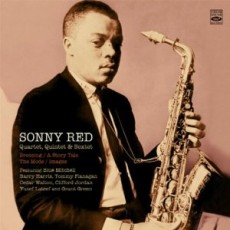
Sonny Red was born Sylvester Kyner Jr. on December 17, 1932 in Detroit, Michigan. He learned a lot in the shadow of hard bopper Charlie Parker but went on to develop his own voice and style.
He started professionally in the 1940s playing with Detroit pianist Barry Harris. By the mid-Fifties he was playing tenor with both the trombonist Frank Rosolino, and Art Blakey. Three years later he performing and recording in New York with the trombonist Curtis Fuller.
A fluent soloist, Sonny found success as a sideman and in the late 1950s and early Sixties his reputation increased leading albums for the Blue Note and Jazzland labels. With Barry Harris and Cedar Walton splitting piano duties on the “The Mode” and Harris solely on “Images” these two albums showcased his talent and established his voice. He would go on to work as a sideman with Clifford Jordan, Donald Byrd, Bill Hardman, Paul Quinichette, Bobby Timmons, Frank West and others.
The fortunes of jazz diminishing and changes in the music offered limited opportunities for him to record a slim discography and unfortunately gained him a modest reputation. Sonny Red fell into obscurity in the Seventies and he died in his hometown on March 20, 1981 at 49 years old.

More Posts: saxophone
From Broadway To 52nd Street
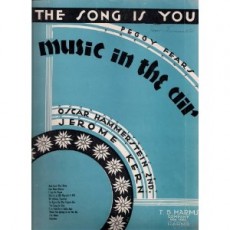
On November 8, 1930 at the Alvin Theatre, the curtain rose for Music In The Air starring Walter Slezak, Natalie Hall, Tullio Carminetti and Katherine Carrington. Running for 342 performances and the tune, The Song Is You was written and composed by Jerome Kern and Oscar Hammerstein becomes a jazz classic standard.
The Story: We follow Karl who writes a song and along with his Bavarian villages trek to Munich to have it published. In Munich, Karl is pursued by a flirtatious prima donna, while composer Bruno falls in love with Karl’s sweetheart. Her indifference to Bruno only lends to fuel Bruno’s ardor and he confesses to her that no matter what melody he creates, it’s always her. The romance and high hopes prove fruitless, so all return home together.
Jazz History: Art Tatum was to become one of The Street’s brightest stars and legendary giants with a following that brought him the highest paid salary to any performer. He moved between The Onyx, The Three Deuces and The Downbeat and was always in great demand for private parties and was once paid a hundred dollars at a George Gershwin shindig to perform during his sixty-minute intermission at the club. With his vision limited to 25% in one eye, he would often ask a friend to walk him down to Hanson’s Drugstore at 51st and 7th, New York’s equivalent to Schwab’s in Hollywood, where it became a gathering place of theatre-goers, celebrities and hopefuls and where Walter Winchell regularly stopped by. Tatum always took a seat at the L-shaped counter and when it was full he would ask someone to drop a handful of coins on the counter and impress the onlookers with his acuteness of hearing by identifying each coin. Art Tatum lived, drank and died with the prodigality that characterized his keyboard pyrotechnics. Frequently he stayed up for days at a time with only catnaps to sustain him or slept long stretches only to awake instantly the moment his hand was touched. Of the 46 pianists queried after his death, 30 named him as their favorite pianist.
Sponsored By

www.whatissuitetabu.com
More Posts: broadway
Daily Dose Of Jazz…
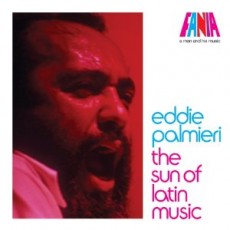
Eddie Palmieri was born of Puerto Rican parentage on December 15, 1936 in Bronx, New York and when he was only 8 years old, he would musically accompany his older brother Charlie and together they entered and participated in many talent contests
Palmieri continued his education in the city’s public school system where he was constantly exposed to music, specifically jazz. He took piano lessons and performed at Carnegie Hall when he was 11 years old. Influenced by Thelonious Monk and McCoy Tyner and inspired by his brother he formed his own band in 1950 at age 14.
In 1961, Palmieri formed the band Conjunto La Perfecta, featuring legendary singer Ismael Quintana and replaced the traditional violins with trombones to create a more robust sound by including a touch of jazz in his recordings and incorporating a popular Cuban rhythm known as Mozambique.
Eddie disbanded the band in 1968 but three years later was recording with his brother and in 1974 was the first Latin musician to win a Grammy Award for Best Latin Recording with The Sun of Latin Music. Through the Eighties he continued performing and recording, winning two Grammys for his Palo Pa Rumba and Solito albums.
In the 1990s Palmieri was part of various concerts and recordings with the Fania All-Stars and the Tico All-Stars; he introduced La India with the production of Llego La India via Eddie Palmieri released in 1992. In 2000, Palmieri announced his retirement from the world of music. He recorded Masterpiece with Tito Puente, won 2 Grammys and was also named the “Outstanding Producer of the Year” by the National Foundation of Popular Culture. Palmieri has won a total of 9 Grammy Awards in his career, most recently for his 2006 album with Brian Lynch – Simpatico.
Palmieri teamed up with longtime trumpeter and band member Brian Lynch, has worked with Phil Woods, Lila Downs, Donald Harrison, Conrad Herwig, Gregory Tardy, Edsel Gomez and Rubén Rodríguez among others. With more than three-dozen albums to his credit he continues to perform and tour.

More Posts: piano